It’s good to be back. While away from my blog these past many days, my attentions focused on lots of writing for my job and preparing presentations around building relationships in multi-cultural, multi-lingual, multi-ethnic populations. My “lessons” and publications target educators who work with multicultural populations. So, I have not sat down to write in this blog, but I still have to eat, and I still have many friends who stop by for a meal.
My featured photo today is my jammy fruit compote that I call CAOS (sounds like chaos!) I created this one Thanksgiving as my answer to cranberry sauce that we serve with turkey. Making more than one jar at a time also assured that I will have fruit to serve during times of our Native ceremonies where we have some fruit of the bounty.
So, what is CAOS? Cranberry, apple, orange, spice. I love the taste of Chinese 5-Spice, so I used it as my spice. Here’s my recipe:
24 ounces (680.39 g) fresh cranberries
6 red (any kind) apples – cored and chopped (do not peel)
3 oranges – chopped (do not peel and remove seeds if applicable)
2 cups (453.59 g) apple cider
1/2 cup (113.40 g) honey
1 Tablespoon (140.18 g) Chinese 5 Spice (my version is a mixture of cinnamon, ginger, cardamom, cloves, and nutmeg). Sometimes I use fennel or anise seeds in place of cardamom.
Combine all ingredients, and bring slowly to a boil stirring to a simmer. Simmer until nice and thick until to a gelling point. You can test for gelling by checking your stirring spoon. I like to put a small pat of butter in my jams to reduce foaming. When the jam is thickened, ladle into hot canning jars leaving 1/4 inch head space, seal with new lids and rings. Process in a boiling water bath “canner” for 15 minutes. Remove from boiling water and place on a towel on the counter out of a breeze. The jammy fruit is ready to store when you hear the little “pop” that tells you it’s sealed. Let the jars cool completely before you store on the shelf in your pantry.
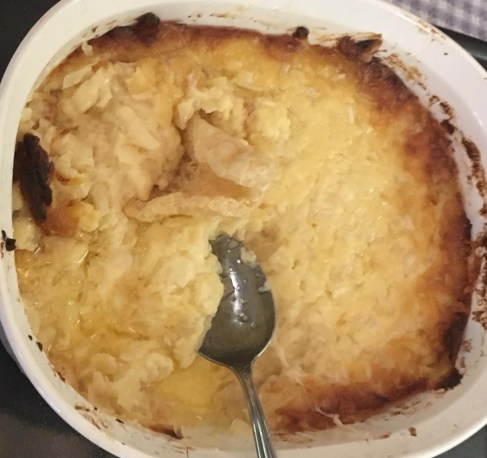
Now, dinner with friends, Mark and Kathy, which was sort of a potluck since Kathy brought one of her famous appetizers (“appies”), Vidalia Onion Dip. Rather than serve with the, usual crackers, we ate the dip with pork rinds to make it a low “carb” snack. I can’t remember Kathy’s recipe for the dip other than 1 or 2 whole onions, Swiss cheese, and mayonnaise. Then you bake it. Kathy says it freezes well, too. I think I prefer it with crackers over the pork rinds.
For the main course, I served ground lamb kabobs, which are really ground lamb with a handful of chopped cilantro, garlic, and salt/pepper. Form a log or a patty. Grill the lamb and serve with tzaziki (yogurt, cucumber, and garlic powder). Lately, we’ve been sauteing red cabbage in butter with a little pepper. It’s delicious when you allow the butter to caramelize the cabbage a bit. We served the ground lamb with a dollop of my cilantro pesto (made with walnuts, Parmesan, garlic,and olive oil) and grilled Halloumi cheese.
Delightful flavors await you when you experiment. Luckily, I have friends who like my experiments.
I am a geographer specializing in human systems. My passion is studying underrepresented populations so that I can assist in their integration into the communities in which they live. I studied Human Ecology because it is a wonderful blend of the disciplines of geography, anthropology and sociology. No matter the context in which I find myself, I am an observer of humans in their environments and how the influences in those settings build and nurture sense-of-self, sense-of-place, and sense-of-direction in educational, familial, and community settings. My work focuses on the cross-cultural and intercultural traditions of multi-lingual populations acculturating into their receiving communities and being successful in educational arenas of higher education. This work includes gathering, analyzing, and writing about health, well-being, and environmental/social connectedness in their communities. My research focuses on Minority-majority, rural, Midwest communities. My role as director of intercultural learning and academic success at Kansas State University allows me to discover more about myself as I work with others in their paths to self-discovery in their own interactions with students and families who come from different parts of the country and the world all converging in educational spaces. Recently, I lived, worked and played in Southwest Kansas, a region marked by Minority-majority populations centers (56% – 68%). Some of my research results are used to address poverty, low educational attainment, poor health outcomes, and cultural norms in multi-cultural settings. I work to assure a representative sample for my research, so I engage in multi-lingual research (English, Spanish, Burmese, French, Tigrinya, and Somali). Building trust and relationships is the key to my success as a multilingual researcher. Presently, my research takes me in the micro-communities of populations represented by nine African countries (Eritrea, Ethiopia, Sudan, Kenya, Senegal, Uganda, Ivory Coast, Somalia, and Cameroon), seven Latin American countries, and six Asian countries. Yes, it is rural Southwest Kansas, and many of the densely-settled and frontier rural communities act as receiving centers for refugees and other displaced populations, because of the availability of jobs.
I am the recent recipient of National Geographic Society’s Research and Exploration grant to introduce Geographic Information Systems (GIS) to females of color. This inter-generational, intercultural class hosted middle school, high school, and adult females who learned the basics of GIS with a variety of applications from remote sensing to city planning to Google Earth, and to Pokémon GO! By the time the young ladies finished the class, they were able to build cities, map their communities, log trips from their countries of origin to the Midwest. I am in the mid-year of the grant funding, and my target for completion was July 2018. I have new funding to extend this work to new cohorts.
Currently, I work at Haskell Indian Nations University on an NSF project: Rising Voices Changing Coasts addressing climate change in Indigenous Coastal Communities in Alaska, Puerto Rico, Hawai'i, and the Louisiana Gulf Coast.
I am a mother, grandmother, sibling, friend, banjo player, and a geographer dedicated to studying humans in their environments.
View all posts by djhbolton
Published
One thought on “Love to Cook and Eat with Friends”




Looks good
LikeLike