Cooking with Wild Game

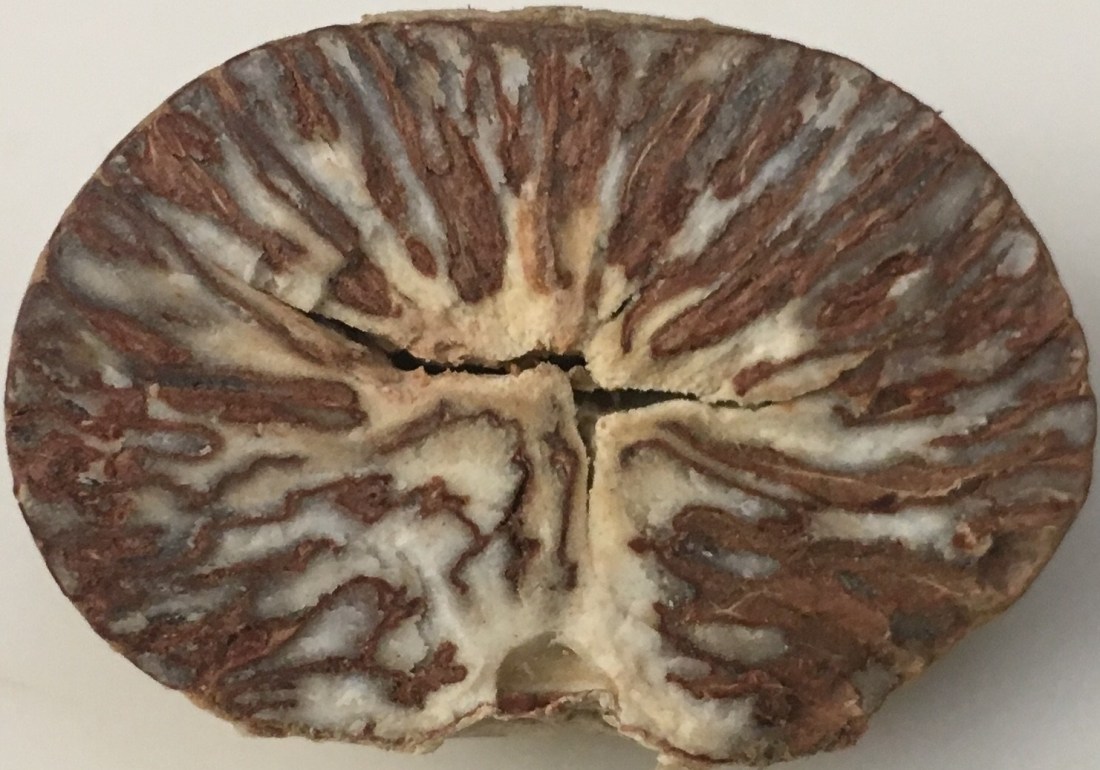
First of all, I should tell you about my featured photo, which has little to do with my story today.  The community in which I live hosts a wide cross-section of refugees and other immigrants, so I like to visit their markets.  Keep in mind that my county is 40,000 people, and the city where I live has about 26,000 inhabitants.  Today, I visited the Burmese, the African (I’ve told you about their delicious tea-making), and the El Salvador markets.  From each store, I purchase a variety of cooking ingredients.

Pictured here is the betel nut, which comes from the areca palm (Areca catechu).  The nuts are known their stimulant properties much like coffee and tobacco.  In fact, those who make a regular practice of chewing these nuts expose themselves to a variety of ill-health conditions such as rotting teeth and mouth cancers.  I purchased the half nut that you see here.  I like the patterns.  The convolutions remind me of the brain.

I really want to talk about cooking with wild game today.  I am a deer hunter, because I love the taste of venison.  I hunt white tailed deer.  They are a beautiful animal: graceful and lithe.  Part of me rather mourns before I take the shot, and even more when the animal goes down.  I always thank the creature for giving his or her life so that I have a bountiful table.  Debra Hunting

Today, I made a wonderful marinara sauce for topping a plate of pasta.  My ingredient list:

  • I pound (.45 kg) of ground venison
  • 5 cloves smashed garlic
  • 1/2 yellow onion
  • 1 large bunch fresh basil (chopped)
  • 1 spoonful of OGB (my mixture of olive oil, garlic, and basil). Venison is super lean and needs some oil
  • 4 Tablespoons (56.7 g) tomato paste (I like to purchase large jars of tomato paste at the African Store. It comes from Instanbul)
  • 1/2 Cup (113.4 g) red wine
  • Salt and pepper to taste
  • Usually, I add mushrooms, but in the absence of the tasty fungi, I used my dehydrated mix of onions, mushrooms, and celery.

Let simmer on stove top until all ingredients are blended. I like to prepare my sauce in the morning.  Then I place it in the refrigerator.  At noon, we come home and prepare the pasta and re-heat the marinara.  Here’s my sauce:

Venison Marinara

If I would have remembered to take the picture of sauce on the pasta, it would have made more sense.

When cooking with wild game, the flesh often takes on the flavors of what the animal eats.  In Colorado, where I grew up, the high snowfall hinders access to grains, leaves, and other browse.  Consumers of that meat will say, “That’s really gamey!”  My grandmothers used juniper berries to neutralize the strong flavors, which worked beautifully.  It works wonders for mutton, too.  My grandmothers fed us mutton all my years growing up, and I never noticed the strong flavors, thanks to juniper berries (Rocky Mountain or Utah junipers).

In Kansas, where I live and hunt, the deer enjoy farm fields of sorghum and corn, much to the chagrin of local crop producers.  Kansas venison tastes quite delicious!  I hope you get to try it sometime.

Last summer, my friend Bob, when rabbit hunting.  When he returned, he called to ask if I would/could make something out of rabbit.  I said, how about rabbit cacciatore, hunter’s style rabbit?  I use passata (rich, strained tomatoes), garlic, fresh rosemary and basil, mushrooms, and white wine.  I cut the rabbit in pieces as one would with chicken.  Simmer until all ingredients are well blended and the liquids are thickened.  Serve with pasta, white wine, and lots of crusty bread to sop up the rich juices.  Here I am with a skinned rabbit.  My friend, Adrian, is married to the rabbit hunter, Bob.

debra-with-rabbit.jpg

Hopefully, I have frightened you with this talk of eating beasts, large and small.

Thank you for reading.

Saturday at Home and Creating in the Kitchen

We have not been home for many weekends, so this weekend, we stayed home.  Dale mowed the ever-growing lawn because of an unusually wet July.  The wet July also gave rise to ants!  I cleaned shelves, placed oil of peppermint in every nook and cranny to ward off the little creatures. We woke up to clear counter tops and shelves in the kitchen, so those essential oil home remedies work!

All that work in the kitchen did not stop me from cooking.  I love to cook, and the summer’s bounty contributed greatly to locally-sourced meals.

So, Saturday lunch was simple.  Menu:

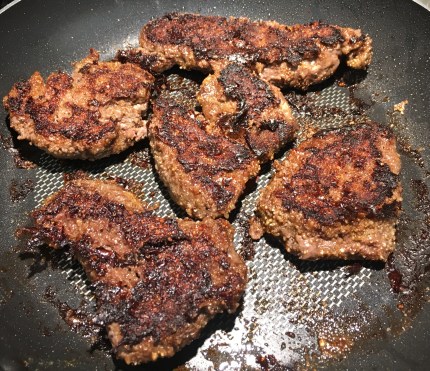
  • chicken fried venison steaks
  • baked and mashed sweet potatoes
  • Spanish rice made with a wild/sweet/black rice mix.

I live in a region of Kansas popular for its hunting opportunities.  Hunters come from other countries and from different corners of the U.S. to hunt for pheasant, quail, and deer in this region.  Having grown up in Colorado, I know the wonders of great-tasting venison.  However, I am loathe to say, that Kansas venison may be a bit better.  Colorado deer resort to eating sage and lichens when the snows are too high for their usual forage.  When someone says, “This venison is strong!”  He or she is reacting to the tastes of sage and lichens, for example.  My Native grandmothers would crush juniper berries and rub it onto the meat, and that neutralized the “strong” flavor in any wild game and old mutton.  Try it sometime.  It really works.  Kansas venison does not need juniper berries, because this wild game feeds on corn and sorghum, which makes for wonderful tasting meat!

Okay.  How did I prepare this meal?

Before frying my venison in a combination butter and sunflower oil, I dusted it with sprouted wheat flour, and sprinkle some seasoned salt.

Chicken fried venison.jpg

I like sprouted wheat flour from my childhood.  The grandmothers used it cooked as a gruel with milk and sugar.  They did the same with ground blue corn, and called it, “chackawe”.  The Spaniards called it, atole. It was said to fixed “what ailed you!”

The sweet potatoes were simply baked.  I scraped the baked flesh into a bowl, added salt, ¼ teaspoon of brown sugar, and butter.  I mashed them and served with a pat of butter.

This version of Spanish rice:

In a tablespoon of oil, sauté onions, yellow sweet pepper, (some of my dehydrated tomatoes, onions, and green chili), and 1 cup of rice until veggies are soft and the rice is browned.  Add about 2 cups of chicken stock and bring to a boil.  Lower heat and simmer for up to 40 minutes until liquid is absorbed.  In the end, I didn’t like the rice mix, because the wild and brown rice took longer to cook than the sweet rice.  It was a little hard to judge.

I looked for the history of “Spanish Rice”, but I just kept finding recipes for “Mexican Rice”.  Having eaten my way through Spain, about 10 years ago, I wonder if what we call Spanish rice, is a form of Spain’s “paella” (pie-yay-yah), which is rice, veggies, fish, sausage, chicken, and flavored with saffron.  So, since saffron was not readily available when Spain was colonizing what is now New Mexico and, a bit later, Meso, Central, and South America. What we cook today, may be a cousin to paella.    I’ll keep looking.  If you know, let me know.

So, that was lunch.  We ate a wonderful supper (dinner), too.

Menu:

  • Fish tacos with marinated cabbage topping
  • quinoa garden salad

Here’s how I prepared it.

2 cod fillets – Sautéed in ghee (clarified butter) and olive oil and seasoned with a dried “fish tacos” seasoning.

I sliced the cabbage and tossed with olive oil, sherry vinegar, smoky salt and garlic powder.

We grilled the locally sourced corn tortillas made freshly on a daily basis.

The quinoa salad:

  • 1 ½ cups cooked quinoa (keen-wah) – a lovely South American grain
  • 3 ears of grilled corn cut off the cob
  • 1 ½ cups black beans
  • 1 large grilled zucchini (not too large!)
  • 5 green onions
  • 2 TBS snips of celery (off my celery plant from my window pot)
  • 1/2 cup thawed sweet yellow and red pepper (I had thawed my chopped/frozen pepper for the noon meal.  This was the other half cup).

My dressing for this salad: olive oil, lime juice, sherry vinegar, seasoned salt, chili powder, and cumin.

Toss and chill before serving.

Fish Tacos and quinoa salad

Try these meals.  Let me know what you think.  If you don’t have one or more of the ingredients, don’t hesitate to substitute.  It’s fun to experiment.  I don’t use a lot of measurements.  Use what works for you.

Thank you for reading.


Regional Foods of Patabamba – Peru

A few years ago, I went on a study trip to Peru.  I wrote about it previously.  Of course, I’m always up for a new adventure in eating, though I love interacting with people with different backgrounds from my own. (Which is every day, really!  I don’t have to go to another country to do that!). My study group and I took many trips in-country, so I will talk about those from time to time.  This story begins in Cuzco, and it includes food, too!

The Cuzco church bells pealed at 4:00 a.m.   We ate a lovely breakfast of ham, cheese, eggs, fruit, granola made with puffed millet in place of our traditional oatmeal, liquid yogurt, and hot espresso.  Espresso is the only type of coffee served in Cuzco!  Having only been a consumer of coffee for a few years, this was strong for me, but it proved to be beneficial in the high altitude.  Cuzco is considered the Peruvian Andes and is 11,152’ altitude.  Coming from a mountainous region in Colorado, I adjusted quite well.  As for the espresso and any coffee in Peru, I must say that there was no such thing as a bad cup of coffee in Peru.  After a lovely breakfast, we chewed on some coca leaves for good breathing, and then, we boarded the bus to Patabamba.

Patabamba, in Quechua, means “upper flat.  Originally, it was Patapompa, but the Spanish colonizers changed it to Patabamba.  From what I could gather regarding Quechua, it is a complex language, which was largely replaced with Spanish after Spain’s invasion in the 15th Century.  Many of the remote villages around Cuzco are functionally monolingual speakers of Quechua.  It is a beautiful language with only three vowels (i, a, u), and in some words the vowels are completely devoiced (silence, a stop, or a sort of throaty sound).  I was able to observe the language in action when village members relayed instructions to one another as they prepared our most sumptuous and interesting meal of the whole trip. At first, I did not understand that the, aforementioned, stops, hisses, and throaty sounds were part of the language.  Then after, I learned to listen for the “devoiced” part of the language that is Quechua (Ketch-wah).

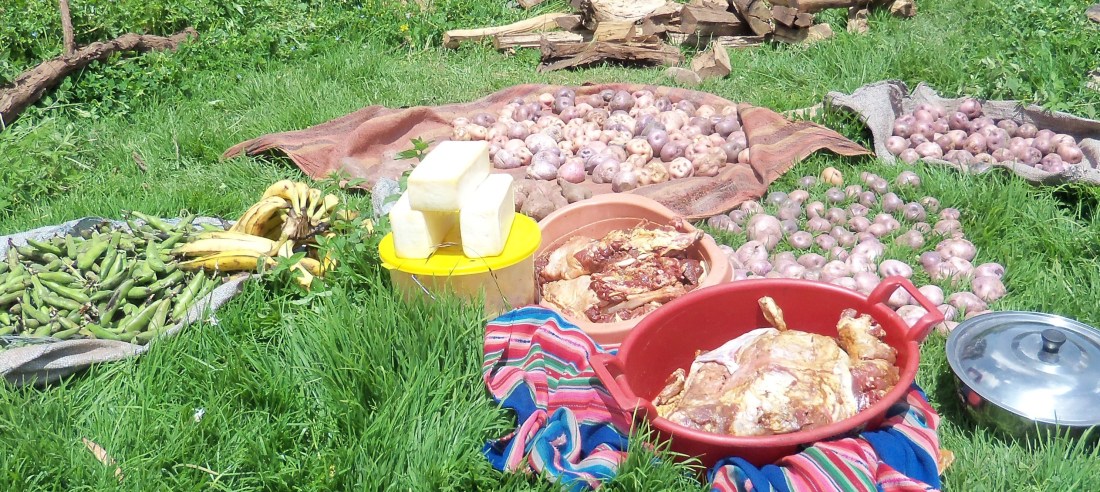
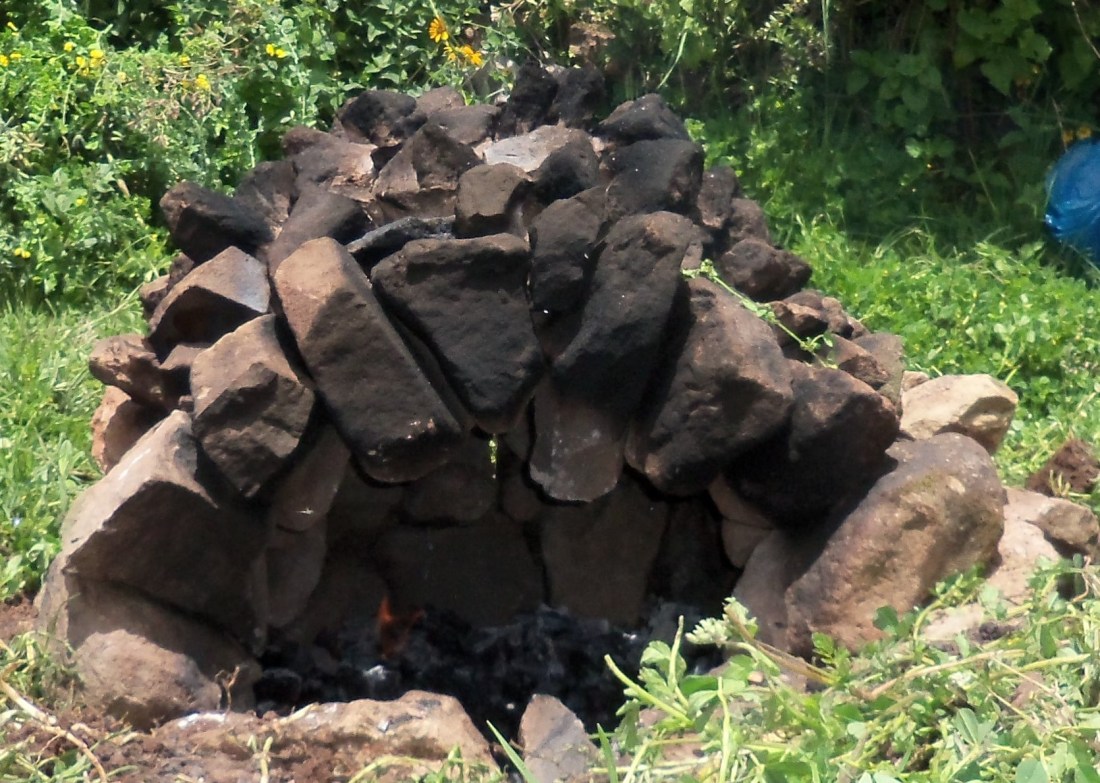
Our menu of lamb, chicken, llama, potatoes, sweet potatoes, lima beans (cooked in their pods), plantain, and blocks of farmer cheese were baked in a rock “oven” especially built for the occasion.   We watched as the hole was dug, and then lined with the rocks.  The most impressive was the dome built by the large stones leaning against each other. The crowing touch came when the “keystone” was placed in the ground oven.

Peru Oven

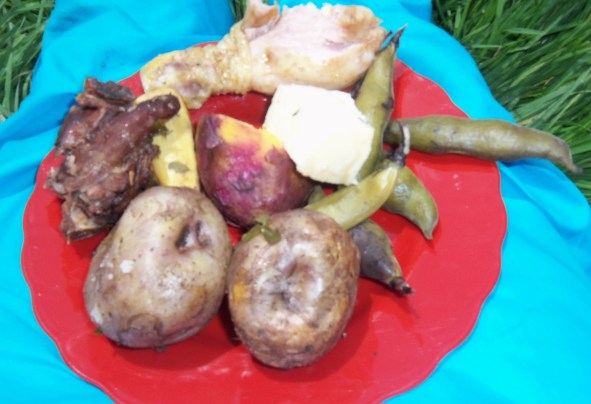
The domed rock oven was filled with wood fuel and burned until the rocks were hot.  When the rocks reached the target temperature, the dome was deconstructed by first removing the cap stone which held all the stones in place.  The rocks that made the dome were removed, and the raw foods were placed on the hot stones.  The cheese was wrapped in brown paper before being place on the other ingredients.  When all the food was in place, green branches with yellow flowers still in place, were spread on top of all the foods.  Then large sheets of heavy plastic were laid out on the green branches.  Then the moisture-rich soil dug to make the cooking pit was spread out on the plastic until nothing, but soil was visible.  The food stayed in the “oven’ for 35 minutes, and voilà!  We ate the most agreeable meal with cups of coca tea to wash it all down.  The meats, plantain, and vegetables cooked to perfection.   We ate with our hands.  I ate my potatoes with the peelings still intact, and I noticed that the villagers peeled their potatoes.   It was my favorite meal of the trip.

Peru cooked in Patabamba

While the meal was cooking, my fellow travelers and I met the elders of the village.  The elders, male and female, invited us to try on their beautifully dyed and woven dresses, ponchos, capes, and hats for photo opportunities.  One of the featured photos in a past blog was me and one of the elders.

After interacting with the village elders, we went for a walk to gather plants and flowers.  That was followed by a lesson on the plants used for dying wools for weaving.  The flowers gathered that day became the dyes of brilliant reds, yellows, and blues from which all other colors were made.  After spending a fine luncheon with the villagers, they set up a store for us to purchase handmade clothing, wraps, and hats.

What struck me most was the happiness of the people.  They seemed to be quite contented.  As they told us about their plans for promoting the village for tourism, which includes home-stays, I wondered if the influences that would inevitably follow would interfere with the peace they appeared to possess.  I wonder how they are faring these few years later.

Thank you for reading.


History of Mince Pie and a Recipe

I was an English major as an undergrad and for graduate school.  It was later that I worked in Human Ecology for a second grad school.  I must say that I fell in love with the food in so many British and American classics such as Great Expectations by Charles Dickens, Huckleberry Finn by Mark Twain, and the books by Jewish author, Chaim Potok.  One thing these books had in common was superb descriptions around food preparation.  Oh, I forgot to mention that Patrick O’Brien’s books about the British fleet on the high seas during the Napoleonic Wars were full of great description of the foods on board a ship.

One of the things that peaked my interest in Dicken’s Great Expectations was the traditions around the food.  Especially those served during holidays.  In case you have not read Great Expectations, there’s this great scene where the story’s main character, “Pip” stole mincemeat from a jar in the pantry to feed an escaped convict, named, Abel Magwitch.  This was an act that endeared Pip to Mr. Magwitch forever.  Earlier in the story, before the theft, Pip’s sister, Mrs. Joe, had already made the “handsome mince pie” for the holiday gathering, so she did not notice any missing (Dickens 22) shortly after Pip had stolen it to feed his convict.

I love mincemeat!  I continue to be intrigued that my Native American grandmother, born in the New Mexico, made mincemeat much the same way that the Brits made it.

Mincemeat has its origins in thirteenth century England when the aristocracy kept large amounts of dried fruits in their larders because varying climate made the storage of fresh fruit impossible.  In addition to the variety it added, dried fruits served to disguise meat past its prime. Mrs. Joe likely served it because of tradition, and almost everybody in England continues to eat mince pies at Christmas, presently (Hale 86).  The World Atlas of Food cites “Mrs. Beeton’s Household Management of 1856-1861” as having the original mincemeat recipe, which bakers continue to use today.  It includes raisins, currants, lean rump steak (my grandma used beef tongue), beef suet, sugar, candied citron peel, lemon peel, orange peel, nutmeg, apples and brandy all mixed and stored in glass jars to mature for about two weeks (87). The Kerr Home Canning and Freezing book written more than a century later offers the same basic recipe as well (25). However, Kerr promotes the use of a pressure canner, 10 pounds of pressure for 90 minutes. Mincemeat’s function, besides serving as a sweet treat, lay in its relatively long shelf life, essential in not having adequate refrigeration (Davidson 507).  At Pip’s Christmas dinner, the mince pie came just before the “savory pork pie”.   Here’s a notes about pie crusts:

Quick Pie from Scratch

After finishing a lovely meal on a cozy winter evening, one of our friends said, “I wish we had a pie!”  Luckily, our dear friend, Mary Lake, was at table, too.  She’s one of the best pie-makers in the world!  Mary and I bet, those around the table, that we could produce a pie from scratch in 30 minutes.  The race was on!  The stop watch began.  Mary got busy making her famous oil crust, and I set to getting the apples ready.  Fortunately, I had several quart jars of canned apples from the previous summer’s windfall of crispy, sweet apples.  I dumped a quart of apples in a bowl with 2 tablespoons of quick tapioca, cinnamon, 3 tablespoons sugar, and a pat of butter.  Here’s Mary’s crust recipe:

2 cups of all-purpose flour

Dash of salt mixed in flour – put flour/salt mixture in a bowl.

½ cup of vegetable oil (Mary likes corn oil for its nutty flavor)

5 tablespoons buttermilk (Make some with milk and vinegar if you have no buttermilk on hand)

1 glass pie plate.  It must be a clear, oven-proof pie plate.

With a fork, emulsify the oil and buttermilk until well blended.

Add to flour mixture

Stir with a fork until all flour is well-moistened

Divide, and put half of the dough on a square sheet of parchment paper. Shape into a round, flat disc without handling the dough too much. Place another square sheet of parchment, and roll out the dough with a rolling pin.  Once the dough is the size of your glass pie place.  Shape to the pie plate.  Repeat for the top crust.  Once the top crust is rolled out, place the fruit in the pie plate with the bottom crust.  Settle the fruit in to the crust, and then place the top crust. Shape the edges of the pie crust, cut air vents with scissors, and sprinkle crust with cinnamon sugar.

Place your pie in the microwave oven for 12 to13 minutes.  Meanwhile pre-heat your conventional oven to 400°.  After the time sounds for the microwave, remove the pie from the microwave, and place it into your conventional oven for 12-13 minutes, or until the crust is browned.

Mary and I put our apple pie on the table in 35 minutes.  The microwave oven gets the fruit cooking and thickened.  This shortens the time in the conventional oven, and prevents burned edges.  Starting the pie in the microwave only works for fruit pies.  Do not try with custard pies.

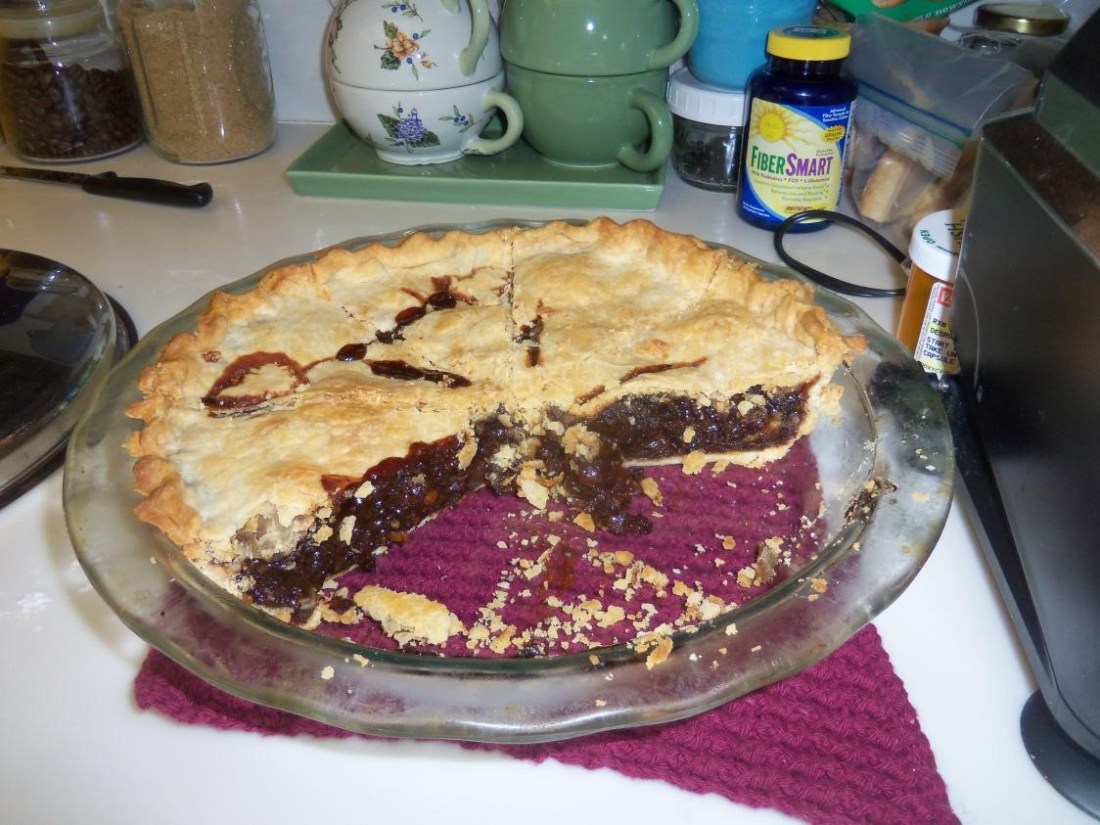
The featured picture is the mincemeat pie with the oil crust.  You can see that the crust is tender and flaky.  I did not add the cinnamon sugar mixture here, but it gives the crust a beautiful glow.

Mmmmm…I’m hungry!   Thank you for reading.


Celery and Dehydrated Veggies

Based on what readers are following in this blog, it seems that writing about cooking is a bit more popular, so here goes another entry about food.

If you have a thriving garden, no doubt, you wonder what to do with odds and ends of the vegetable waste.  I have a few ideas for you.

Whether you grow celery or buy it in a store, it can keep feeding you even after you’ve used the stalk, ribs, and leaves for varying recipes.  You can grow your own, for continued use, right in your own kitchen!

Hold your whole celery with the leaves on top.  Cut from the base of the stalks up about 2-3 inches from the bottom.  Put the ribs/stalks in the vegetable drawer of your refrigerator.  I like to wrap mine newly cut celery in a clean dish towel for a dryer storage.

Place that cut base in a small jar filled with water.  After a week, or so, you will begin to see roots sprouting from the base in the water.  When you see many small roots coming off the bottom, you will, also, see small leaves and stalk begin to reach up toward the “sky”.  Either you can use snips of the growing stalk to add flavor to your cooking, or you can plant the rooted base in potting soil.  After a week, or so, the celery will begin to grow taller each day.  You can use those growing celery stalks to further flavor your cooking.  I’ve used my growing celery for about six months.  Each time you cut the growing stalks and leaves, they will keep growing.

Those small stalks are tender, and work well in tuna salad, stir-fry, and that ubiquitous, aromatic trio of carrot, celery, and onion.  French cooks call it “mirepoix” (meer-pwah), Spanish cooks call it, “Sofrito” (so-free-toe), and Italian cooks call it Buttuto (boo-two-toe) or Soffritto. This lovely “trinity” pulls the best of flavors from the other ingredients included in your cooking and makes a lovely base for many soups.

Another thing that I do when I get to the end of my vegetables, if I have more than I need, or if I don’t think I will use the veggies before they go bad, I chop them into small pieces and put them in my food dehydrator. 

 Once the vegetables are dehydrated, I grind them in my coffee grinder (used only for herbs/spices) and process until the dried mixture resembles small flakes. 

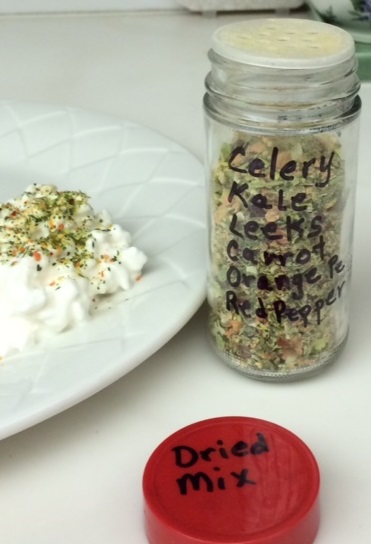
I put the vegetable flakes in a small jar with a shaker top (used herb bottle/jar) for use in a variety of food preparations. I have some favorite combinations: 

General Dried Blend: 

  • Celery 
  • Kale 
  • Carrots 
  • Leeks 
  • Orange Peel 
  • Sweet Red Pepper 

This blend goes well in soups, on cottage cheese (for a Bourisin Cheese taste), on eggs, etc. 

 My next favorite blend I like to use in seafood soups, on fish, etc. 

Seafood Blend: 

  • Fennel bulb 
  • Celery 
  • Carrot 
  • Lemon Peel 
  • Sweet Red Pepper 

 Drying veggies takes about 24 to 48 hours to dry on the “dried vegetable” setting of the dehydrator. You can be creative in the kinds of vegetables that you dry for your mix. You can also dehydrate veggies without grinding them for use in soups. 

As mentioned previously, with the Mirepoix, I make a dehydrated Mirepoix, and I add mushrooms to the trio before drying.  The mushrooms add extra glutamate for more enhanced flavor in cooking.  I like to use this mix in my marinara or pizza sauces.

Somehow, I think creating dishes in the kitchen becomes a sort of therapy that feeds my artistic side.

Thank you for reading.


It’s Basil Time!

After work today, I returned home to realize that my basil plant needed harvesting, again.  The climate in my usually draught-stricken part of the state has been especially wet this summer.  The farm manager, where I work, told us that the average precipitation in July, for this region, hovers around 2.5 inches of rainfall.  As of last week, we had received 8.98 inches of rainfall, and the basil is loving it! I hear other gardens are doing well, too.  Let’s talk about basil.

If you read about the healing properties of basil, you know that it’s an anti-viral.  So, let’s look at pesto.  I think it could be a near perfect food, in my estimation, because of the ingredients.  It’s full of basil with its “green” power, protein from the pine nuts and the parmesan cheese, garlic is known as a vasodilator, and extra virgin olive oil is known for its healthy mono-unsaturated fats, antioxidants, and anti-inflammatory benefits.

Here’s how I make pesto:

1 very, very large bunch of fresh basil leaves

5 large cloves of garlic (Glad we don’t live in Chicago in the 1920s when one could not go into public for 24 hours after consuming garlic!)

½ cup grated parmesan cheese (more or less)

½ cup pine nuts (piñon nuts) (more or less)

Enough extra virgin olive oil for a nice consistency

Of course, I’m not exactly sure about the measurements.  I just add them until it “looks right”

Throw it all in a blender, and blend into a pourable consistency, or thicker, if you like.

It’s best to freeze it for a lovely green treat in the winter months.  It looks just as green the day you take it out to thaw as the day you put it in the freezer!

So, what do you do with pesto?

It can be tossed in any pasta salad or anti-pasti salad.  Just the other day, I cooked some whole wheat spaghetti, and I cooled them.   To that I added grilled zucchini, onions, carrots, corn (on the cob), and eggplant (cubed after grilling).   After the veggies have cooled, I added them to the cooled pasta.  Then I tossed all with cubed mozzarella.  Grilling the veggies added a special smoky flavor to the “salad”.  Then I added the fresh, green, thawed pesto with just a bit of balsamic to add that tang.

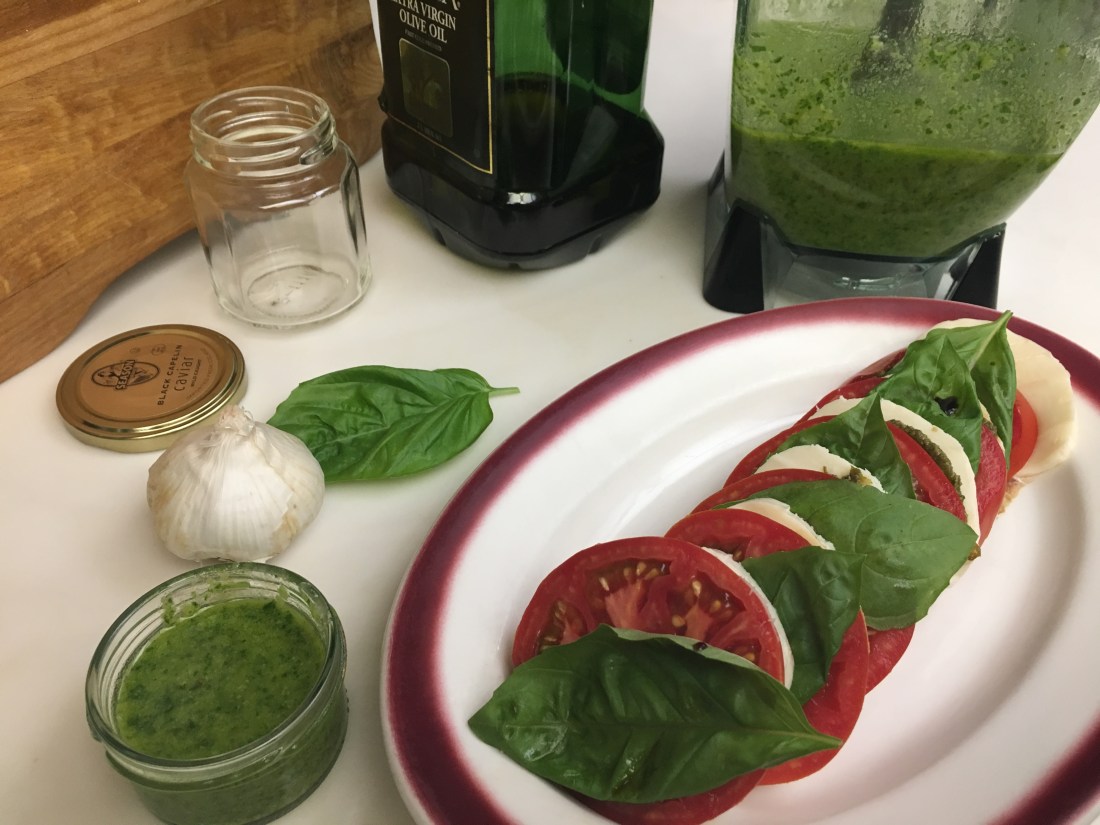
Another is caprese salad, as shown in the featured photo.  I had fresh garden tomatoes, so they called for basil leaves, fresh mozzarella (smeared with pesto), and tomato.  Don’t you just love the colors in the photo.  Do you think caprese salad was made to look like the flag of Italy?  I like to drizzle a little balsamic.  We ate a lovely supper, tonight, of the caprese salad, with canned sardines, and saltine crackers.  It was a most satisfying meal with an accompanying glass of Sauvignon Blanc.

Thank you for reading.

Conviviality and “Hygge”

The goal today is not to be another foodie blogger, though I love to cook, bake, and, often, I get to do those things in a social settings with family, friends, and acquaintances.  I do want to talk about an aspect of nourishing our bodies along with our spirits and our lives, as in “Joie de vivre” (joy of living).

As a word collector, one of my favorites is conviviality, the quality of being friendly and lively or friendliness. Merriam-Webster takes a different approach in its meaning by connecting conviviality, specifically, to food and feasting in “good company.”  Whatever the definition of conviviality, I love the concept, and I love engaging in the act of being convivial.

A few years ago, I went to a food science conference at the University of Arizona in Tucson.  The focus of the conference was the Mediterranean Diet: Eating fresh, non-processed, omega rich foods and having a small amount of red wine each day.  What I found to be the most intriguing was the emphasis on convivial eating: sharing food with family or friends and taking your dear, sweet time to allow slow, digestible consumption of food while enjoying each other’s company.  The food scientists at this conference emphasized that the food choices play an important role in healthful eating, but went on to say that the slow, deliberate sharing of food and conversation is equally as important.  It made me wonder if there is a word in the Italian vocabulary for “fast food”.  I hope not.  I can’t help but connote the notion of fast food with un-healthful eating.

The food writer, Michael Pollan said, “The shared meal elevates eating from a mechanical process of fueling our bodies to a ritual of family and community, from mere animal biology to an act of culture”.  To that I think of the holiday meal that takes a full day to prepare, and most eat it in a matter of moments.  Perhaps a healthier thing would be to take at least half of the preparation time for consuming the meal.  So, if it takes 8 hours to prepare the meal, take 3-4 hours to eat it.  Okay, that may be excessive!  What if we took 2 hours to consume our holiday meal?  It would certainly honor the hands that prepared it.  In addition, the slow consumption of the meal would keep us from overeating, because our brains would know when we’re full sooner.

Opposite of convivial meal times is observing our grandchildren eating in the school lunch room.  The students must consumer their meals in as few as 15 minutes. The lunchroom “monitors” highly discourage conversation as well.  I know children are highly adaptable, but I can’t help but think that the daily school lunches may add some unnecessary stress to the developing mind and body. From all appearances, the children don’t seem to enjoy the process.

The Danish have the word “Hygge” (pr. Ooga or hee-gah).  Likely the word from which we get “hug”, hygge is the feeling of coziness, fun, or contentment.  The intimate setting of a small dinner party or an impromptu gathering with family or friends makes me think of hygge.  One of my favorite places for that feeling of hygge is around the camp fire in the mountains or sitting with family or friends near a body of water.  The word, “delicious” comes to mind.

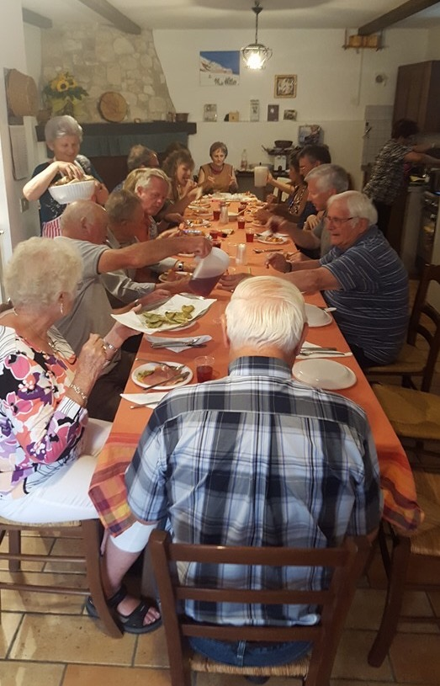
The featured photo in today’s blog is that of my sister’s in-laws in Italy.  My Sis is at the far end and cannot be seen from this vantage point.  Please notice that the family is gathered around a table that seats 18.  My sister tells me that the hostess prepares fresh mozzarella and bread every day.  When I gaze at this photo, I think I can smell the flavorful food, and I marvel at the wine being poured from pitchers.  Sis tells me that the meals there take two to three hours to consume; even when everyone at table does not speak the same languages.

Thank you for reading.


Another Exciting Day in Peru

Yesterday, I introduced the topic a trip I took to Peru as part of a leadership program focused on agriculture and rural life.  Our first stop was Lima, which was the central travel point to each part of our journeys across the country.  So, from Lima, we departed to Chincha by bus, to Tarapoto (the jungle region), by airplane, to Cusco (the high Andean region) by plane, and back home, by plane.  Those trips will be outlined in due time.

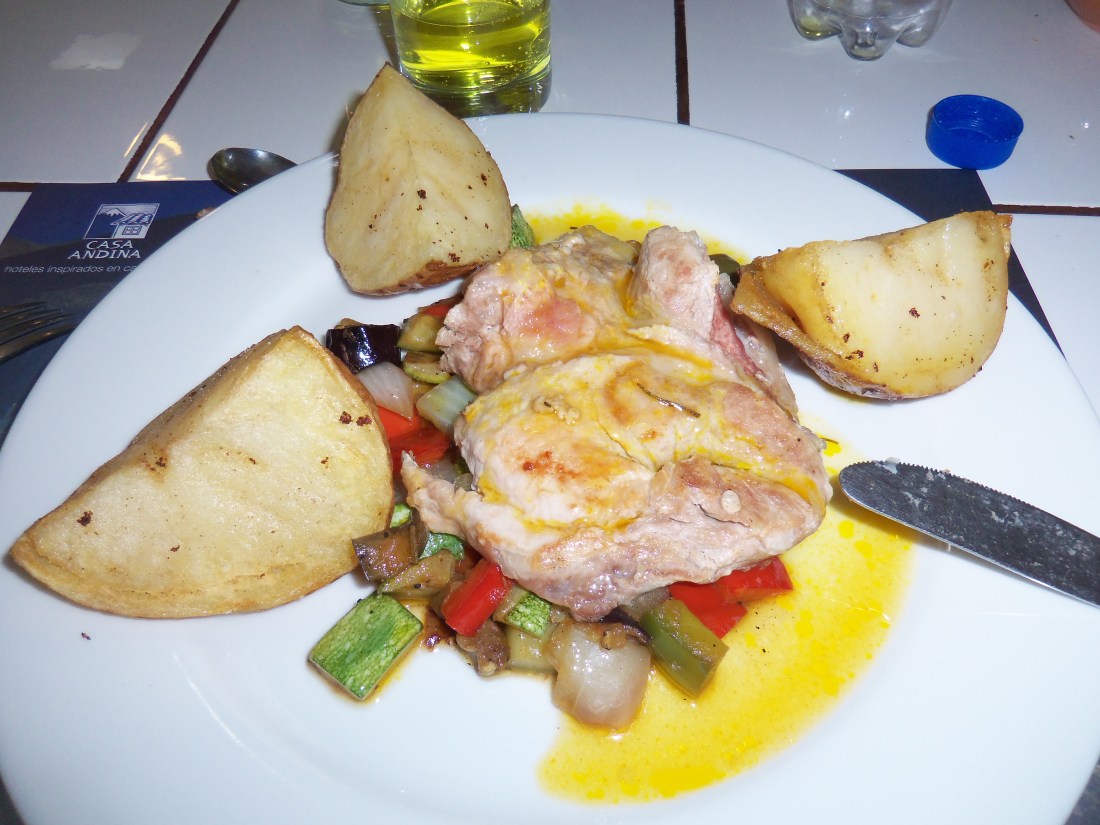
As previously mentioned, our first day included a U.S.D.A. country briefing at the U.S. Embassy with Ambassador Rose M. Likins and her staff.  After the briefing and tour of the U.S. Embassy – Peru, we departed for lunch at the Casa Andina.  We were fed one of Peru’s favorite dishes, chicken. We ate chicken in many dishes.  This was a delicious baked chicken place atop a sautéed vegetable medley of onion, eggplant, zucchini, and sweet red pepper all lightly touched with a savory butter sauce. A baked and quartered potato accented the dish, which we washed down with Inka-Kola, a cotton-candy-flavored cola (caffeine) drink.  This dish is my featured photo today.

We departed for the Corgono S. A. flour mill in Callao.  It was a fascinating tour.  It made me think of the sugar factory at Ayala, in the state of Morellos, in Mexico where very old equipment was handled with the most care and “babied” to get the most out of it.  Similar to that sugar factory, the flour mill in Callao ran three shifts per day, and one shift was set for maintenance of the milling machinery and equipment.  Otherwise, the grain went through all of the steps that one might imagine in any flour mill.  Before the tour, we were asked to wear long pants, no open-toed shoes, and to bring no cameras.  Apparently, I didn’t take copious notes as I look back to my journal.  I do remember great pride that each person had in his work at the mill.  It was very loud, and there were no women employed on that day.  One wondered if that was the rule for this mill.  I neglected to ask.

After the flour mill tour, we boarded two buses to Chincha Province.  Our bus journey was along the coast line running south from Lima.  Interestingly, the coast line was dotted with what looked like chicken houses.  Remember, Peru eats a lot of chicken.  Also memorable was lots of eating establishments named for their proprietors: Restaurant Betty, Restaurant Oscar, Restaurant Wilbur, etc.  I delighted in the entrepreneurial spirit of the Peruano (How they refer to themselves.  We had been saying, “Peruvians’).  We stopped for snacks at a gas station along the way.  One could buy a bag of puffed corn, sweet potato chips, or lima bean “nuts” (similar to Corn Nuts) with a bottle of beer.  That was interesting, so most everyone availed themselves of the opportunity.  Our scheduled two-hour bus ride took a bit longer as one our buses had a flat tire.  I didn’t mind.  It gave us time to get out for a look about.  We watched automobiles and “Moto-Taxis” whiz by.  The salt-filled air was comfortable, and many aromas arose in the evening air.

We made it to our hotel in Chincha that evening.  We cleaned up and stayed in for dinner at the hotel. We ate lovely chicken or beef dishes and drank Pisco Sours.  We were first introduced to the Pisco Sour when we had visited the Embassy of Peru in Washington, D.C. the previous year.

I hope you found this story interesting.  Thank you for reading my blog.


A Ute Prayer: Earth Teach Me to Remember

I can’t remember where I found this, but it comes from my father’s people, the Uncompahgre a.k.a. Northern Ute.

Earth teach me stillness
as the grasses are stilled with light.
Earth teach me suffering
as old stones suffer with memory.
Earth teach me humility
as blossoms are humble with beginning.
Earth Teach me caring
as the mother who secures her young.
Earth teach me courage
as the tree which stands alone.
Earth teach me limitation
as the ant which crawls on the ground.
Earth teach me freedom
as the eagle which soars in the sky.
Earth teach me resignation
as the leaves which die in the fall.
Earth teach me regeneration
as the seed which rises in the spring.
Earth teach me to forget myself
as melted snow forgets its life.
Earth teach me to remember kindness
as dry fields weep in the rain.

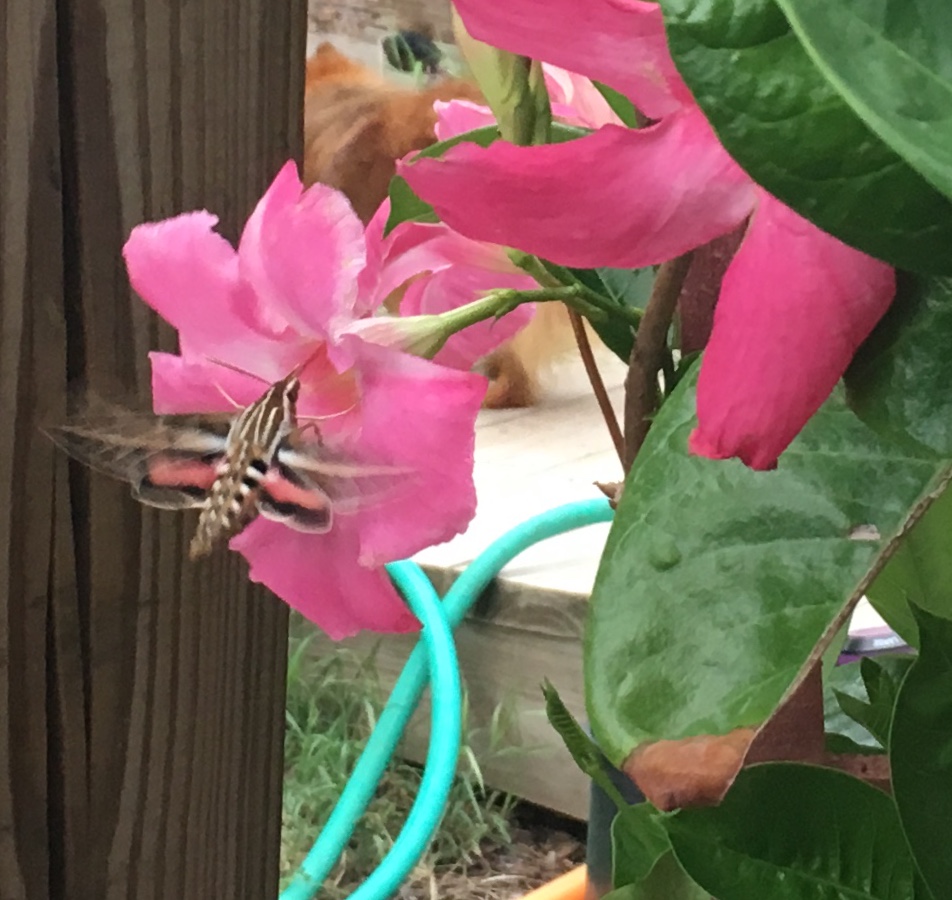
p.s. I posted a picture of a hummingbird moth (sphinx moth) feeding on an umbrella plant.  It reminds me of the beautiful wonder of nature.

Thank you for reading.

Making Your Own Fun

We just spent the past month with our grandchildren, which is the height of our summer months.  They like to eat different foods, so we focus a lot on the evening meal, and the eldest, KDW, has given himself the job of choosing the menus (grilled lamb, lasagne, fried chicken, shrimp fried rice, macaroni & cheese,  and spaghetti).  We try to have one meal with mussels, which is our only granddaughter’s favorite.  All meals end with some sort of ice cream or other frozen dairy product and games, such as Monopoly, bowling, swimming, and movies.  Never a dull moment!

The children have returned to their homes, and we are alone again, naturally.  So now,  we turn our focus to our friends.  My hubby is out of town, so I’ve been seeing our friends a lot this past week.   I just said goodbye, for the evening, to some ladies who came for dinner.  I’ve heard the phrase, “There’s nothing to do around here!”   Perhaps, it’s the non-creative mind that says such a thing.  There is always something to do.  When you’re used to making your own fun, it can be most stimulating.

This weekend has been especially busy for me, in terms of interacting with friends.  Friday, we had happy hour on the back porch.  There was lovely food, conversation, beverage, laughter, and getting to know some new friends.  On Saturday, I went to Lynn’s, house for some interesting fun.  We sat in a stock watering talk, filled with water, which was delicious on a hot, muggy day.

The point is that we can make our own fun.  I have wonderful friends, and all of us are easy “entertainers”.  That is, we fix some food, and have some friends, who usually bring more food, come to visit.  We share these evenings, evenly, among one another.  I suppose it helps that we all like to entertain, we love to cook, and we love discussing our lives with each other.  Half of our group is retired and some of us still work.  That’s another story, however.

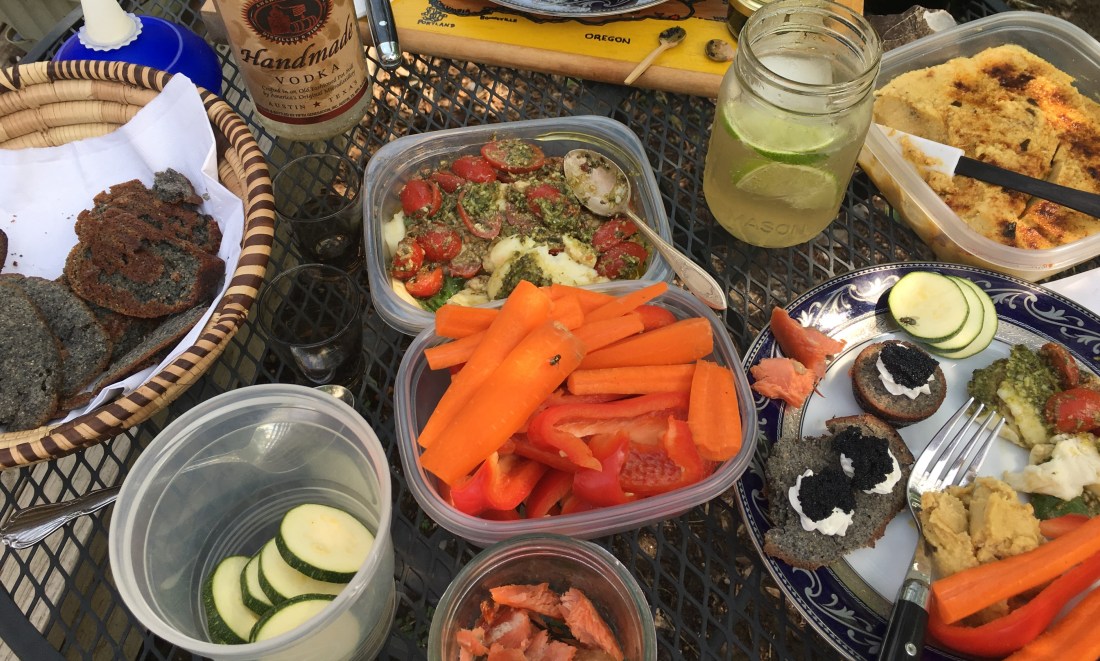
The picture that I’m featuring here, is the Saturday afternoon on Lynn’s back porch with her “spa” made from a livestock tank.  We filled it with water, set out the spread of smoked salmon (caught in Alaska by Mark & Kathy), blue corn cakes, cavier, sour cream, hummus (made from scratch with my own cooked chick peas), caprese salad (fresh basil, fresh mozzarella, tomatoes, and pesto sauce), and some cut up veggies. Lynn made Moscow Mules, and we soaked in the water, and passed the time.  It was marvelous.  Water is such a healing element.  We put our lawn chairs in the water tank so that we could sit next to the food table and help ourselves.  The afternoon was lovely, and before we knew it, five hours had passed.

Tonight, we had a girls’ night the featured ground lamb kabobs, veggies with dip, Brussels sprouts sauteed with bacon, fresh corn on the cob, and watermelon.  The great thing about summer is that one has access to fresh fruits and vegetables.  Our conversation centered on music and the arts.

I’m not sure what motivates one to be around friends, or not to have those types of relationships.  I realize there are some people who simply do not entertain guests in their homes.  I’m sure it’s a preference that either we have or do not have.  I was raised by a mother and father who fed a lot of people when I was growing up.  Mostly, it was relatives who ate at our house, but I remember the interactions and conviviality with great affection.

What are your thoughts on entertaining people in your home?