Based on what readers are following in this blog, it seems that writing about cooking is a bit more popular, so here goes another entry about food.
If you have a thriving garden, no doubt, you wonder what to do with odds and ends of the vegetable waste. I have a few ideas for you.
Whether you grow celery or buy it in a store, it can keep feeding you even after you’ve used the stalk, ribs, and leaves for varying recipes. You can grow your own, for continued use, right in your own kitchen!
Hold your whole celery with the leaves on top. Cut from the base of the stalks up about 2-3 inches from the bottom. Put the ribs/stalks in the vegetable drawer of your refrigerator. I like to wrap mine newly cut celery in a clean dish towel for a dryer storage.
Place that cut base in a small jar filled with water. After a week, or so, you will begin to see roots sprouting from the base in the water. When you see many small roots coming off the bottom, you will, also, see small leaves and stalk begin to reach up toward the “sky”. Either you can use snips of the growing stalk to add flavor to your cooking, or you can plant the rooted base in potting soil. After a week, or so, the celery will begin to grow taller each day. You can use those growing celery stalks to further flavor your cooking. I’ve used my growing celery for about six months. Each time you cut the growing stalks and leaves, they will keep growing.
Those small stalks are tender, and work well in tuna salad, stir-fry, and that ubiquitous, aromatic trio of carrot, celery, and onion. French cooks call it “mirepoix” (meer-pwah), Spanish cooks call it, “Sofrito” (so-free-toe), and Italian cooks call it Buttuto (boo-two-toe) or Soffritto. This lovely “trinity” pulls the best of flavors from the other ingredients included in your cooking and makes a lovely base for many soups.
Another thing that I do when I get to the end of my vegetables, if I have more than I need, or if I don’t think I will use the veggies before they go bad, I chop them into small pieces and put them in my food dehydrator.
Once the vegetables are dehydrated, I grind them in my coffee grinder (used only for herbs/spices) and process until the dried mixture resembles small flakes.
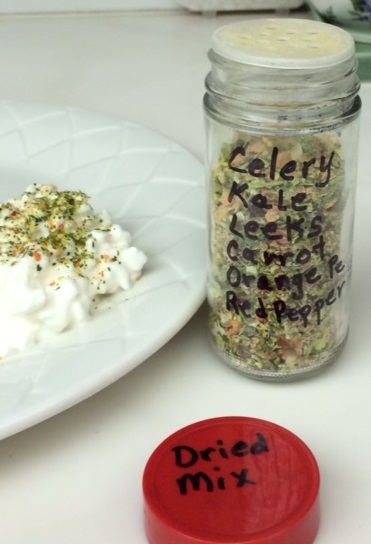
I put the vegetable flakes in a small jar with a shaker top (used herb bottle/jar) for use in a variety of food preparations. I have some favorite combinations:
General Dried Blend:
Celery
Kale
Carrots
Leeks
Orange Peel
Sweet Red Pepper
This blend goes well in soups, on cottage cheese (for a Bourisin Cheese taste), on eggs, etc.
My next favorite blend I like to use in seafood soups, on fish, etc.
Seafood Blend:
Fennel bulb
Celery
Carrot
Lemon Peel
Sweet Red Pepper
Drying veggies takes about 24 to 48 hours to dry on the “dried vegetable” setting of the dehydrator. You can be creative in the kinds of vegetables that you dry for your mix. You can also dehydrate veggies without grinding them for use in soups.
As mentioned previously, with the Mirepoix, I make a dehydrated Mirepoix, and I add mushrooms to the trio before drying. The mushrooms add extra glutamate for more enhanced flavor in cooking. I like to use this mix in my marinara or pizza sauces.
Somehow, I think creating dishes in the kitchen becomes a sort of therapy that feeds my artistic side.
I am a geographer specializing in human systems. My passion is studying underrepresented populations so that I can assist in their integration into the communities in which they live. I studied Human Ecology because it is a wonderful blend of the disciplines of geography, anthropology and sociology. No matter the context in which I find myself, I am an observer of humans in their environments and how the influences in those settings build and nurture sense-of-self, sense-of-place, and sense-of-direction in educational, familial, and community settings. My work focuses on the cross-cultural and intercultural traditions of multi-lingual populations acculturating into their receiving communities and being successful in educational arenas of higher education. This work includes gathering, analyzing, and writing about health, well-being, and environmental/social connectedness in their communities. My research focuses on Minority-majority, rural, Midwest communities. My role as director of intercultural learning and academic success at Kansas State University allows me to discover more about myself as I work with others in their paths to self-discovery in their own interactions with students and families who come from different parts of the country and the world all converging in educational spaces. Recently, I lived, worked and played in Southwest Kansas, a region marked by Minority-majority populations centers (56% – 68%). Some of my research results are used to address poverty, low educational attainment, poor health outcomes, and cultural norms in multi-cultural settings. I work to assure a representative sample for my research, so I engage in multi-lingual research (English, Spanish, Burmese, French, Tigrinya, and Somali). Building trust and relationships is the key to my success as a multilingual researcher. Presently, my research takes me in the micro-communities of populations represented by nine African countries (Eritrea, Ethiopia, Sudan, Kenya, Senegal, Uganda, Ivory Coast, Somalia, and Cameroon), seven Latin American countries, and six Asian countries. Yes, it is rural Southwest Kansas, and many of the densely-settled and frontier rural communities act as receiving centers for refugees and other displaced populations, because of the availability of jobs.
I am the recent recipient of National Geographic Society’s Research and Exploration grant to introduce Geographic Information Systems (GIS) to females of color. This inter-generational, intercultural class hosted middle school, high school, and adult females who learned the basics of GIS with a variety of applications from remote sensing to city planning to Google Earth, and to Pokémon GO! By the time the young ladies finished the class, they were able to build cities, map their communities, log trips from their countries of origin to the Midwest. I am in the mid-year of the grant funding, and my target for completion was July 2018. I have new funding to extend this work to new cohorts.
Currently, I work at Haskell Indian Nations University on an NSF project: Rising Voices Changing Coasts addressing climate change in Indigenous Coastal Communities in Alaska, Puerto Rico, Hawai'i, and the Louisiana Gulf Coast.
I am a mother, grandmother, sibling, friend, banjo player, and a geographer dedicated to studying humans in their environments.
View all posts by djhbolton