As we draw near the 10th year of your passing, I want to tell you how we’re doing, because I remember that you called me every day to check on me. I know that you check on your children every day, too, even now. Today would have been your 44th birthday.
First of all, we miss you so deeply. We remember your sense of humor, your devotion to your three babies, your talents in the kitchen, your ability to draw people to you, your friendliness to everyone you met, your high vibrations, and your empathy toward others.
Your children are doing well. Korbin is moving up the ladder at Walmart, and he continues to cook at Coyotes, because that’s where his friends work. He loves cars, and he plays in Pokémon tournaments. Shawn is a wonderful daddy to his little girl, Nova. He is thriving at work as an HVAC expert, and he’s supervising a crew, too. He is going through a rough patch, and he tells me every time we talk, that he misses you dearly, and he wishes you were here to give him advice. Nova is thriving and seems to be a happy little girl.
Sam is in school and doing well. Her lowest grade is an A-. She is a wonderful mother to the happiest little boy I’ve ever met. His name is Finn.
I know you’d be the best grandmother for these babies. Finn loves to talk to the big portrait I have of you in my living room. He senses that you are his grandmother and that you are special.
As you know, we went through some terrible times last year, but we came through it, because we are strong. All of my GC friends were there to support us during the whole time. Your children have your strength. I see you in them every day. They learned how to be strong from you, and that is what has carried them through the tragedy of losing you, of watching their own daddy struggle with addictions, and through having a “grandpa” who only hurt them all with his deceit and selfishness. Oh, how I wish you were here to ease their pain. Please go to them in their dreams. That would help a great deal.
I know your friends miss you desperately, too! They continue to celebrate your birthday, and none of the Village misses your children’s big events, like graduations, birthdays, births, and the like. I still have some of your recorded voice, so I listen to that every now and again. I continue to ask why a wonderful young mother would be taken from her children in at the prime of her life and at the serious developmental stages of her children? You were the heart and soul of your family and of your friend group, the Village. That’s why they called you, “Mama Bear.”
Your Brother will likely light a fire in your memory tonight. The children and I will go out to dinner and reflect on your legacy.
Finally, I think of you every day. I ask for your guidance of your children. I love you, dearly, Riki, and I hope you are resting in Power!
My lovely daughter, Riki L. Warner, would have been 42 years old today. We’re coming up on eight years of her passing. We continue to wonder what would have been had her medical care team met her needs and better served this young mother who left behind three beautiful children and a loving husband. I suppose we never should ponder such questions.
The top image features my necklace with Riki’s picture. The compass rose, given to me by Lynn, not only represents my occupation and passions as a geographer, but I love that it sits next to Riki as she was my north, my south, my east, my west, my working week, and my Sunday rest, so the W.H. Auden poem goes. The Zuni turquoise inlay ring represents the drum, so important in our (Native) ceremonies and prayers.
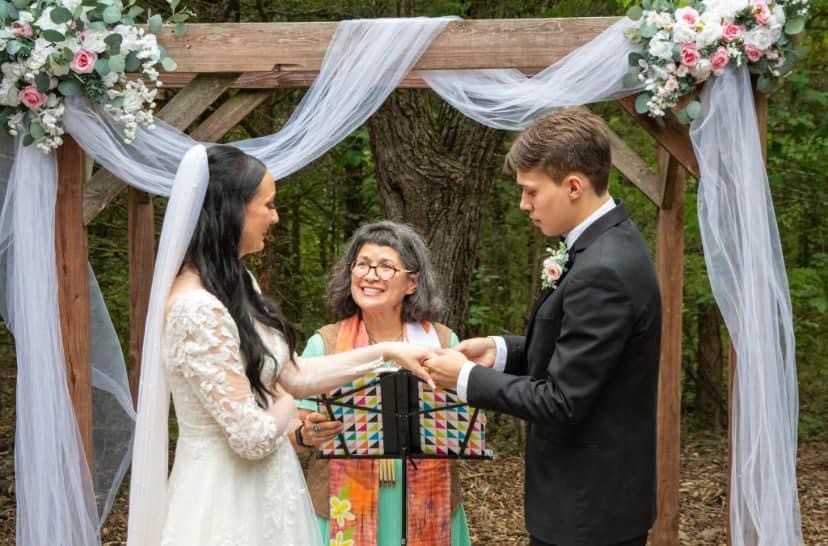
The past two weeks have been those of family gatherings and celebrations. On September, I had the honor of officiating my nephew’s wedding in Southwest Colorado, and then this past weekend, I officiated my grandson, Shawn to his bride Gracie. Shawn is Riki and Jonathan’s middle child. His empathy for others shines as his super strength. My sister, Eileen, joined in the celebration which took place in Southwest Missouri. Yes! We had a busy week.
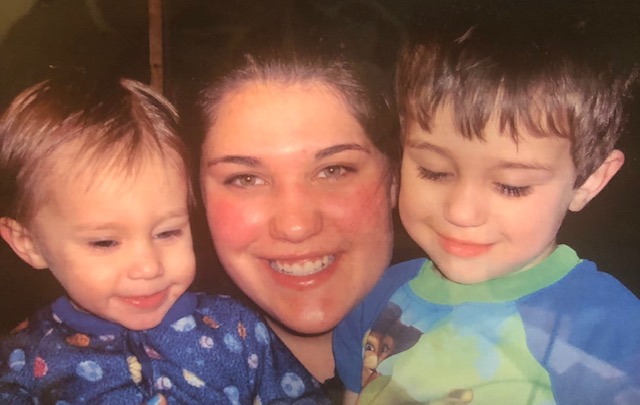
I will have to write about the first wedding later, but my focus for this is to highlight Riki’s son, Shawn. This would have been a major event for Riki to see her son married. Shawn and Gray have known each other since middle school. Similar to Riki and Jonathan who met in 6th grade and had been married 12 years when she passed from a heart condition that doctors did not take seriously, because, “She’s very young and may grow out of it.” Who says that. We found out later that she should have had a defibrillating pacemaker. I now share some lovely pictures of the wedding. Here’s Riki with Shawn as a sweet child.
Jonathan sat next to this picture for the ceremony. I thought it such a great tribute to Shawn’s mommy. Shawn’s brother, Korbin, my eldest grand child was the best man, and gave a lovely speech to his brother and new sister-in-law at the reception.
Everyone felt Riki’s presence at the wedding. Her children made her proud on this beautiful day. Sammy and her friend Darrell distributed the bags of bird seeds on the chairs for the recessional. That was fun, and my sister Claudia made the bird seed bags.
Maybe it’s not everyday that a grandma gets to officiate her grandson’s wedding. My son, Stevie, took his nephews to his special barber for their wedding haircuts the day preceding the wedding. My sister gave me tremendous emotional support and great suggestions. Riki’s “Village” was there to celebrate Shawn and remember their dear friend, Riki. I am so grateful to those young families.
Stevie and Dianna entertained Eileen and me, after the reception, with hilarious talk and Stevie’s rendition of Tony Montana from Scarface! Who knew this bittersweet celebration could be joyous and sad at the same time? We make the best of our situations everyday while we greatly miss our Riki.
This time last year, one of Riki’s school friends wrote to me on messenger. Joey told me that he thought about her in so many different situations. The greatest gift Joey gave to me was to say, “Thank you for bringing Riki into this world.” Such a kind and beautiful thing to say to a grieving parent. Riki, we miss you everyday.
Now that we’re shedding out winter blankets, in the Northern Hemisphere, it’s time to think about warmer weather. Often times, we tend toward a more sedentary life in winter weather. That means we may gain a few pounds, lose a little muscle mass, and our motivation decreases. How do we keep this all in line so that we experience optimal health year around? My answer? Holistic Self-Care.
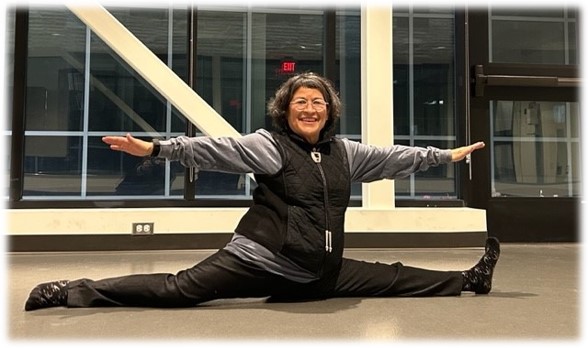
About a month ago, I reached my 66th birthday. The day before my 66th year, I taught a self-care class for my co-workers. It was fun. I called it, “Finding Hygge and Other Emotional Well-Being Concepts.” I’ve written about hygge and other forms of coziness in previous blog articles. I had a co-worker take the picture you see in the “featured image.” That was for my “Meet Your Presenter” slide in the power point for my workshop.
Let’s get started.
I offer this lovely image that I call, “Sunset on the Flinthills” as a gentle reminder for you to bring the natural world into your time reading this and for engaging in self-care practices. Here are some learning objectives:
Self-advocacy promotes equity and belonging
Health and well-being practices promote physical, emotional, social, and occupational well-being
Long-term outcomes include increased confidence and overall well-being
“When we cultivate environments of well-being, we see each other as holistic beings who seek fulfillment through work, leisure time, and personal or professional development. We strive to engage in self-care when necessary and without judgment.” -Bolton
Let’s Breathe
I borrowed this image from social media promoting a Mastery of Self, a book by don Miguel Ruiz Jr.:
Sit quietly with all distractions muted as best as possible.
Circle arms above head while inhaling – then exhale. Do this 8 times.
Breathe in through your nose and out through your mouth: 8x
Inhale to the count of 5 – Exhale to count of 5: 8x
Place your hands on your diaphragm and breath out with a loud “ho!”: 8x
What is Holistic Health and Well-Being?
When we think of when we humans are at our best, there are many needs that must be met. I could bring in Maslow’s Hierarchy of Human Needs, here, but you likely know what those are, and this reflects that, too. I think most humans work toward self-actualization. Here is what we need:
Physical needs – Food, clean water, oxygen, elimination, clothing/shelter, sleep, and movement/activity for sensory and motor stimulation
Mental/psychological needs – attachment, orientation/control, self-esteem, pleasure, and avoiding pain
Spiritual needs – Meaning, purpose, to love, and to be loved
Social needs – Relationships, belonging, respect, affirmation
What under-girds each of these human needs, of course, is SAFETY?
Safety means, security of body, employment, resources, our moral codes, any type of family, optimal health, and a place of one’s own. Can you image what happens to humans who do not have the privilege of holistic health and well-being? Can you imagine what happens to the human psyche when one is displaced due to war, poverty, colonization, or no job opportunities?
We must feel safe and affirmed in any space in which we navigate. All of these needs move forward once safety has been met.
On another note of importance, we must understand others’ identities and how those identities may contribute to feelings of non-safety when others view them as lesser than, who don’t belong, or somehow don’t fit in. Remember, there are those who do not feel safe in certain environments. That happens when basic human needs are not met. Abraham Maslow was absolutely correct when he talked about basic human needs as critical to thriving.
Our Own Cultural Behaviors Contribute to Our Senses of Work, Rest, and Play
A dominant cultural behavior of the United States is work, work, work. Brené Brown tells us that “crazy busy is a great armor. It’s a great way for numbing. What a lot of us do it that we stay so busy, and so out in front of our life, that the truth ow how we’re feeling and what we really need can’t catch up with us.” I see this in my work place when my colleagues boast that, “I’m losing vacation days, because I don’t use them!” Unfortunately, that is an ethos that is honored in my work place. That is the opposite of praising for self-care.
Think About You:
What are some things you do to wind down after a hard day at work?
What are ways in which you balance work and rest?
Is “winding down” a practice you do?
Most of us are not in survival mode nor are we in subsistence mode. We tend to forget about “self-care” mode. Let’s change that practice!
Let’s Stretch
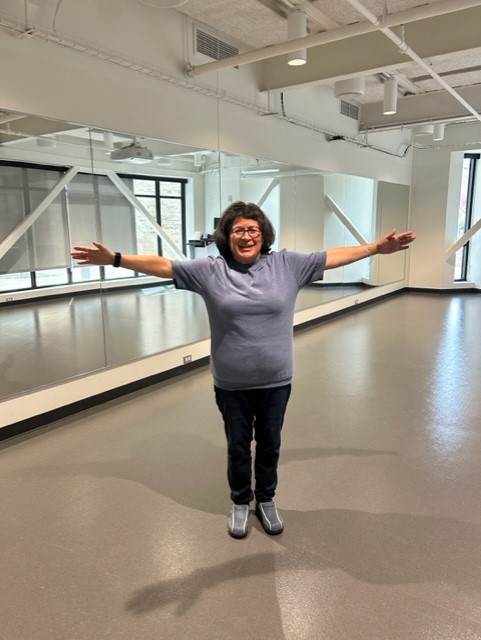
Stand tall and reach for the sky with a full inhalation. Drop your arms as you exhale. 8x
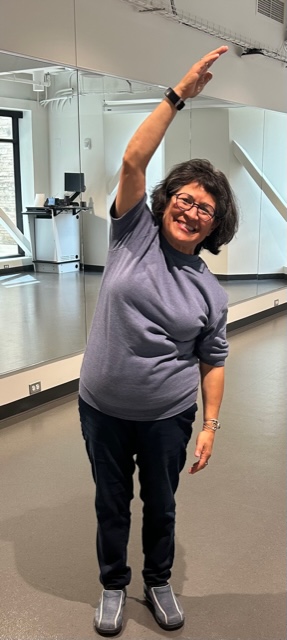
Stand tall and reach from side to side over your head. You will cross your right arm over to your left side and vice versa. 8 x
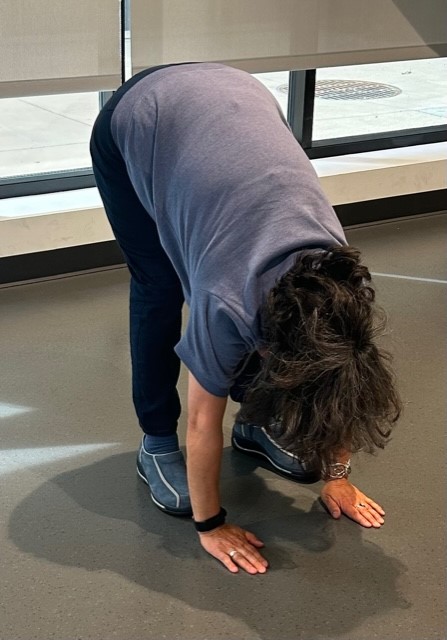
Stand tall and reach for the sky. Take deep breaths. Reach up, and then bend to touch the floor. 8x
Now, squat low and stretch your inner thighs to a ten count on each side. 8x
Take This Moment to Reflect
•What gifts or talents do you possess?
•What new characteristic did you discover about yourself recently?
•What are you grateful for?
–Looking to the future
•Which value or action would bring you closer to a vibrant way of living?
•If you have or would design a personal ritual, what would it be?
•Have you found a way to focus on your successes?
•What kind of person do you strive to be?
•Have you ever thought of naming what you want your life to be as a chapter in a book?
What is Mental Health?
“…a state of well-being in which the individual realizes [their] own abilities, can cope with the normal stresses of life, can work productively and fruitfully, and is able to make a contribution to [their] community.” (WHO, 2004, p.12)
= positive capacity = social and emotional wellbeing = behavior, thoughts and emotions
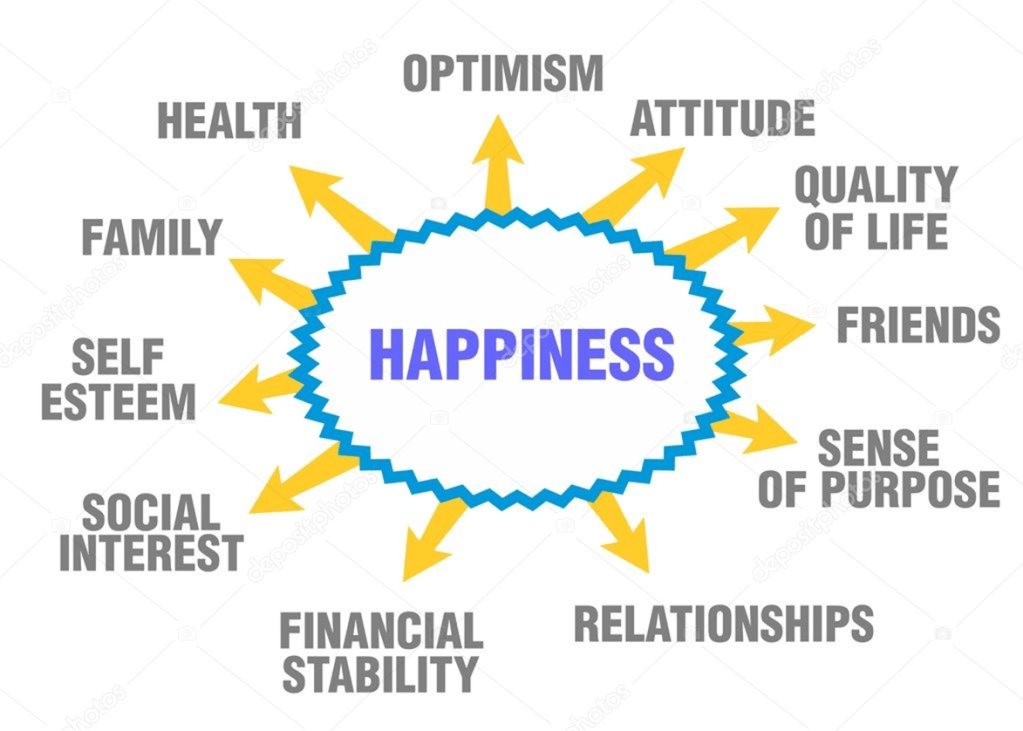
≠ mental ill-health* ≠ happiness
Open dialogue on Mental Health
In you own words, what does the phrase “Mental Health” mean to you? What definitions/connotations does this phrase evoke?
Mental Health Defined
Its important to recognize that mental health encompasses our recognition of adapting ourselves to our surroundings in a way the promotes our well-being, while still acknowledging the experience. I say this to note that mental health isn’t singularly about being “happy” (especially not all the time). That is an unrealistic or attainable standard for mental health and ignores that we utilize all of our emotions to make sense of our experiences.
Prioritizing mental health ensures we are taking the necessary steps to alleviating those stresses while retaining our functionality in life. We see this in
-Driving personal development
-Seeking out and maintaining relationships with others
-Positive & Affirming
-Speaking Up when in need / communicating our concerns/problems to others who can help
-Expressing our Emotions
-There is no such thing as a “bad” emotion, its how we understand them and express them
-We all feel sadness, anger, joy, etc. We need to see all emotion as natural, but learn how to cope with them as they come
-Last example is a continuation of development
-When we stop problem solving, or setting goals we can slip into states of ill-health that can perpetuate the stresses we are experiencing
So now, what is ill-health?
How Do We Maintain Our Balanced Mental Health?
Personal Development
Positive/Respectful Relationships
Open Communication
Identify/Understand/Expressing Emotions
Setting Goal / Problem Solving / Taking Responsibility
So, Then Ill Mental Health May Be…
“… a spectrum of problems that interfere with an individual’s cognitive, social, and emotional abilities including both ‘mental health problems’ & ‘mental illnesses’”
Reflect
Stress is a normal response to situations
It includes both eustress (“good” stress) and distress (“bad” stress)
Stress responses vary based on the person
What does stress look like during an infectious disease outbreak?
Fear or worry about your own health
Fear or worry about the health of a loved one
Changes in sleep or eating patterns
Difficulty sleeping or concentrating
Worsening chronic health problems
Increased use of alcohol, tobacco, or other drugs
Stress can impact your body, thoughts, feelings, and behaviors- it can effect so much!
Body- headaches, muscle tension, chest pain, tiredness, upset stomach, etc.
Mood (including thoughts and feelings)- anxiety, restlessness, lack of motivation, feeling overwhelmed, irriability or anger, sadness or depression
Behavior- changes in appetite, angry outbursts, drug or alcohol misuse, tobacco misuse, social withdrawal, exercising less often
Self-Care is More Than a Hot Bath or Taking a Day from Work
Here are two quotes from researchers who study human behaviors in societies that push for power and material wealth.
Thank you for reading me. I hope this can be a nice road map for returning to a healthy way of life.
I find it difficult not to reflect on the pain in the world, at present. How do we center ourselves in the face of such hurt? Well, here I go again touting the benefits of mindful thinking and about my outlook on life. These are some common question that I ask myself. Am I practicing gratitude? Am I practicing stewardship of the land, water, language, and preserving other parts of the natural world? I do realize that when we navigate in environments of poverty, exclusions, marginalizations, and living in the fringes, it becomes a great challenge to have gratitude for much of anything. But, what if we looked inside for what is going well for us? Are we able to stop for a minute and think about for what we can be grateful?
I know. Digging through your mind in the midst of conflict, deep emotions, and sadness may be the worst time to gather positive reflections. I do know that it works, however. My practice, which now is a habit, has been part of my life these past four months. Yes. I am facing some great life challenges, and I can tell you that focusing on gratitude and daily affirmations works! Challenges become navigable.
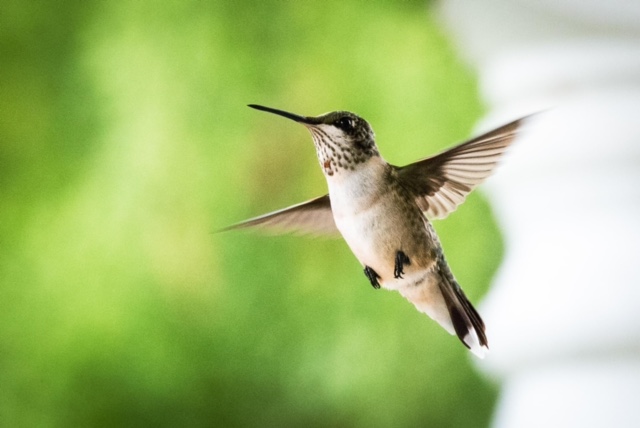
Bianka’s Hummer
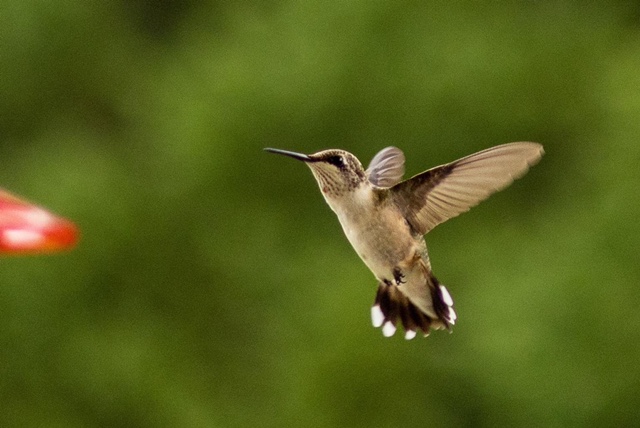
I find that nature offers the best self-care, meditative, and gratitude-giving opportunities. My sweet cousin, Bianka, a war veteran who now spends much of her time bike racing on BMX tracks with her twin brother, also a military veteran, who builds racing bikes, like his father did, now works to perfect her photography skills. That’s her hummingbird picture. It gave me time to stop to appreicate the delicate body, the exquisite little feet, the striations on the neck, and the moment in time when Bianka got this perfect photo of the little bird hovering near the sugar water feeder. When we take that time to appreciate the perfect details of the natural world, we begin to offer gratitude for what some may think of as mundane, but it helps us to be thankful for what we may think of as insignificant details of the world. Also, when we take time to offer thanks for the small things, it helps us to slow down from busy lives and be in a moment with ourselves. Try it.
Bianka Hummer 2
Consider camping as an outdoor activity where you get to interact with the natural world. Camping is one of my favorite pasttimes. It’s a time when I just allow myself to do nothing but breathe in the clean air, listen to the birds and other flying, loping, crawling, or jumping lives of the natural world.
Kelly’s Flock (a few of them)
My dear friend, Kelly, recently, acquired a flock of chickens to raise in his and his lovely wife’s backyard. Kelly told me about raising chickens, “It is therapeutic for me and I have peace when I am around them! I know they are just chickens to most people and is not a big deal, but I almost can’t put into words the joy these animals bring to me! I want many more, and one day, I will have chickens galore will be our theme!” I cannot imagine a flock of chickens being in more gentle hands!
Kelly’s Chickens at His Feet
Kelly went on to say, “I think the older you get the more you see the benefit of working to live and not living to work! We are in a world that is so disconnected from the natural things around us that we forget the incredible inner peace found in nature! We have lost the fact that nature is our kin and we have neglected that relationship.” Those are words that we Indigenous People live by, and those words coming from my dear friend Kelly mean the world to me.
I will end with a few of my daily affirmations that come from those around me who inspire me to improve:
I am curious to know something about everything and everything about something
I am thankful for…
I am courageous
I am living a great life
I am interested in everyone I meet (from my Dad)
I am valuable
I have wonderful friends who enrich my life
I learn great lessons from my loved ones
Today, I will learn something new
There are more, but I leave you with this great picture of a friendly kiss from Heidi, a dog who belongs to a business associate of my son.
The hounds of winter (Sting) linger where I live. The north winds blow the warmth from a seemingly sunny day, and the chill cuts to the bone. Relief from the grind of work comes from gathering with friends, family around the table enjoying a slow meal featuring a nice glass of wine.
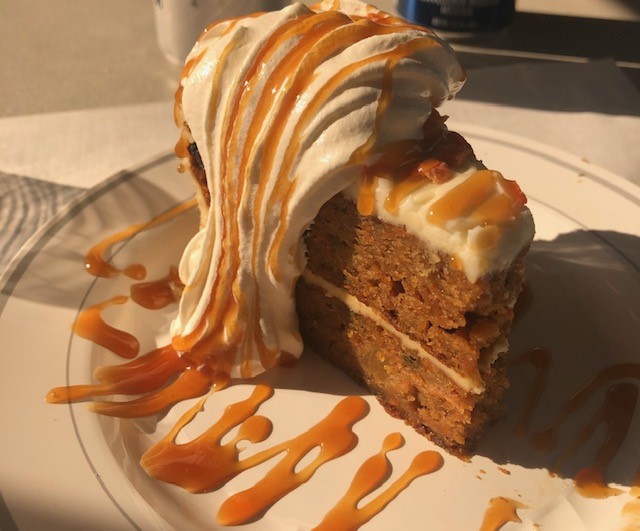
Since the holidays of winter my joy continues to be hosting family and friends. While conversations and food go hand-in-hand, I find the loving preparation of a meal to be an intense form of love, because I want it just right! Here, I offer some highlights from varying meals along the way, with pictures of food and company.
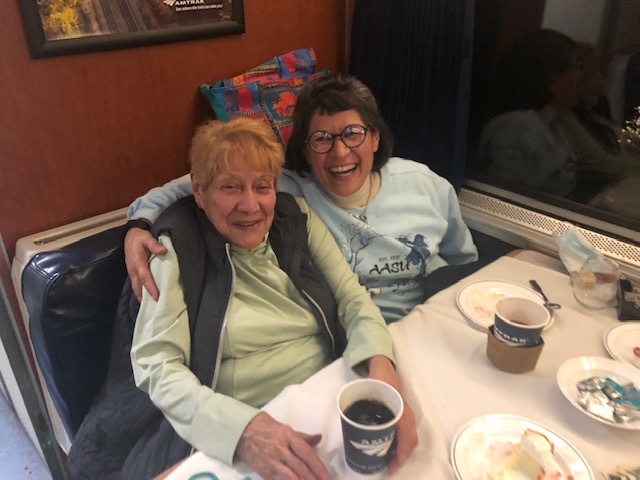
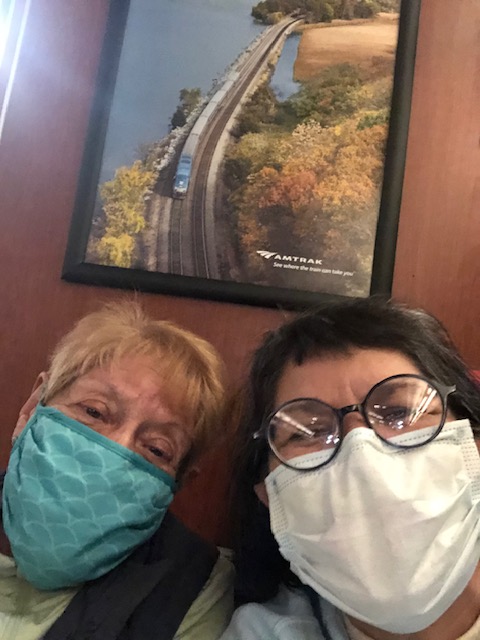
2021 proved to be a wonderful year for riding the train. In November, we boarded the California Zephr to Salt Lake City. We stopped in Grand Junction Colorado after passing through 31 tunnels in the Rocky Mountain from Denver. My 92 year old mother and her 84 year old husband boarded in Grand Junction. My mother had not ridden the Amtrak until this point. We had roomettes, so the meals were included, and the Amtrak works hard at assuring a great dining experience. Dinners come with a glass of wine, white linen table cloths, and the tables always feature a red rose in a silver vase. I love riding the train. It appears to be the one time that I allow myself to sit and do nothing but watch the world go by. Here, I share some lovely highlights from the trip. We arrived in SLC at midnight and departed for home a few days later at 3:00 a.m.
Early in January, we set out on the train to head to our friends in West New York. Amtrak’s Southwest Chief travels from Los Angeles to Maryland in its entirety. We boarded in Kansas City, MO, and it took us to Chicago for a five-hour layover, which afords the travelers some time for sightseeing in Chicago. Though, its Union Station provides some great history and a lovely environment. The lounges provide quiet or busy areas to relax with snacks and beverages.
I’ve read train reviews by a younger set of riders who appear to be in a hurry and are grumpy about less than perfect accomodations. Like a slow meal that one savors, I find train travel to be a time to savor. Why be in a hurry? I find it a great time to sit back, enjoy the passing scenery, eat lovely meals, and get in some reading or napping. Try it sometime. The life in a cozy roomette is like a gentle hug.
Back to the layover in Chicago. With the lake affect chills, we found it difficult to roam the city, so we made our way to a close restaurant to have a little bite to eat.
Sorry. I can’t seem to make the pictures smaller.
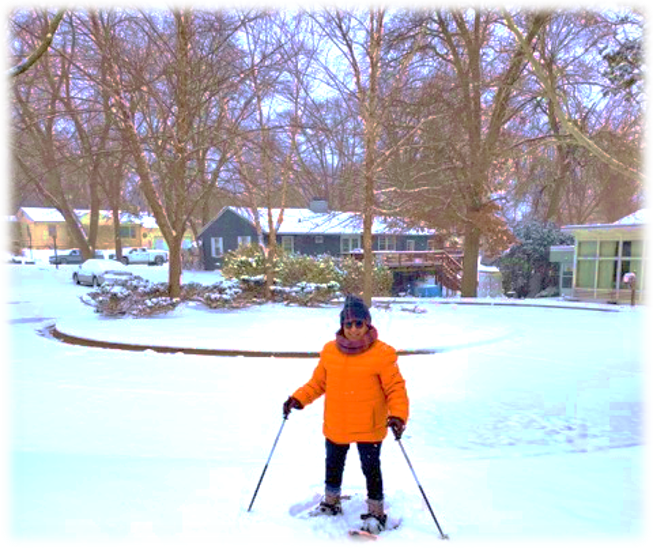
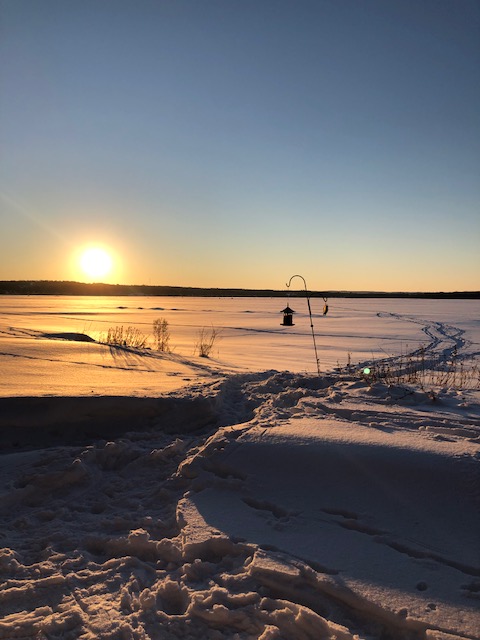
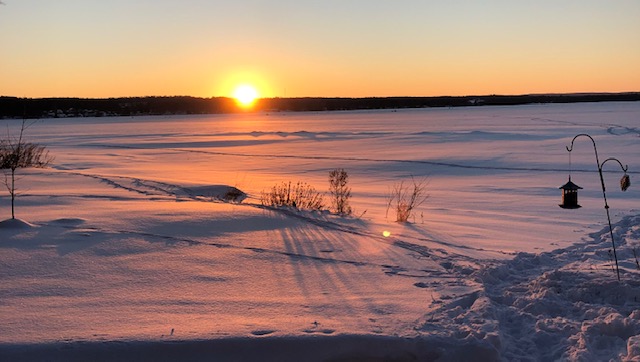
As we made our way to see our friends, we waited until 9:00 p.m. to board the next leg of the trip. We arrived in Erie, PA at 7:00 a.m., and we traveled 45 minutes to the cottage on the frozen lake. How wonderfully delightful that was. After a nice breakfast, we set out snowshowing on the lake frozen so deeply that it serves as a winter paradise of ice fishing.
We enjoyed a delightful time with our friends, with whom we’ve traveled to Alaska, the Gulf Coast, to Puerta Vallerta, and on many camping trips together. I love these friends.
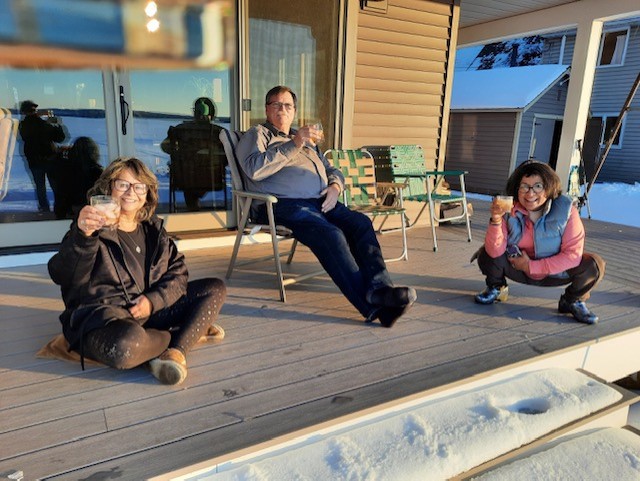
Well, I could go on and on, but I will leave you with a lovely picture of happy hour at 20 degrees Farenheit. Thank you for reading my blog.
When we think of a year that’s passed, it can be a good time to reflect on the past and to look forward in a new year. We can think about the good things that happened and contemplate any of the negative happenings. Of course, it does not serve us well to focus on our misfortunes, mistakes, losses, and other events that made a negative impact. However, it could serve well to give each of those challenges their due. I want to spend this space for reflecting on the year past and looking forward to year unfolding before us. Every year, I learn something new, and I give myself grace when I come up short. I will share some things I’ve learned and ask you to reflect on your life as well.
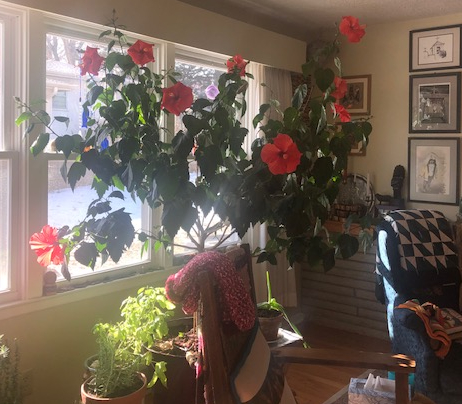
Blooming Hibiscus with Eight Blossoms
Reflecting on events of the past takes a Mindfulness approach. In the process, be a neutral observer. Think about what gave such an event a positive or negative impact. Notice how the event or interaction elicited emotions. How was that emotion navigated, or what was the response? The point in this reflection is to remind ourselves to be 1) a neutral observer to each experience, 2) Be patient with yourself: allow each experience to emerge at its own pace, 3) Have a “beginner’s mind” by experiencing the memory as if for the first time, 4) Trust and believe in your intuition and your ability to see things in a new way, 5) Take it as it comes without the need to win or avoid losing. At this points, just be; 6) Accept and see things as they are in the present moment; 7) Let go and detach from your usuall feelings and thoughts. Perhaps this is a way for us to slow down for a moment to recharge our senses.
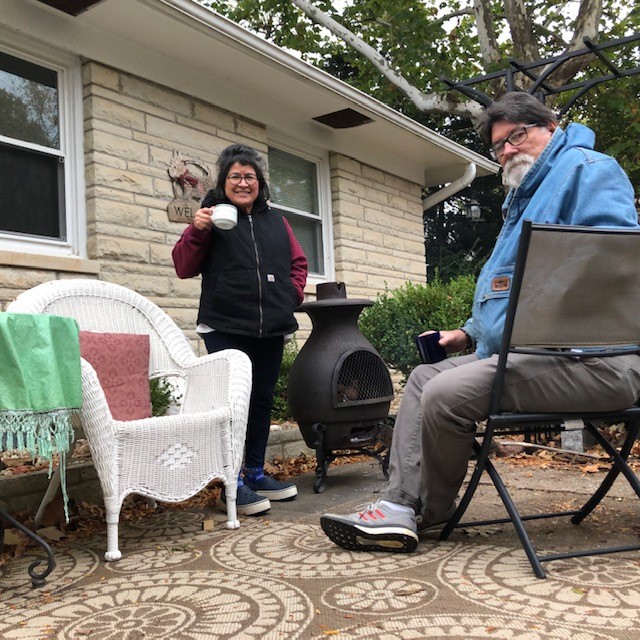
Enjoying a hot cup of tea on a crispy morning in front of the outdoor fire place
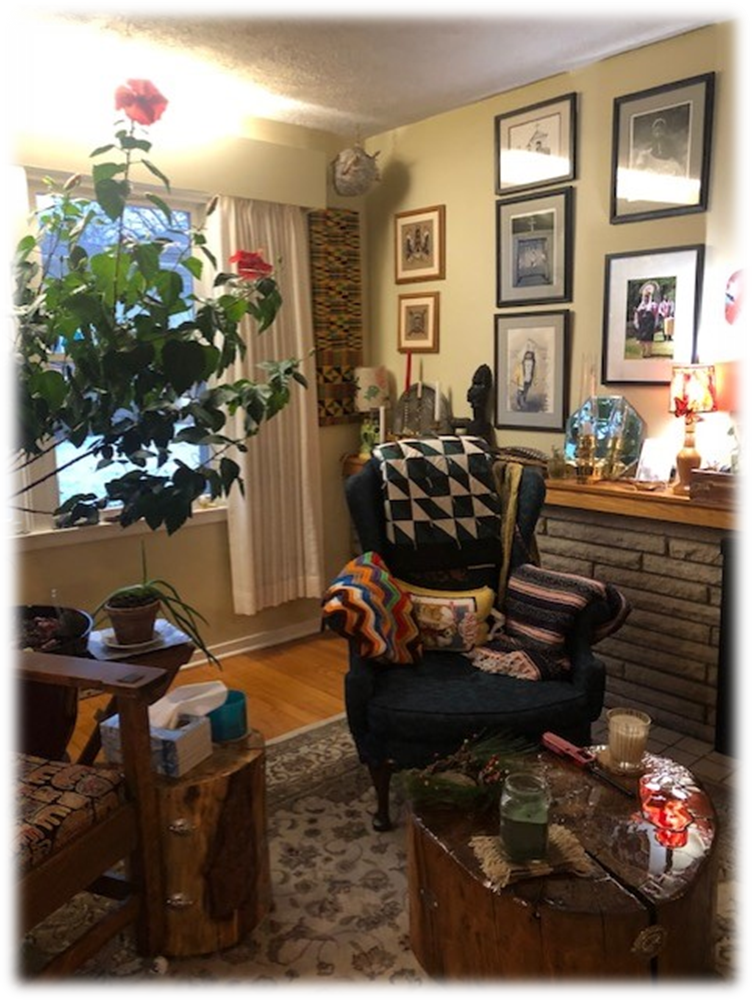
I’ve written about the “art of hygge.” Hygge is that danish word (Hoo-gah) that denotes comfort at the point of being cozy. Think of a hug! We get to decide on the characteristics of that hug. When the danish speak of hygge, they outline all the situations in which one can practice that coziness: our living spaces, our work spaces, and in outdoor spaces. I have designed my “living room” as a hygge corner.
Cozy Corner
Another way of practicing that sense of being hugged, is looking to the outdoors for rest and relaxation. Viewing nature as if for the first time can be exhilirating! Perhaps asking oneself, “Which season do I like best? Why?” I like to notice what birds are active in which season? For example, I’m seeing more juncos during the winter than in the summer. We see snow geese in the winter but not summer! Those are changes that are only noticed when one looks up or notices changes in nature. It such a thing is new to you, try it sometime. As another example, in the photo, one could ask, “Why is the sunset so red?” The answer: Dust and smoke in the atmosphere from fires and wind (in many cases).
A Kansas Sunset
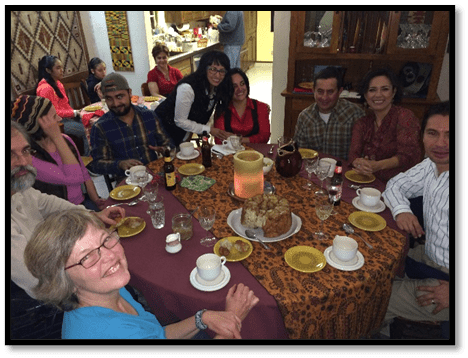
In a busy world where we are measured by how much we do, how much money we earn, and how we stand out as individuals (an individualistic society). I wonder if we would have less illness if we emulated that of a collective society (group oriented) and took the time to sit and talk, build relationships, and take more collective actions when it comes to governance. The concept of hygge supports that very thing, as does the Mediterranean way of conviviality. So what if we took three hours to consume our meals conversing around the table? Our lives would slow down, and we would take more time for ourselves and our loved one. I love the concept of “hygge with others,” which focuses on our relationships. While we have fewer opportunities to gether during this pandemic, and we’ve had to find new and different ways to connect with people, such as with on line platforms. When I think of “hygge” with others, I tend to think of gathering around meals. Sometimes it may be connecting through interest groups. Sometimes we attend a movie group, which meets online after participants watch the movie on their own. That is one way of connecting during a pandemic time. The meet up consists of questions by the facilitator. We found common themes through which we connected. A few years back, in a town where we spend nearly thirty years, we used to attend what we called, “Second Friday Cinema” at our local library. We picked nine movies for each of the months we met from September through May. We watched the movie together enjoying snack that each of us offered on a table. Unfortunately, that has gone away per safety measures. I miss those time, so I will share some photos of former gatherings and ways of enjoying our environments.
Friends at Table
My Home State
Setting a goal of practicing holistic well-being does take some discipline. For example, I made a pledge to myself to keep my house organized and free of clutter. That takes a lot of work! It seems that we get so involved in making a living, being a good employee, and meeting institutional goals that we forget to take care of ourselves. Now, all this sounds like I’m an expert at such things, I do teach about holistic well-being, but that means that I practice such things, and “practice makes perfect” as the saying goes. That’s the best we can do, and our best needs to be enough for us. That does not mean that we’ve reached a pinnacle. It’s just means that we keep trying. I saw a quote on practice the other day. The gist of it was that someone had asked the great cellist, Pablo Casals about his daily practicing at the age of 90 years. “After a stellar career and now at the age of 90, why do you practice the cello for the minimum of six hours per day?” Casals answered, “Because I think I am seeing progress.” Humans are not perfect. We work toward perfects, but perhaps too much, I wonder? I want to be the best for the world not the best in the world!
As one who identifies as Indigenous, the latest findings of Indigenous children’s marked and unmarked graves on the grounds of Native Boarding Schools across Canada and the United States abhors me, which can feed into generational wounds. Lately, I have been invited to offer lectures on the topic. Here I share with you some of my reflections as presented to church groups. Remember, I only speak with my Indigenous relatives. I do not speak for all Indigenous Peoples.
Residential Boarding Schools: We must acknowledge what happened to the First People of these Lands at the hands of Colonial Settlers
To all my Relations…
Following in the ways of loving one another, as any faith journey tells us to do, gives us a framework for our way of life. Our works of truth and reconciliation must mirror that. Like baptism, we must face the truths of our past, even when they give us discomfort. When we learn some painful truths, we must reflect on those truths rather than deny, wallow in guilt or point fingers. The painful actions of history belong to all of us… together. Again, the painful actions of history belong to all of us. I say that as one who is Indigenous to these lands to which I acknowledge: My homeland is the Uncompahgre Valley, Western Colorado, from where colonial settlers displaced my father’s people (Ute). My Mother’s people experienced the same atrocities in their homeland of what is now, New Mexico. In Kansas, I live and work on the ancestral territory of many Indigenous Nations, including the Kaw, the Osage, and the Pawnee. Kansas is currently home to the Prairie Band Potawatomi, the Kickapoo, the Iowa of Kansas and Nebraska, and the Sac and Fox Nations.
I am grateful to these Nations. I ask you to Please remember these truths
Bathe in the Beauty of Nature
Today, we take this opportunity, no matter who we are, and no matter from whom we descend, to face the pain of the past, to confess it, and above all, to learn from it and not repeat it. To tell the truth in love, as our Creator teaches, gives us pause to learn love’s excellent way of life and way of being.
What are the ways in which we can behave in actionable ways to follow the path of love rather than hate, rather than ignoring inhumanities, rather than justifying slavery and other exclusions and turning away from the practice of human hierarchies? We must recognize and acknowledge the wounds of Indigenous Peoples promulgated by governments, churches, and other institutions that join in the cause of separation and erasure. Then we must remove the barriers to access for all historically excluded identities. Only love, honor, and respect can dwell in the Creator’s presence, and we must join our hearts and hands to rebuild our communities of faith.
Let us move away from mere performance to authentic and measurable actions toward an equitable society where we honor and love one another as the Creator loves us.
In reflection, what makes me hopeful today are the Indigenous youth who are learning the spiritual teachings and the folkways of our ancestors. We promote generational healing through prayer and acknowledgement that we only survive in the light and love of our Creator and through the support of one another. When this society begins to acknowledge the truths that segregation, torture, abuse, and separation of Indigenous children is, by design, meant to erase a people not love them, the healing will begin.
A Healing Fire
Please note that of the 367 Native boarding schools in the U.S. 73 remain open, and 15 continue to board Indigenous children taken from their parents. Here in Kansas, we must acknowledge the following boarding schools and the atrocities fraught upon Native children: Haskell Indian Training School (now Haskell University), Great Nemaha Indian School, Kaw Manual Labor School, Kickapoo Labor School, Osage Manual Labor School, Potawatomi Labor School, and the Shawnee Mission boarding school. The goals of these schools promised to “take the Indian out of the boy or girl.” Graduation was never a goal, however survival remained a wish for the children. Again, The children who were able to leave these schools did not graduate! They survived!
We cannot heal in the places that make us sick. We can only heal, if the society complicit in Indigenous extermination can move away from greed and the concepts of superiority in order to teach a people that they are, indeed, inferior. I am hopeful because I am here today, with each of you, lamenting the wrongs of the past by governments and other institutions who do not follow the teachings of the Creator to “Love one another.” I ask you, How is genocide of a people, Love? How are exclusionary laws and policies, Love? How is justifying slavery, love?
Rev. Linda Nicholls and Rev. Mark Macdonald note that:
“The wrenching legacy of residential schools is felt not only by those who survived. It lingers in the pain of families whose children died while at school. It lingers in the agony of not knowing why they died or where they are buried. It lingers in the inadequate record-keeping that does not tell the cause of death. It lingers in the neglect to even record the names of almost one-third of those who died. For a parent the death of a child is an unimaginable pain.”
I ask you to empathize with the parents. Can you imagine such a thing to happen to you and your family?
My featured image illustrates the loveliness of our daughter, Riki. We lost her, nearly six years ago, to a stroke at the young age of 34 years. She would have been 40 on September 27. She had lived with atrial fibrillation for 11 years, and a new doctor took her off her medicine “to see how she’d do!” I had later read that taking someone off this particular heart medicine could lead to stroke. The new cardiologist simply listed Riki as a “non-compliant patient” to avoid any law suit. Left behind were three young children, a husband, and a loving family to ponder, “why?”
Riki was a leader. She exercised her voice to support and advocate for those who did not have a voice. She was a devoted daughter, sister, mother, spouse, and friend. She loved her work as a school nutrition administrator. Riki was full of energy, and she loved innovation in meal preparation and addressing life’s challenges. Some called her, “bossy,” because strong women scare those who do not have the confidence to put themselves “out there!” She worked hard, played hard, and loved hard, and that’s what made Riki unique and beautiful.
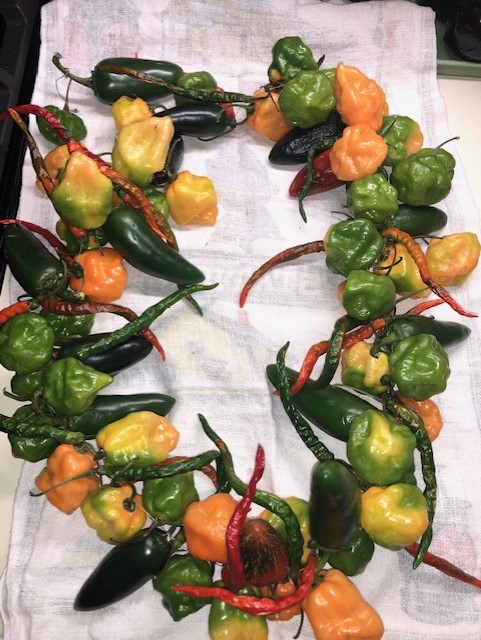
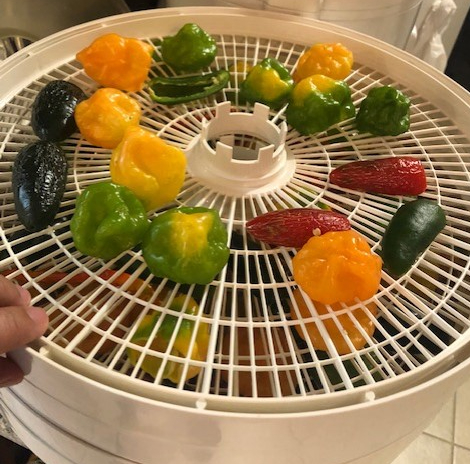
If my daughter learned anything from me, it was to gather friends and family to socialize around stories, laughter, music, and food. I learned even more from her about the stewarship of great friends. She hosted her “village” every Wednesday for a “taco bar.” She loved to cook, and she cooked fabulously. Her friends loved all that Riki was. One of Riki’s dear friends, Danika, began a tradition of making Riki neck garlands out of the peppers from the garden. A few years back when “the village” was celebrating Riki’s birthday, I was gifted with the chili necklace. I dehydrated the hot monsters, and I use the pepper flakes, very sparingly, in recipes calling for some heat. About a week ago, Danika did it again! She sent a chili garland! The chilies are bright and lovely, and the flakes proved to be quite potent! Behold, the color! I call the chili flakes, “Danika’s Chili Blend,” or simply, “Danika.”
Chili Necklace
Today, Riki’s boys work for Danika, Riki’s best friend, in the kitchen, at a local pub/restaurant. The 18 year old just started college, and the 17 year old is a senior in high school.
What we know is that she was a beautiful, unique, loving, and thoughtful person. Most of all, Riki loved her children and her spouse, Jonathan. They miss her dearly. We were lucky enough to get a visit from Jonathan and Sam, Riki’s only daughter, this past weekend. The “boys” have jobs, so were not able to make the trip. We honored Riki with meals around the table, as was her practice, and stories of her life.
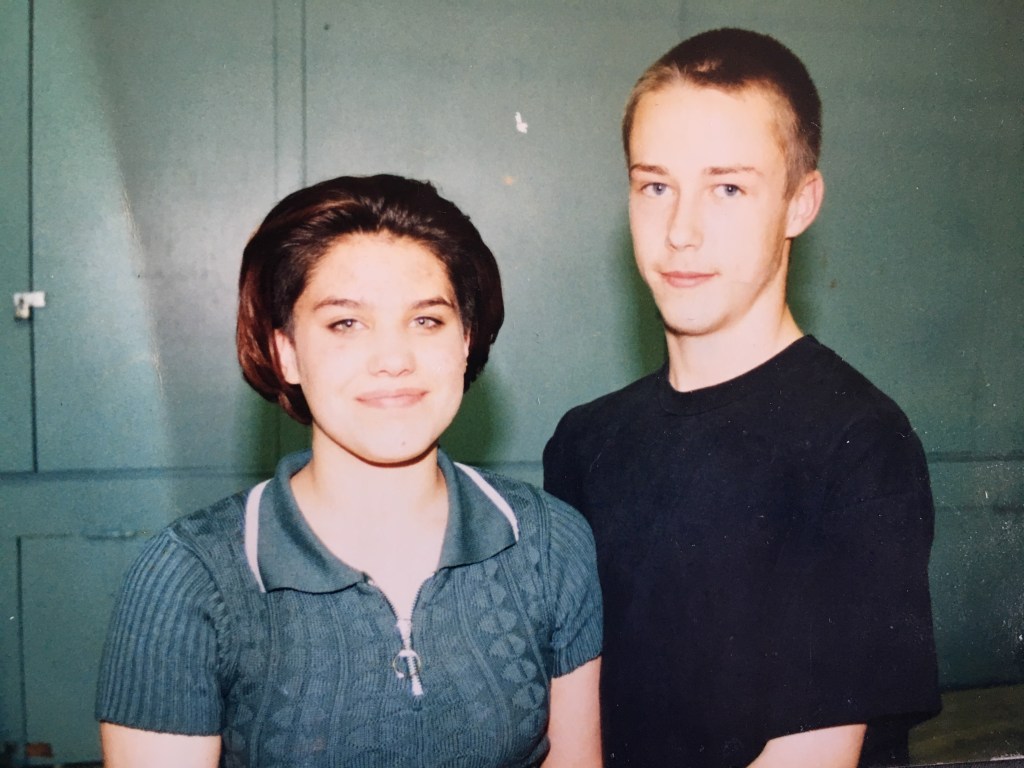
Riki and Jonathan in 7th Grade
While we tend toward daily thinking about our time on earth with Riki, we rejoice in that we see her so heavily in her children. While I know that our son-in-law will likely find love again, we see her influence in him, too, and we know that he keeps Riki in his heart.
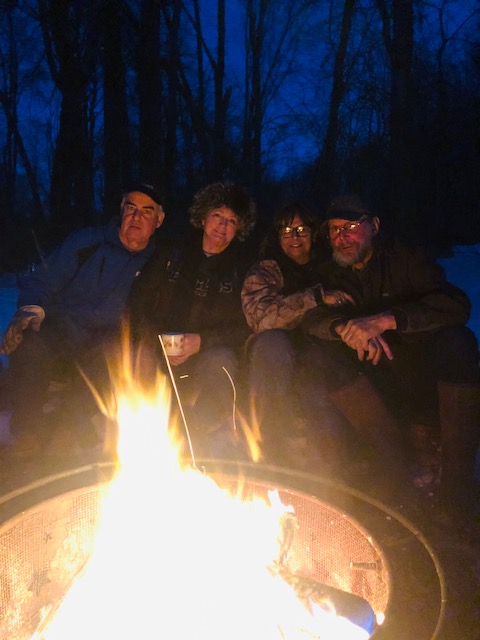
We will celebrate her birthday this evening with one of her favorite dishes: Fried chicken, mashed potatoes, gravy, and corn. One of the most lovely things is that she and her brother, Stevie, had a very close and loving relationship. He will likely celebrate his sister with a fire and tobacco blessings (from our Indigenous teachings). I look forward to the pictures that he sends when he has a fire. Come to think of it, we will have a fire, too.
My featured image is one I took from a car as I was about to board an airplane from Los Angeles International Airport. At one time, the Mid-century structure was used as a restaurant and remains a symbol of the airport. I like the “Atomic Age” design, which the light poles further establish.
My topic today explores a framework that we can employ in our learning processes of one another. National Geographic Society uses this framework to help people understand the concepts of geographical inquiry. The Society calls it a, “Learning Framework.” I adapted NGS’s framework for teaching self-awareness, which greatly improves how we interact with those who we see different than ourselves. I call it, “A Learner’s Mindset for Understanding Self and Others.”
Did you know there are people who do not recognize that they have a culture? This continues to be a heavy subject in my teaching. Teaching cultural awareness required that I create/adapt this framework. Usually, I present this in a table for easy usage. Here, I present the framework in narrative form. The framework focuses on three elements: Attitudes, Skills, and Knowledge each with three subheadings.
A Learner’s Mindset for Understanding Self and Others
Attitudes
Curiosity: Engage in an on-going process of learning about yourself, about others around you, and about the environments (spaces) you and they inhabit.
Responsibility: Have concern and care for the well-being of other people, their journeys, and their experiences.
Empowerment: Understand your unique lived experience. Developing shared experiences builds self-confidence in social interactions. Empower others by internalizing that “different” is not bad or threatening. State your opinions and listen to others.
Skills
Observation: Create a framework for knowing through the “mental” gathering of data, which informs our daily behavior and interactions. Are you able to observe without judgement?
Communication: Use language and media that speaks to truth, historical uses of words, and implications of wording in spoken language, writing, visual, and audio media. Apply this mindset to advancing learning about self and others.
Relationships: Collaborate across disciplines to advance understanding. Listen to re-state the main points and to find common ground. Above all, build and value your relationships, which dissolve the lines of difference.
Knowledge
Understand the Human Journey: No two humans have the same journey. Share the story of your journey. Listen to the story of another person’s journey. All humans develop their preferences, their ways of knowing, and their observations of others depending on their journeys. Do some humans have an advantage over others based on their journeys?
Understand the Interconnected Human Systems and their Dynamic Forces: Seek and internalize frameworks of information to discern between truth and convenience. Discern the quantities, patterns, rhythms, and symmetry in human systems. How are they unique, and how are they related? How do they change over time?
Acknowledge and Celebrate Human Difference: The social construction of hierarchies, class, and race historically benefit some groups and put others at a disadvantage. We can build relationships across these social barriers to see one another as individually contributing to the social fabric of humanity. Celebrate this.
This may not be the answer to every little thing in human interactions, but I do believe that it can be a start in our interpersonal relationships with those from cultures different than you own. Yes! Every human has a culture! Simply put, our cultures come from our knowledge and beliefs systems. Culture comes from our patterns of behavior learned from childhood, our language, our symbols and institutions. Culture is created, learned, and shared. Thrown together, the definition of “culture” seems to challenge people. To some, “culture” might seem an abstract concept mostly because some do not think about what constitutes “culture”
Sit down and think about your own patterns of behavior. Where did they originate? Human difference is a marvel. Celebrate it.
This week I am part of a conference called, Cambio de Colores, Change of Colors. The conference focuses on the Latinx diaspora. I presented on topics of adaptive and culturally relevant practices theory and youth development identity. My focus for my workshops in this conference was on Indigenous peoples in the Native diaspora of the United States. The topic idea of this blog came from one of the plenary speakers, Dr. Maribel Alvarez, whose topic was food ways of, mostly, Latinx peoples, but I thought it certainly generalized to me and my Native identity, as it does to other identities. The speaker said, “We [often] use food as a tool to find common ground.” She added, “Sharing food is one of our greatest secular rituals.” Brilliant! That has been my practice since I began my active life in the Kitchen.
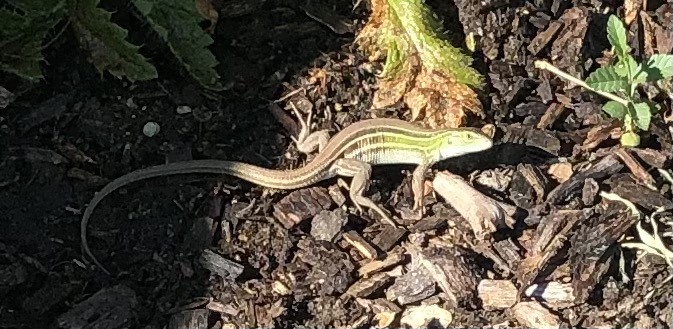
My work in the garden this week gave me much to write after having spent much time in the kitchen this week. My featured image today shows the six-lined racerunner (lizard) running through the vegetable and herb garden. It proved to be nice company. Now, I back up to two weeks ago when my neighbor shared oyster mushrooms. She, apparently, enjoys the bounties of a friend who grows these beautiful fungi, so she shares her abundance with me! I so love the umami that edible fungi add to food dishes, so I prepare something immediately when my neighbor shares, and there remains some to preserve for future use.
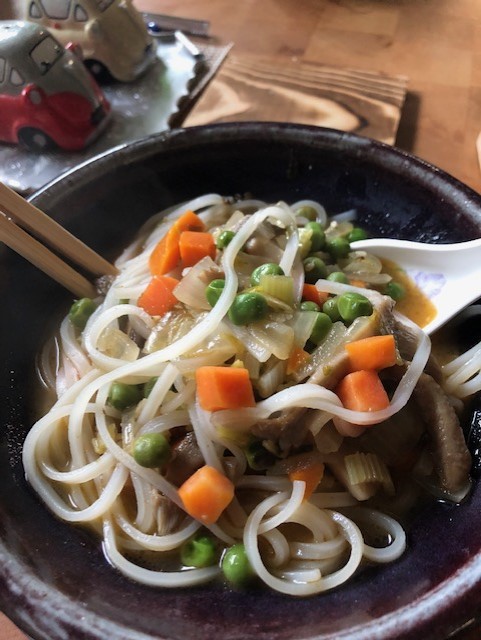
For the rice noodle soup, I began by chopping the lovely mushrooms, and adding onions, garlic, celery to sauté in butter and sesame oil. When all was fragrant, I added peas and carrots. While I cooked the mushrooms and veggies, I soaked the rice noodles in warm water. Once all the veggies were smelling most fragrant, I added two cups of vegetable broth. (You can use any type of broth. I just happened to have the vegetable broth in the freezer that I prepared from a windfall of veggies. I let the veggies and broth come to a simmer, and then I added the softened rice noodles. I added soy sauce and let it simmer for one minute, or so. It made a lovely evening meal. To finish my preparation with the mushrooms, I sautéed the remaining mushrooms in butter and put them in the freezer so that I have them for the next meal that calls for mushrooms, such as marinara sauce or in macaroni and cheese, or what ever dish calls for mushrooms.
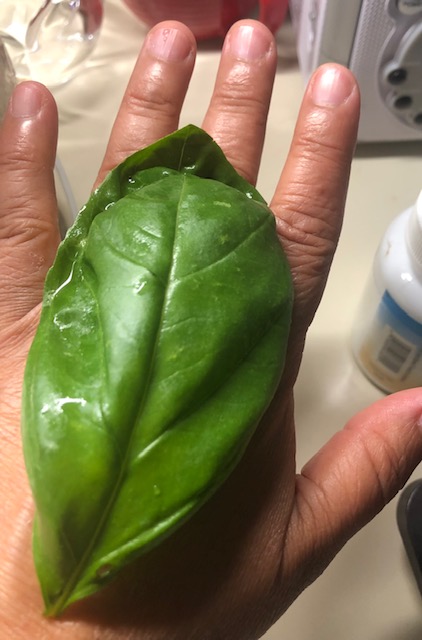
Well, I wonder if your garden is beginning to produce herbs and vegetables. I am not sure why, but I seem to over plant basil. This year I have giant basil. I took a trip to a community garden plot that went in the ground about two weeks before I planted the one in my yard. This garden, planted by colleagues as a learning opportunity for urban students, is crazy with herbs, squash, and peppers. I picked basil, spearmint, cilantro, and parsley along with a few strawberries (eaten on site!) and three zucchini.
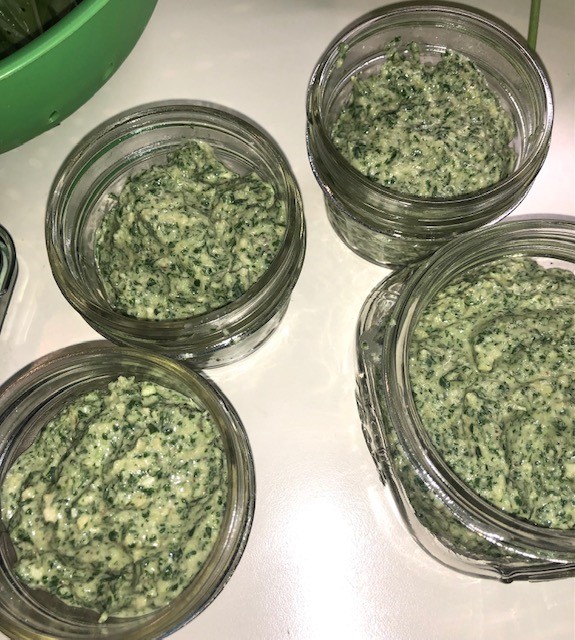
Basil and mint come from the same family of square-stemmed plants. Others in the mint family include thyme, lavender, lemon balm, oregano, and marjoram, to name a few. I began preparations with the mint. I made mint pesto. I thought it would pair well with lamb. Think of preparing the traditional basil pesto.
I took five big hands full of mint. For recipes like this, I rarely measure or weigh the ingredients, so these are estimates for Mint Pesto:
Three packed hands full of fresh mint, parmesan cheese, salt, pepper, harissa (combination of peppers), garlic, olive oil, small amount of lemon juice, and two small hands full of mixed, raw nuts (almond, walnut, hazelnut, pistachio, and cashew). Be sure to omit any nut if you have a concern about allergens. I like using raw pumpkin (pepitas) seeds for pesto. Use what ever you have on hand. Blend until smooth and aromatic.
The pesto blended into a beautiful sauce easily frozen to later thaw in the vibrant color it had before freezing.
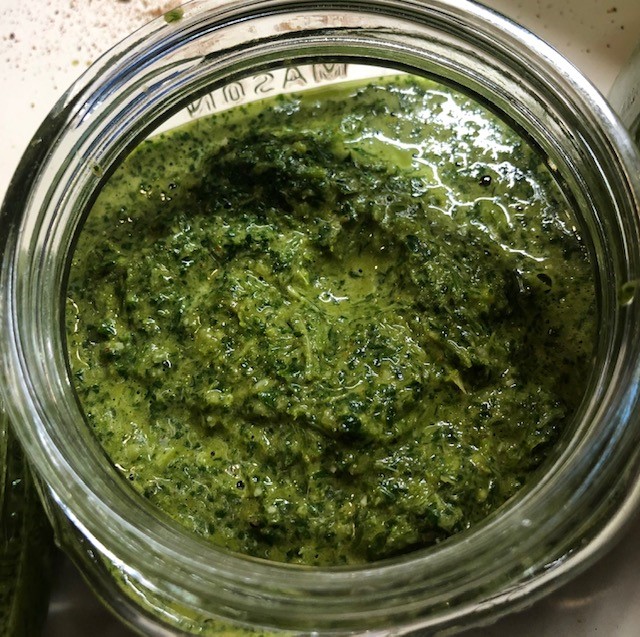
With the abundance of cilantro and parsley, I made chimichurri sauce, popular in Uruguay and Argentina. The delightfully green sauce pairs well with grilled meats. I like it on fish and shrimp tacos. Actually, it’s so fragrant as I blend it, I can’t help but take a spoon full just like that! I have changed the recipe a bit from what I hear is the authentic recipe from Argentinian ingredients:
1/2 cup olive oil
2 Tablespoons red wine vinegar (I like to substitute with sherry vinegar)
1/2 cup finely chopped parsley (In addition to the parsley, I also added about the same in cilantro)
3-5 cloves of garlic (for this batch, I used a combination of onion sprouts and wild garlic, pictured below)
2 small red chilies (I was out of red chilies, so I used 1/2 teaspoon of harissa, which combines chilies with peppers)
3/4 teaspoon dried oregano
1 teaspoon salt
Black pepper (That is in my harissa)
Now, after I made my Chimichurri, I learned that one does not process in a blender. Oops! I did! Instead, I should have chopped everything and let it sit in the oil and vinegar for a few hours to bring out the flavors. I will do that next time. Here is my finished product, though I will do it “right” the next time. I am told that those in Argentina use it for basting, rather than marinating, as the meat is on the grill. It can be used to finish the meat just before serving. Again, I like it on fish or shrimp tacos. Chimichurri freezes very well and retains its bright green color when thawed. Thaw it in the refrigerator about three hours ahead of intended use.
Farmers markets offer great variety in seasonal vegetables and fruits, if you do not have your own garden. The asparagus in my garden was planted last year, so I did not get any sort of a crop this year. Hopefully next year. Our farmers’ market yielded great asparagus this year. I’ve been playing with it in my pasta recipes. As I play around with different iterations of a recipe for asparagus-based pasta, perhaps this may interest you.
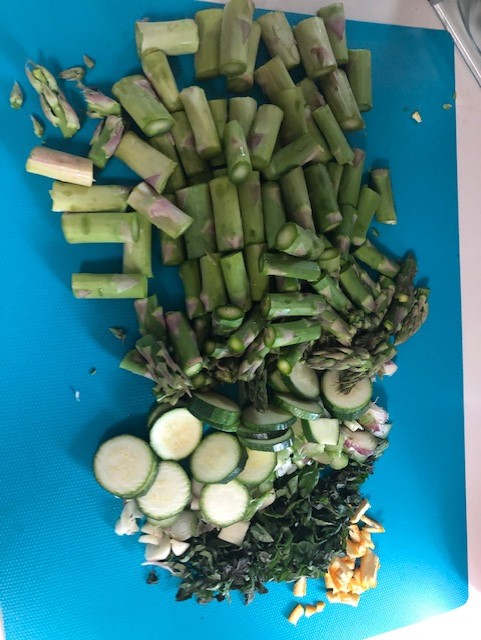
Chop onions, garlic, flowering chives, mushrooms (thawed from the frozen oyster mushrooms previously prepared), a tiny zucchini, for this recipe. I think one can be quite creative in making this.
I start with chopped bacon or ham as my base for flavor. Then I add the veggies. Then I add seasonings including my prepared pesto. Once all the veggies are added and have cooked for a short while, I add a half cup of white wine and cover for a short simmer. Then I added parmesan cheese and cream. Allow to thicken, then serve. It goes well with a crisp Sauvignon Blanc. I served the sauce with rotini, this time.
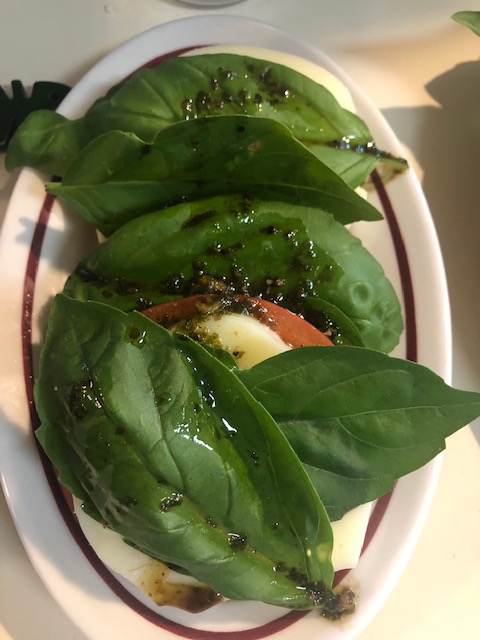
Finally, I leave you with one more of my dishes from the bounty of the garden, already over flowing with basil. Caprese salad appears in a few iterations. Its simplicity makes it a lovely, fresh salad. I like mine ever better when I make the cheese myself. With temperatures hovering in the high 90s (Fahrenheit), I opted not to stand over a steaming kettle of whey and cheese solids. The grocery maintains a nice stock of fresh mozzarella. Large tomatoes are not setting in the garden, either, so this comes from the produce section.
Simple ingredients: Sliced tomato, sliced mozzarella, and fresh basil leaves. Look at the size of my basil leaves!
After I arrange my three ingredients (cheese, tomato, and basil leaves) on the plate. I mix a dressing of my prepared pesto with some balsamic vinegar and salt and pepper. Then, I drizzle the dressing over the salad. I find it to be a heavy salad when eaten prior to a meat-based dish. I tend to have a caprese salad with a lighter or vegetarian pasta-based main course. The gigantic size of my basil leaves hides the other two slices of tomato and cheese.
I hope we found common ground with one another through sharing recipes. My next entry will focus more on sharing such meals with friends and family.
































 Human Ecology: People, Foods, Travel, Culture, and Social Justice