Distinguished Alumni!

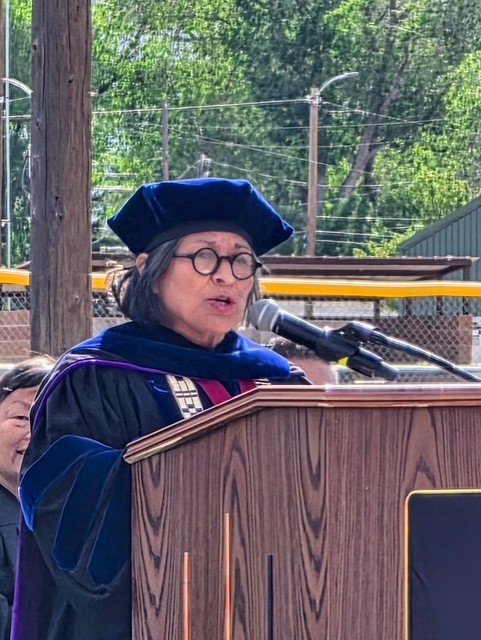
On the 50th anniversary of my graduation from Montrose High School, I was selected as a “Distinguished Alumni!” I remember that my sister, Eileen, had nominated me two times, but that was about 5-7 years ago. It was so great. I set out to write my speech to the 2025 graduating class and their families. I strove to make the points that everything one learns in high school, in deed, all our school days, can be applied to our adult lives. I hope I made the points.
May 18, 2025

Members of the Montrose County School District Board, President Fishering, Montrose Education Foundation, Inc. Members, Superintendent, Dr. Stephensen, Principal Voehringer, and Montrose High School Graduates, I am honored to stand before you today as the recipient of the Distinguished Alumna Award. 

First, I want to acknowledge that we stand on the original lands of my Father’s People, the Ute.  Please remember this truth. 

Graduates: You reached another great milestone in your lives.  Have you asked yourselves: “Where will I be in 50 years? What will I be doing?”  Well, as a graduate in 1975, 50 years ago, I didn’t ask myself that question either!  I never dreamed that I’d be standing before you these 50 years later.  My sense of determination, learned from my parents, is what brings me here.  I don’t know if you still do this, but we had to talk to the guidance counselor regarding our futures.  In my exit interview, the first words out of my guidance counselor’s mouth were, “I guess you’ll want to go work at the candy factory, because I don’t think college is for you.”  He didn’t really know me!  I was a 3.75 gpa student, but luckily, I had great teachers in my school days who saw me in a different light.  Everything we learn in elementary, middle, and high school prepares us for our futures.  Those years prepared me for who I am today! 

My middle school English teacher, Mrs. Bowers, recognized my gift for language and encouraged me to stay the course.  I wrote my master’s thesis, The Origins and Traditions of Foods in Charles Dickens’ Great Expectations, because Mrs. Heavers did a great job of helping us fall in love with literature.  I wish Bowers, Heavers, and Seivers, my English teachers, knew that I was an English teacher for 12 years at a community college.  

I love math, because of Mr. Saults, my 9th grade math teacher, taught with humility and a little humor.   I wish he knew that he laid the ground for me to love numbers and use those numbers in my quantitative research! 

Je parle français parce que j’ai pris deux ans avec Mademoiselle Halverson, et que je continue à utiliser cette langue dans mon travail aujourd’hui avec des refugies du Viet Nam, d’Haiti, du Senegal, et de la Cote d’Ivoire.  

French class was great!  We produced Neige Blanche et le sept nan!  I was cast as one of the dwarves!  (chante: hi ho, le temps c’est q’il fait beau…) 

I continue to sit in the front row at any program, lecture, or event, because Mrs. Sievers, my 11th grade English teacher, suggested it. 

I retired from Kansas State University after 20 years, and now I have the honor of teaching geography at Haskell Indian Nations University.  How did all this happen? 

I stand before you, with years of education behind me, and working in academics as a professor and researcher because David Walter Bauguess, my high school choral teacher, told me I was destined to do great things.  He used to call me “Dr. Debby.”  He loaned me his master’s thesis so that I could digest concepts of academic writing. He made it a point to honor each of my graduations with thoughtful reminders for me to believe in myself.  My brother Danny, a wonderful musician himself, and I were founding members of The Bel Canto Singers, under the direction of Mr. Bauguess.  He encouraged all of us to do great things. Sadly, we lost Mr. Bauguess on December 27, 2023.  David Bauguess would laugh at my bringing all of our music programs from 1971 to 1975 with me today.  The Bel Canto Singers performed its last of 1975 on May 20, shortly before graduation!  We even performed at our baccalaureate (sing a few lines of The Road Not Taken). I have our record album here, too! When the Japanese wrestlers came to MHS to compete against our wrestlers, Mr. Bauguess taught us the Japanese National Anthem (Sing:  Ki me ga a yo oh wah…). 
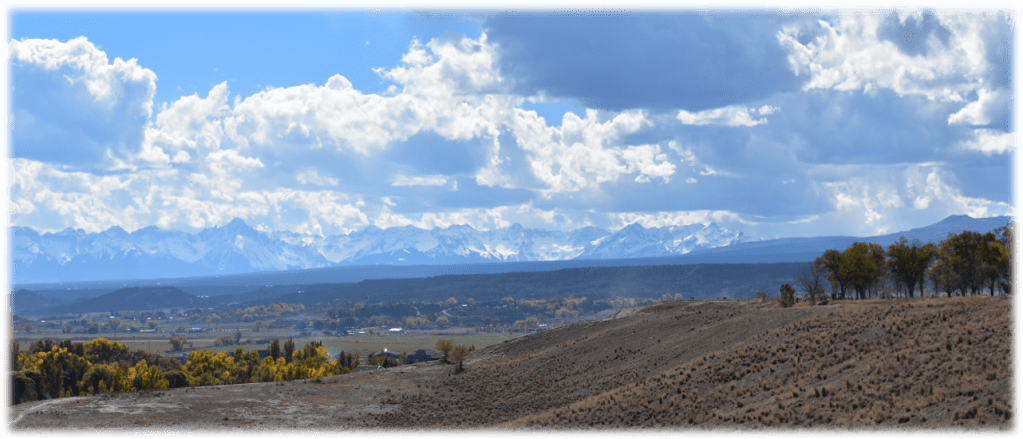
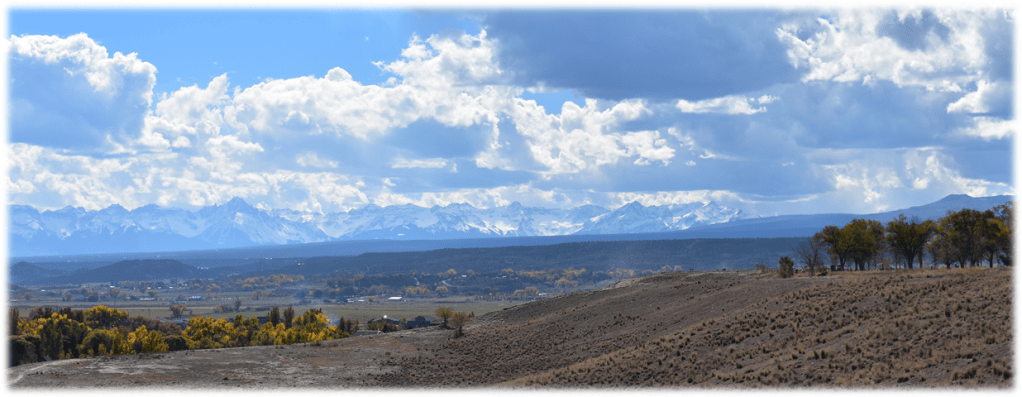
The lovely backdrop of my speech, indeed, my home: The San Juan Mountain Range

My parents were my strongest teachers.  My now 95-Year-old Mother Tina encouraged my imagination.  She never told me that my two imaginary friends, Deddie and Knocky, were not real,  and she even set the dinner table with a place for them.  She also modeled hard work, and we learned from that.  My Dad, Frank, modeled voracious reading and study.  He read National Geographic Magazine from cover to cover.  Sadly, Dad passed in 2007, may he rest in power.  Dad didn’t know that I was awarded National Geographic Explorer Scholarships in 2017 and 2018, joining other explorers like Jaques Cousteau, Sir Edmund Hilary, and Alexander Graham Bell.  And Dad had passed by the time I received my Ph.D. in Geography. 

Later today, I have the honor of attending Olathe High School Graduation, where my Grandson Dellon Nusz graduates at 12:30.   Graduating today from MHS are my niece, Alexis Hernandez and nephew, Hayden Hensley.  So, I am honored to have many of my family members here today.  Each of whom continue to be great inspirations to me.   

Graduates, my greatest message to you today is.  Always know who you are.  Study your ancestry.  Know how things work, whether it’s machines, political arenas, the mechanics of language, or about finances. Know why numbers are important.  They tell us the truth. Practice gratitude every day.  Honor your parents, your leaders, your teachers, your family, your siblings, and yourselves!  Use your voice to stand up for yourselves and others.  Be interested in everyone you meet, and finally: Know everything about something, and know something about everything.  Congratulations on your hard work to graduate high school.  I pray that your futures are bright.  Go Redhawks! 

July 2025

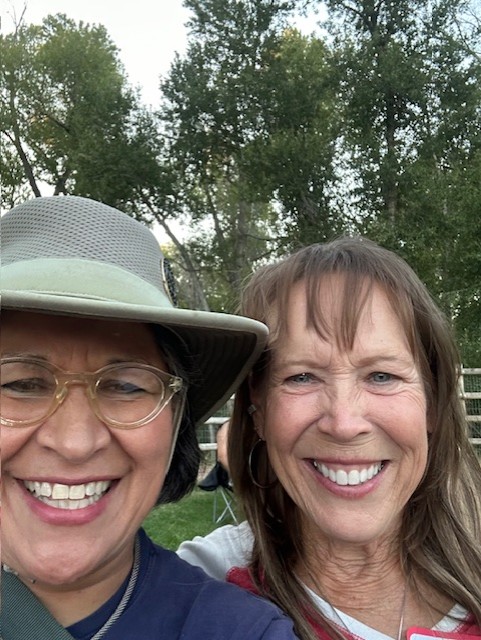
My graduating class hosted its 50th class reunion. It was great to connect with high school mates, and to see where we are 50 years later. Of the beautiful friends with whom to connect were my best friends Roy W. and Lynnae C. My brother Danny and I were in the same friend groups. Here we are.
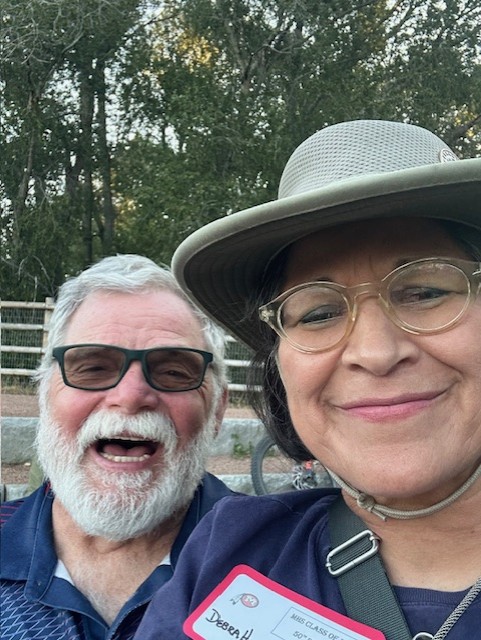
Roy and Me
Lynnae and Me!
Roy and my brother, Danny

Thank you for reading my blog.

A Life Cut Too Short

My lovely daughter, Riki L. Warner, would have been 42 years old today. We’re coming up on eight years of her passing. We continue to wonder what would have been had her medical care team met her needs and better served this young mother who left behind three beautiful children and a loving husband. I suppose we never should ponder such questions.

The top image features my necklace with Riki’s picture. The compass rose, given to me by Lynn, not only represents my occupation and passions as a geographer, but I love that it sits next to Riki as she was my north, my south, my east, my west, my working week, and my Sunday rest, so the W.H. Auden poem goes. The Zuni turquoise inlay ring represents the drum, so important in our (Native) ceremonies and prayers.

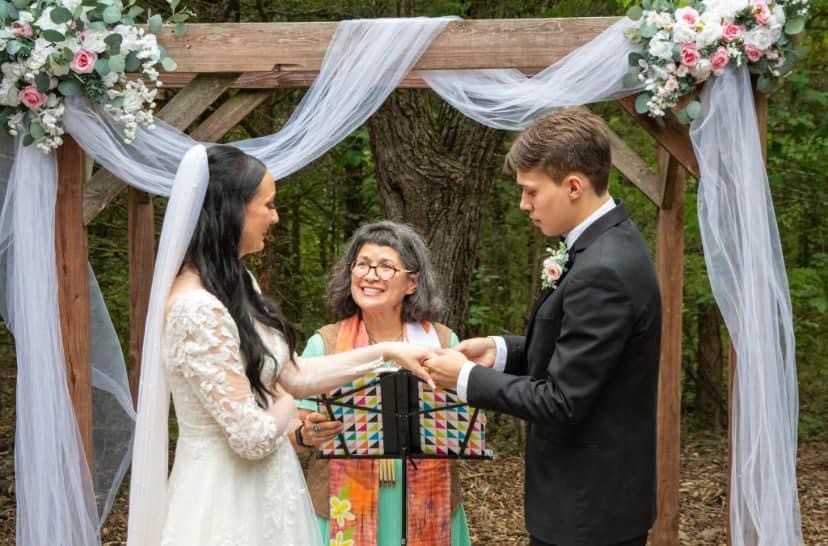
The past two weeks have been those of family gatherings and celebrations. On September, I had the honor of officiating my nephew’s wedding in Southwest Colorado, and then this past weekend, I officiated my grandson, Shawn to his bride Gracie. Shawn is Riki and Jonathan’s middle child. His empathy for others shines as his super strength. My sister, Eileen, joined in the celebration which took place in Southwest Missouri. Yes! We had a busy week.

I will have to write about the first wedding later, but my focus for this is to highlight Riki’s son, Shawn. This would have been a major event for Riki to see her son married. Shawn and Gray have known each other since middle school. Similar to Riki and Jonathan who met in 6th grade and had been married 12 years when she passed from a heart condition that doctors did not take seriously, because, “She’s very young and may grow out of it.” Who says that. We found out later that she should have had a defibrillating pacemaker. I now share some lovely pictures of the wedding. Here’s Riki with Shawn as a sweet child.

Jonathan sat next to this picture for the ceremony. I thought it such a great tribute to Shawn’s mommy. Shawn’s brother, Korbin, my eldest grand child was the best man, and gave a lovely speech to his brother and new sister-in-law at the reception.

Everyone felt Riki’s presence at the wedding. Her children made her proud on this beautiful day. Sammy and her friend Darrell distributed the bags of bird seeds on the chairs for the recessional. That was fun, and my sister Claudia made the bird seed bags.

Maybe it’s not everyday that a grandma gets to officiate her grandson’s wedding. My son, Stevie, took his nephews to his special barber for their wedding haircuts the day preceding the wedding. My sister gave me tremendous emotional support and great suggestions. Riki’s “Village” was there to celebrate Shawn and remember their dear friend, Riki. I am so grateful to those young families.

Stevie and Dianna entertained Eileen and me, after the reception, with hilarious talk and Stevie’s rendition of Tony Montana from Scarface! Who knew this bittersweet celebration could be joyous and sad at the same time? We make the best of our situations everyday while we greatly miss our Riki.

This time last year, one of Riki’s school friends wrote to me on messenger. Joey told me that he thought about her in so many different situations. The greatest gift Joey gave to me was to say, “Thank you for bringing Riki into this world.” Such a kind and beautiful thing to say to a grieving parent. Riki, we miss you everyday.

Thank you for reading my blog.

Travels with Eileen

My featured image is one taken on the patio next to my building on campus, which is two years old. The dear dragonfly landed on wet concrete, lost his life, but left a lovely image that one can enjoy when sitting on the table next to it. The dragonfly lives on…

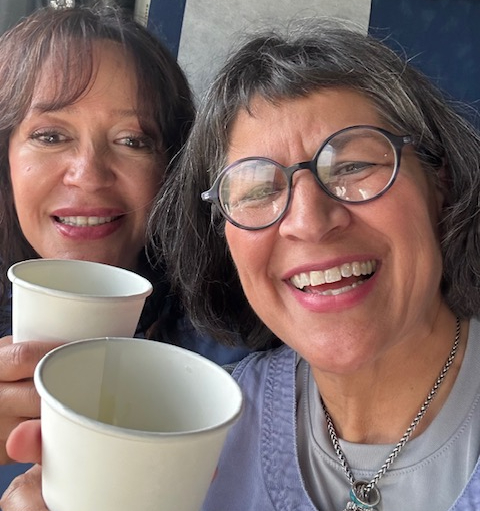
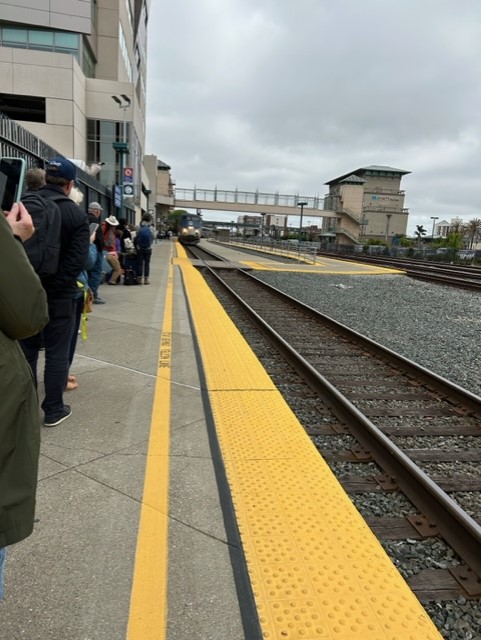
This long read functions as my trip diary. My summer began on May 13, 2023. The graduate school has its ceremony on the second Friday in May, so the next day, I headed to Colorado, to celebrate Mother’s Day. On Monday the 15th, my sister, Eileen, and I boarded the California Zephyr to head to San Francisco. I love riding the train, which I do quite often. It was my sister’s first time on the Amtrak. The train departed at 4:10 pm, and away we went. Before we embarked, I mixed a cocktail for us to have a toast to our journey. We settled for paper cups since I had no access to proper glasses.

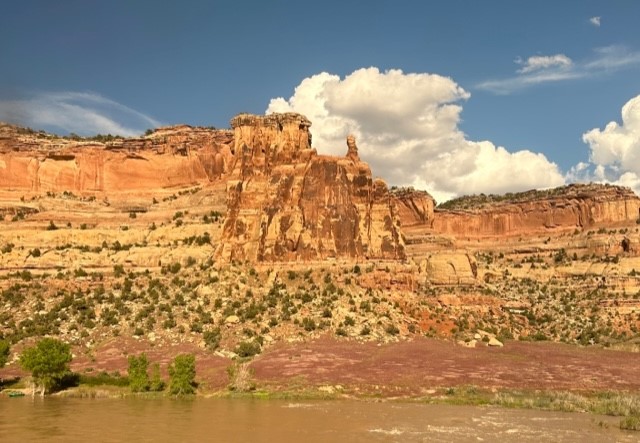
Some of the beauty seen along the way includes the magnificent Colorado River, fabulous geological structures, and brilliant colors. I care not for the rafters on the Colorado that insist on showing the Zephyr passengers their breasts and butts! None too impressive.

We had lovely meals on the train, as per usual. The meals come with the roomette, which is for two passengers. One of my favorite things about train travel includes permission to self to sit and enjoy the ride. I usually bring a book for the return ride, but my sis and I talked the whole way, both directions. I love meal times, too! There are four to each dining table, and when one’s party is two, one gets to meet two other people to be dining partners. This was my 10th train trip on the Amtrak system in the U.S., and I still think that the most friendly people ride the train. At least those remains my experiences in the dining cars and in the observation cars.

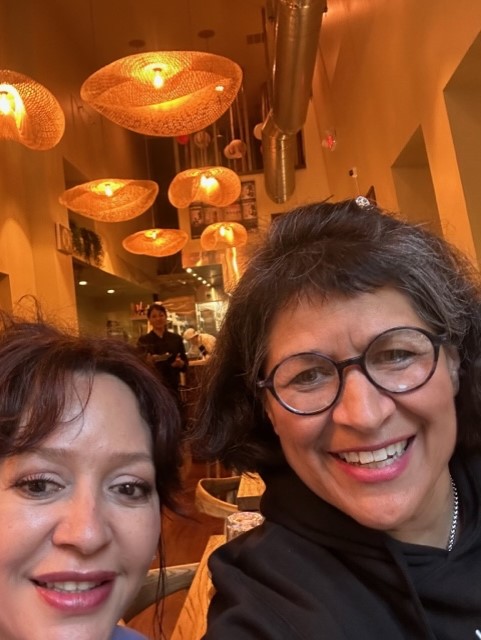
We arrived in Emeryville 24 hours from embarking in Grand Junction, CO. Passengers heading to San Francisco must take a bus across the Bay Bridge to get to the City. We lodged into our hotel by 6:00 p.m., cleaned up, and went hunting for our first dinner in SF. Not far from our hotel, at the entrance to China Town, we found a lovely Asian bistro, called, NOMA. Great staff, and great food. Here’s a glimpse:

We turned in early for a big day on our first, full day. I like to travel with a bit of food, just in case, so we made coffee in the room, and we ate energy bites that I made for the trip. One little “bite” has oatmeal, raisins, cinnamon, honey, and almond butter. Mix all the ingredients and form into spheres about the size of a golf ball. They taste delicious, and just one makes a great breakfast with a hot beverage. That gave us energy for a long morning until lunch.

Our hotel was not too far from Pier 1 on the Embarcadero, so we went the opposite direction on Bush to head toward The Golden Gate Bridge on the opposite side. We walked by retail spaces, auto repair and sale garages, beautiful homes, and tourist attractions. We walked past the homes on Nob Hill and the area surrounding Lombard street. We checked on the prices of those homes for sale. Even the most “simple” homes were priced at 9 million! We marveled at the gardens (a.ka. “yards”) in front of the homes with fruit trees, wild growing rosemary and fennel, and tropical plants. Once we gazed at the Golden Gate Bridge, we began to descend the many stairs toward the Palace of Fine Arts.

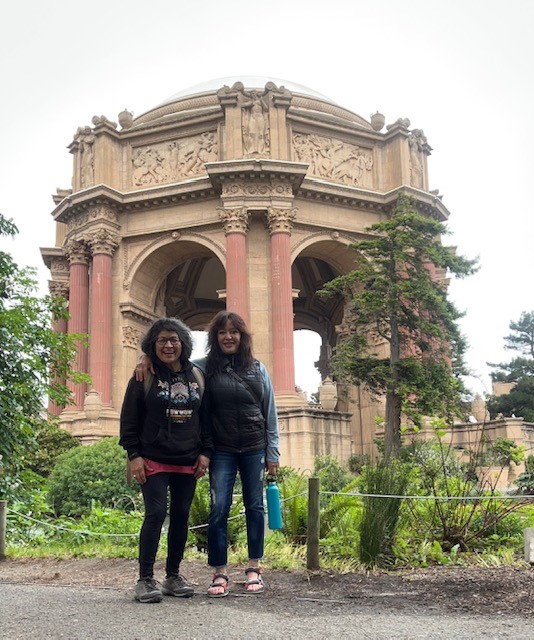
Travels with my sis, Eileen, proved to be a most marvelous time, because she is curious and interested in her environments of flora and fauna. We loved the beauty of the Palace of Fine Arts, built for the 1915 Panama-Pacific Exhibition. From there, we could see most of the peninsula that is San Francisco. All this walking, and a little bit of foraging on the edible flora, we became hungry, so we headed to Fisherman’s Wharf.

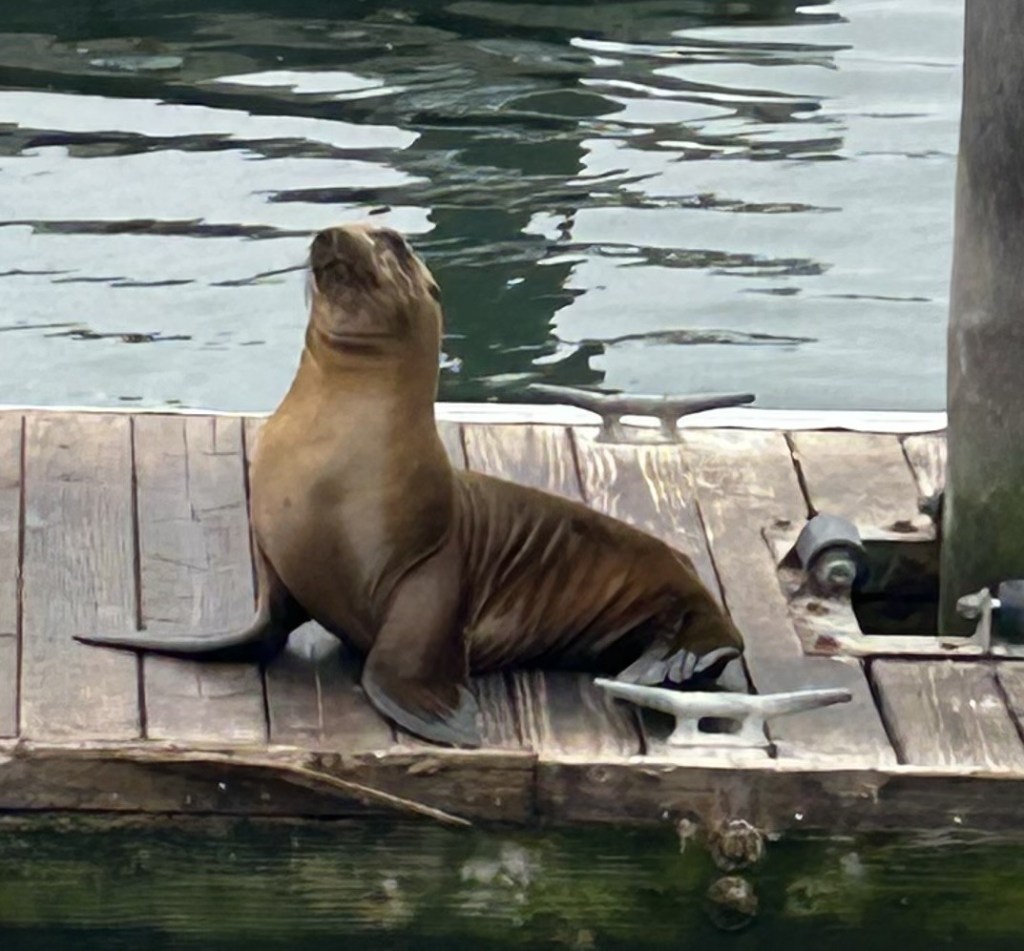
One of my favorite things about the Wharf is the Maritime Museum of once active sea-going vessels, such as the Balclutha, which was closed for “safety concerns.” Years back, I attended several Sea Shanty Sing-alongs, but those were not happening this time either! Of course, we enjoyed the sea lions at Pier 39, too. On to the food…

Fisherman’s Wharf’s fame lies in its many food and local memorabilia. We found one of my favorite open-air fish market/dining places that serves clam chowder in a sourdough boule hollowed out to make a bowl for the chowder. Delicious! Then we wandered over to Ghiardelli Square to chocolate. Most of it was closed for remodeling, so we just saw the small retail store selling the famous chocolates. The walk prepared us for the Hotel Buena Vista for Irish coffee and a most friendly bartender!

After the coffees, we headed to Columbus Ave to visit City Lights Bookstore, as I do on every visit to SF. As per usual, City Lights Bookstore was a haven for readers, and the second floor dedicates itself to the Beats and their literary progeny. We found some books, some by Lawrence Ferlinghetti, the father of City Lights. Sadly, the clerk that waited on us was one of the most sour individuals I’ve ever met! I wondered why he was so rude and dismissive. What is a person like this doing in this haven for literature? I thought maybe he was having a rough day, so I gave him the benefit of the doubt. Nope! We returned two days later only to find the rude guy waiting on us again. He was pleasant to look at, but he, apparently, has a black heart! On to purchase dinner…

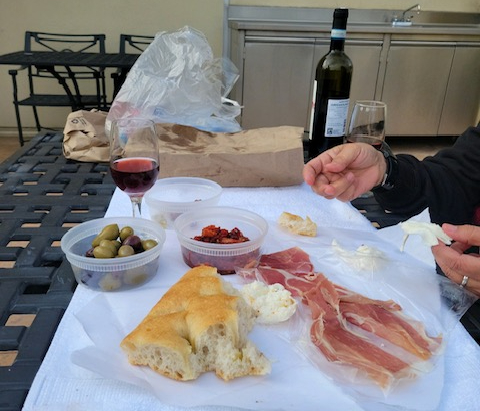
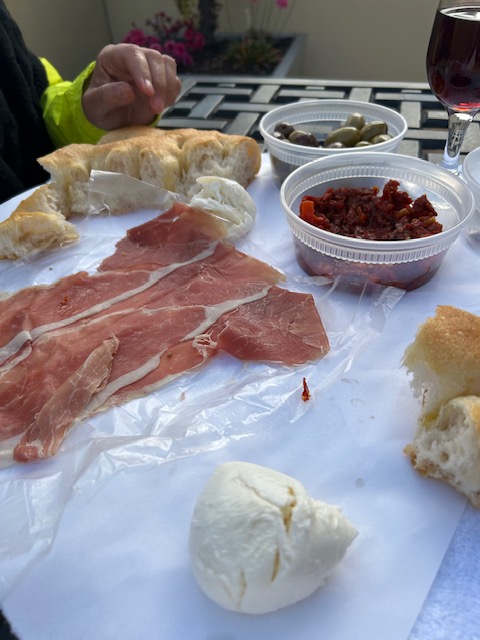
After City Lights and a picture-taking opportunity of Vesuvios (Featured in Mike Myers, So I married an axe murderer) we found Molinari deli with the most beautiful assortment of Italian cured meats, locally made mozzarellas, in-house made bread, and many delights.

We procured a lovely supper of meats, cheeses, olives, sun-dried tomatoes, bread, and wine to enjoy on our hotel’s roof top. Oops! I failed to mention that we stayed at the Orchard Hotel near the entrance of China Town. It has a lovely roof top with tables, chairs, and views of San Francisco! We took our lovely dinner to the rooftop where we enjoyed a chilly evening with great food and wine.

We had leftovers, which we enjoyed at the train station in Emeryville while we awaited our east bound Zephyr on Saturday morning. We retired to bed after a day’s walk of 12 miles, great food, and breath-taking sights. On to Thursday’s adventures…

Early to rise, and after a small breakfast of my energy bites (1 cup oats, 1/2 cup honey, 3/4 cup raisins, 1 cup almond butter, all mixed and formed into a golf ball sized sphere!) and coffee before heading to the Embarcadero, Pier 31, to board the vessel that took us to Alcatraz.

My main interest in visiting Alcatraz was to honor the “Indian” occupation in the 1970s. We were protesting the generations of erasure pursued by congress. We are still here! From Alcatraz, one can only imagine the gorgeous vistas from this place of imprisonment for crimes ranging from theft of fewer than $100 to murder, all in the same place. Yes. People should be held accountable, but some who have done worse are still walking free.

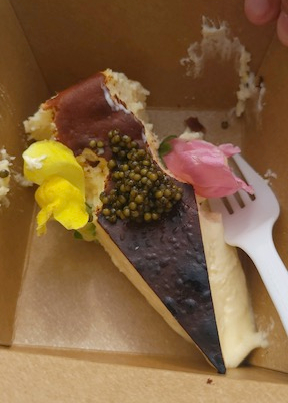
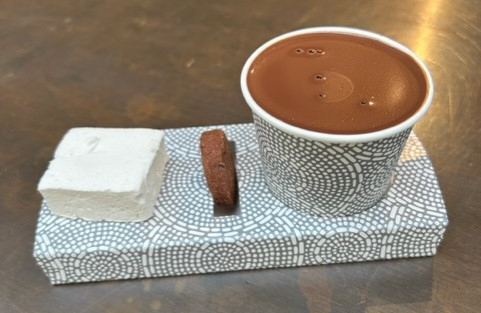
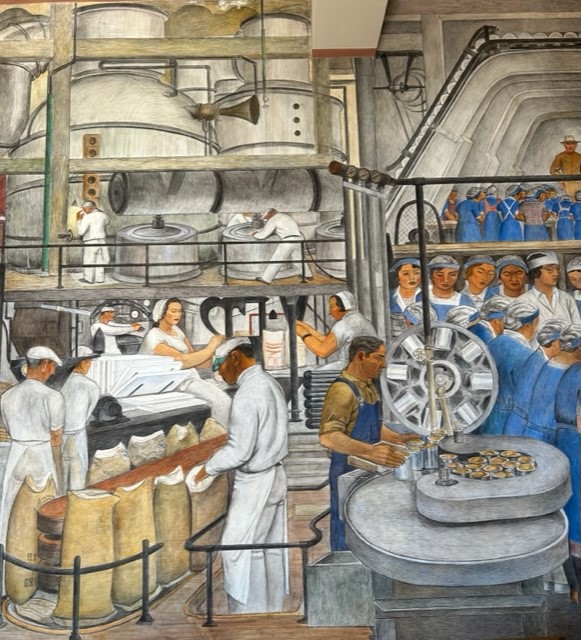
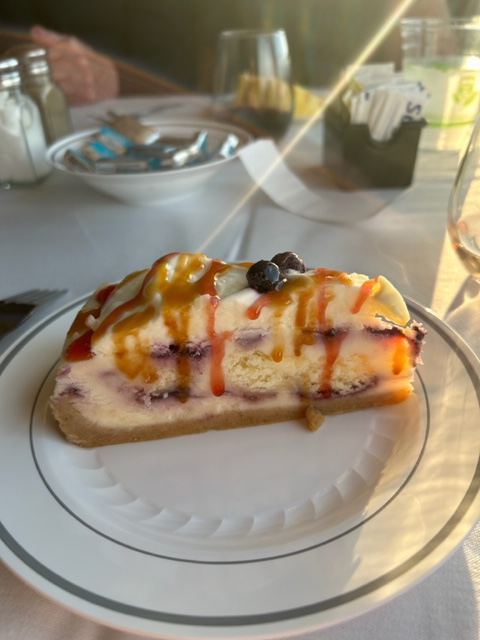
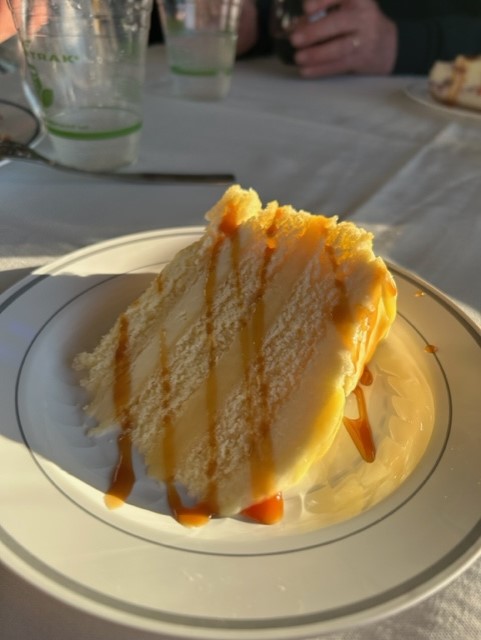
Back to Pier 31 by noon, we were ready for finding food! Luckily, The Ferry Building is near Pier 1, and though it was a bit of a walk, it was worth it! The Ferry Building, now the Ferry Building Marketplace, was built in 1898. While it had some decades of decay, it stands in a state of continual renewal and reimagining. It hosts vendors in an enclosed “farmers’ market” style of booths ranging from caviar to fungi, and all foods in between. For two foodies, it was hard to settle on one cultural food choice, so we combined different taste profiles. For some reason, I didn’t get pictures of our meal, only our desserts: cheesecake with caviar and Aztec chocolate with marshmallow! Yum!

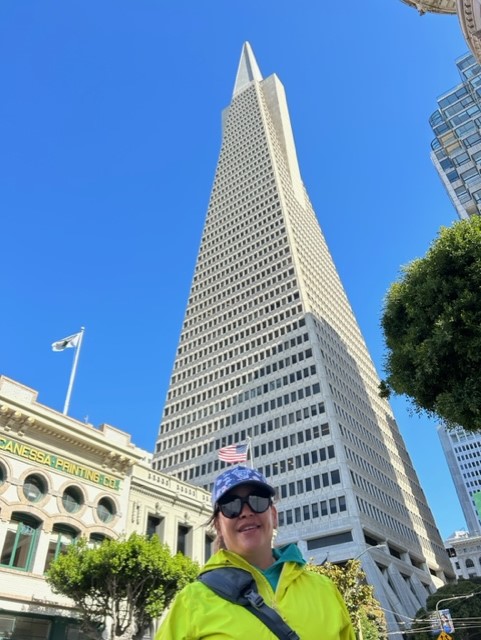
After lunches, desserts, and drinks at the Ferry Building, we headed out for more walking. We ascended the steps to Coit Tower, walked around in surrounding neighborhoods and headed back to the hotel after we took pictures with the Transamerica Building.

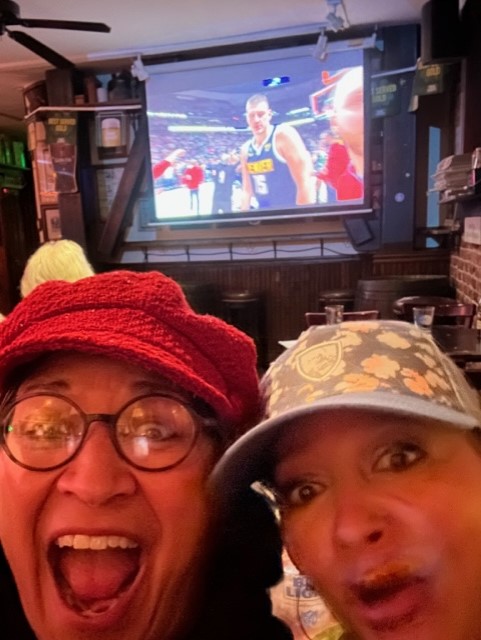
Since Eileen’s husband is a rabid Denver Nuggets fan, we had to find a place to watch one of the playoff games, and we found an Irish Pub with the game. We ate corned beef and cabbage with a nice Guiness while we watched the game. The Nuggets went on to become world champs!

After 9 miles of walking, we retired to sleep eager for our final, full day in San Francisco.

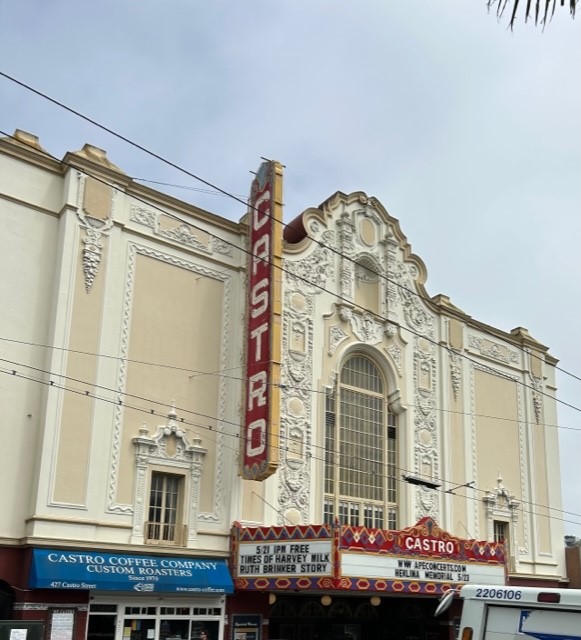
Friday, being our final day, we opted for public transportation since the cable and street cars are moving museums. First we went to the Castro District. Sadly, the theater was dark that week. We walked around, and had a snack.

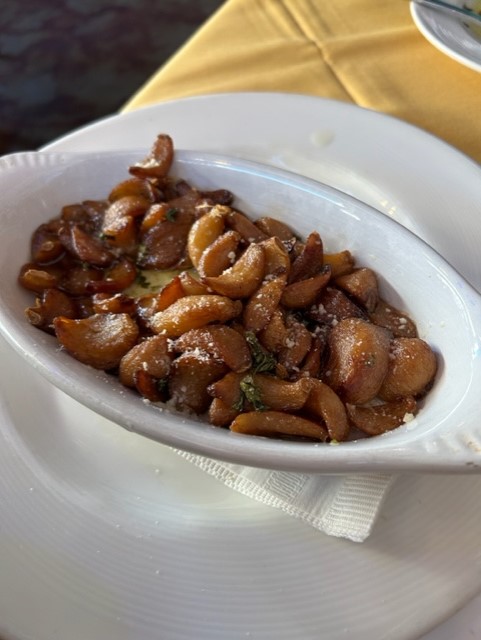
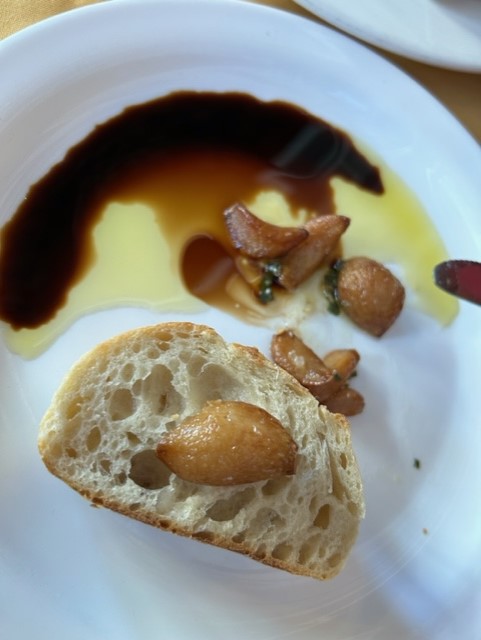
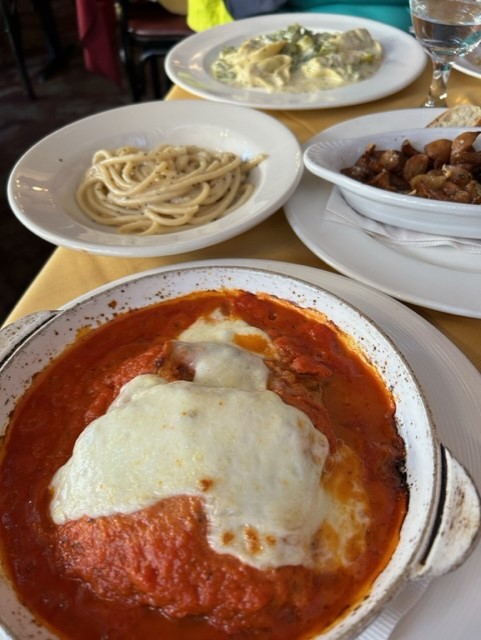
Then we rode the street car back to a point to catch the cable car to Fisherman’s Wharf, for some memorabilia. After much walking and site seeing, we headed to Columbus Ave. for our final big meal at the Mona Lisa, known for their Sicilian Caviar, which is garlic baked in butter and olive oil. I can just imagine how we reeked!

We returned to our hotel, packed our suit cases to prepare for our return trip, and fell into restless slumbers for an early morning departure on a bus from SF and across the bay to Emeryville to board the California Zephyr east bound.

When we arrived in Emeryville, we learned that the train would be six hours late. That’s okay. I love the train! Since we were in for a long wait, we savored a nice breakfast of leftovers from Molinari and Boudin Sourdough, and I made bloody marys with tomato juice from the snack stand. It was a great feast! Is this a travel or a food blog?

We boarded the Zephyr and recounted the great stories of our adventure. Eileen is the best of travel companions. We compliment eachother’s travel styles. She does research on prospective experiences, and I fly by the seat of my pants! Here are some of our final sites.

Thank you for coming along on our trip!

Well-Being Concepts

Now that we’re shedding out winter blankets, in the Northern Hemisphere, it’s time to think about warmer weather. Often times, we tend toward a more sedentary life in winter weather. That means we may gain a few pounds, lose a little muscle mass, and our motivation decreases. How do we keep this all in line so that we experience optimal health year around? My answer? Holistic Self-Care.

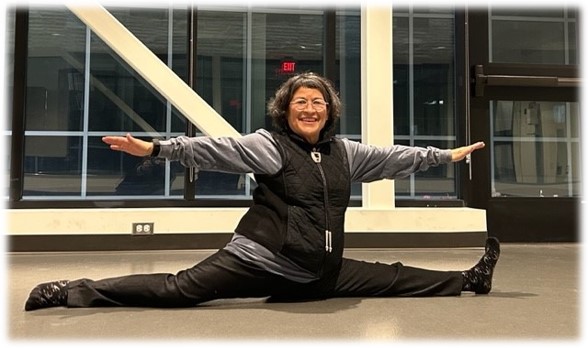
About a month ago, I reached my 66th birthday. The day before my 66th year, I taught a self-care class for my co-workers. It was fun. I called it, “Finding Hygge and Other Emotional Well-Being Concepts.” I’ve written about hygge and other forms of coziness in previous blog articles. I had a co-worker take the picture you see in the “featured image.” That was for my “Meet Your Presenter” slide in the power point for my workshop.

Let’s get started.

I offer this lovely image that I call, “Sunset on the Flinthills” as a gentle reminder for you to bring the natural world into your time reading this and for engaging in self-care practices. Here are some learning objectives:

  • Self-advocacy promotes equity and belonging
  • Health and well-being practices promote physical, emotional, social, and occupational well-being
  • Long-term outcomes include increased confidence and overall well-being

“When we cultivate environments of well-being, we see each other as holistic beings who seek fulfillment through work, leisure time, and personal or professional development. We strive to engage in self-care when necessary and without judgment.” -Bolton

Let’s Breathe

I borrowed this image from social media promoting a Mastery of Self, a book by don Miguel Ruiz Jr.:

  1. Sit quietly with all distractions muted as best as possible.
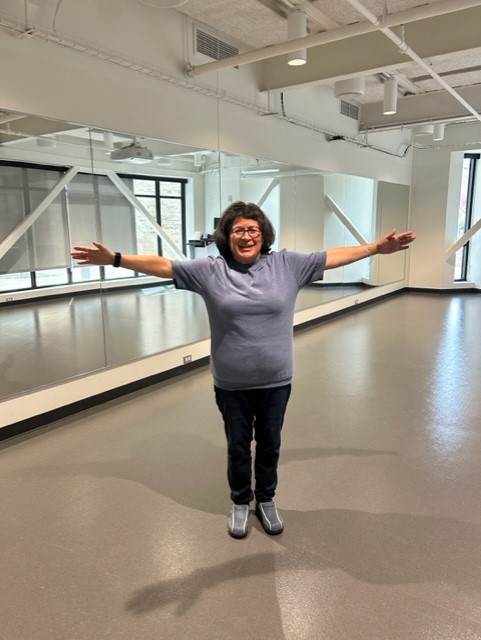
  2. Circle arms above head while inhaling – then exhale. Do this 8 times.
  3. Breathe in through your nose and out through your mouth: 8x
  4. Inhale to the count of 5 – Exhale to count of 5: 8x
  5. Place your hands on your diaphragm and breath out with a loud “ho!”: 8x

What is Holistic Health and Well-Being?

When we think of when we humans are at our best, there are many needs that must be met. I could bring in Maslow’s Hierarchy of Human Needs, here, but you likely know what those are, and this reflects that, too. I think most humans work toward self-actualization. Here is what we need:

  1. Physical needs – Food, clean water, oxygen, elimination, clothing/shelter, sleep, and movement/activity for sensory and motor stimulation
  2. Mental/psychological needs – attachment, orientation/control, self-esteem, pleasure, and avoiding pain
  3. Spiritual needs – Meaning, purpose, to love, and to be loved
  4. Social needs – Relationships, belonging, respect, affirmation

What under-girds each of these human needs, of course, is SAFETY? 

Safety means, security of body, employment, resources, our moral codes, any type of family, optimal health, and a place of one’s own.  Can you image what happens to humans who do not have the privilege of holistic health and well-being?  Can you imagine what happens to the human psyche when one is displaced due to war, poverty, colonization, or no job opportunities?

We must feel safe and affirmed in any space in which we navigate.  All of these needs move forward once safety has been met.

On another note of importance, we must understand others’ identities  and how those identities may contribute to feelings of non-safety when others view them as lesser than, who don’t belong, or somehow don’t fit in.  Remember, there are those who do not feel safe in certain environments.  That happens when basic human needs are not met.    Abraham Maslow was absolutely correct when he talked about basic human needs as critical to thriving.

Our Own Cultural Behaviors Contribute to Our Senses of Work, Rest, and Play

A dominant cultural behavior of the United States is work, work, work. Brené Brown tells us that “crazy busy is a great armor. It’s a great way for numbing. What a lot of us do it that we stay so busy, and so out in front of our life, that the truth ow how we’re feeling and what we really need can’t catch up with us.” I see this in my work place when my colleagues boast that, “I’m losing vacation days, because I don’t use them!” Unfortunately, that is an ethos that is honored in my work place. That is the opposite of praising for self-care.

Think About You:

  • What are some things you do to wind down after a hard day at work?
  • What are ways in which you balance work and rest?
  • Is “winding down” a practice you do?

Most of us are not in survival mode nor are we in subsistence mode. We tend to forget about “self-care” mode. Let’s change that practice!

Let’s Stretch

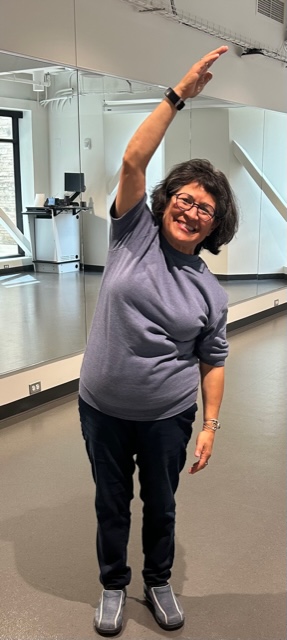
  1. Stand tall and reach for the sky with a full inhalation. Drop your arms as you exhale. 8x
  2. Stand tall and reach from side to side over your head. You will cross your right arm over to your left side and vice versa. 8 x
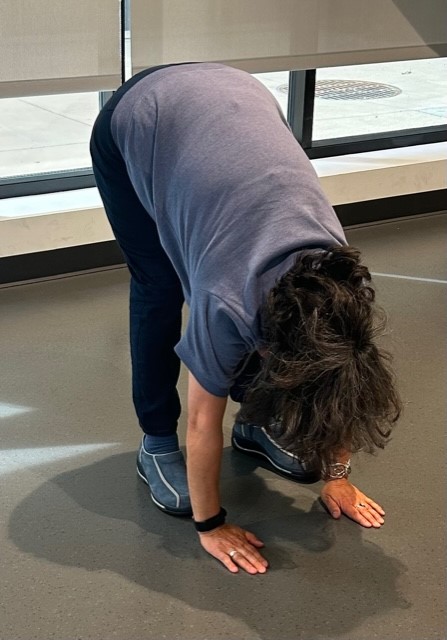
  3. Stand tall and reach for the sky. Take deep breaths. Reach up, and then bend to touch the floor. 8x
  4. Now, squat low and stretch your inner thighs to a ten count on each side. 8x

Take This Moment to Reflect

•What gifts or talents do you possess?

•What new characteristic did you discover about yourself recently?

•What are you grateful for?

Looking to the future

•Which value or action would bring you closer to a vibrant way of living?

•If you have or would design a personal ritual, what would it be?

•Have you found a way to focus on your successes?

•What kind of person do you strive to be?

•Have you ever thought of naming what you want your life to be as a chapter in a book?

What is Mental Health?

“…a state of well-being in which the individual realizes [their] own abilities, can cope with the normal stresses of life, can work productively and fruitfully, and is able to make a contribution to [their] community.” (WHO, 2004, p.12)

= positive capacity
= social and emotional wellbeing
= behavior, thoughts and emotions

≠ mental ill-health*
≠ happiness

Open dialogue on Mental Health

In you own words, what does the phrase “Mental Health” mean to you? What definitions/connotations does this phrase evoke?

Mental Health Defined

Its important to recognize that mental health encompasses our recognition of adapting ourselves to our surroundings in a way the promotes our well-being, while still acknowledging the experience. I say this to note that mental health isn’t singularly about being “happy” (especially not all the time). That is an unrealistic or attainable standard for mental health and ignores that we utilize all of our emotions to make sense of our experiences.

Prioritizing mental health ensures we are taking the necessary steps to alleviating those stresses while retaining our functionality in life. We see this in

-Driving personal development

-Seeking out and maintaining relationships with others

-Positive & Affirming

-Speaking Up when in need / communicating our concerns/problems to others who can help

-Expressing our Emotions

-There is no such thing as a “bad” emotion, its how we understand them and express them

-We all feel sadness, anger, joy, etc. We need to see all emotion as natural, but learn how to cope with them as they come

-Last example is a continuation of development

-When we stop problem solving, or setting goals we can slip into states of ill-health that can perpetuate the stresses we are experiencing

So now, what is ill-health?

How Do We Maintain Our Balanced Mental Health?

Personal Development

Positive/Respectful Relationships

Open Communication

Identify/Understand/Expressing Emotions

Setting Goal / Problem Solving / Taking Responsibility

So, Then Ill Mental Health May Be…

“… a spectrum of problems that interfere with an individual’s cognitive, social, and emotional abilities including both ‘mental health problems’ & ‘mental illnesses’”

Reflect

Stress is a normal response to situations

It includes both eustress (“good” stress) and distress (“bad” stress)

Stress responses vary based on the person

What does stress look like during an infectious disease outbreak?

Fear or worry about your own health

Fear or worry about the health of a loved one

Changes in sleep or eating patterns

Difficulty sleeping or concentrating

Worsening chronic health problems

Increased use of alcohol, tobacco, or other drugs

Stress can impact your body, thoughts, feelings, and behaviors- it can effect so much!

Body- headaches, muscle tension, chest pain, tiredness, upset stomach, etc.

Mood (including thoughts and feelings)- anxiety, restlessness, lack of motivation, feeling overwhelmed, irriability or anger, sadness or depression

Behavior- changes in appetite, angry outbursts, drug or alcohol misuse, tobacco misuse, social withdrawal, exercising less often

Self-Care is More Than a Hot Bath or Taking a Day from Work

Here are two quotes from researchers who study human behaviors in societies that push for power and material wealth.

Thank you for reading me. I hope this can be a nice road map for returning to a healthy way of life.

Namaste!

Cooking for One: Fun in the Kitchen

The kitchen window over my sink gives me great pleasure, because I see beautiful juniper trees, and I’m looking through colored glass!

Every time I cook a meal for myself, I think, “I should write about this in my blog!” It seems like I hesitate to write. I like having written more than my desire to write, sometimes. Two of my favorite pasttimes are writing and cooking. It’s great to share these loves.

Many of my friends love to cook! We used to make it a common practice to take turns hosting dinner parties. Then I moved. Establishing oneself in a new community takes time. Perhaps I don’t know the “right” people for such a thing, but I will keep trying. I love to cook, and I love to entertain.

Many people do not like to cook for themselves. I find it relaxing after a tough day at work. I use my mind in a different way than what I do at work. Music always accompanies my time in the kitchen. Time in the kitchen and listening to music are one of the places and times where/when I find my coziness (Hygge).

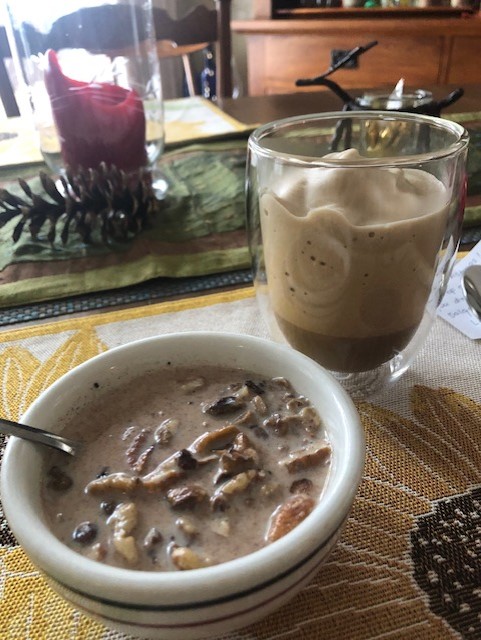
Let us begin with breakfast! My morning routine consists of drinking a lemon/olive oil system cleanser. I make it with 8 cups of water, two whole lemons, a dash of vanila, and four tablespoons of good olive oil. I blend it in 4 cups of water, and then I add the other four cups. Strain it into a half-gallon bottle. I drink 4-6 ounces before 30-minutes of exercise while listening to daily affirmations. Then I prepare my breakfast. Pictured here includes homemade granola (I think the recipe is found in a much earlier blog of mine). Some times I like to eat it was plain yogurt and honey, and other times I like to pour milk on it. I’m having this with a frothy coffee that I prepare in an electric milk frother.

The spices in my granola turn the milk a little murky looking, but the delightful flavor and crunch make it great!
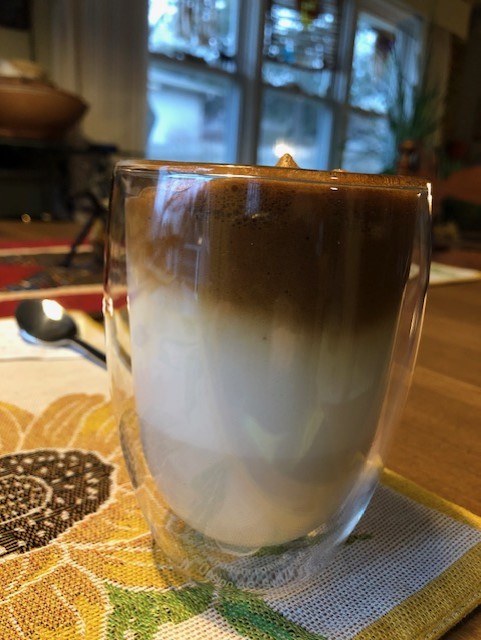
This “Dalgona” coffee was made by whipping the instant coffee in two tablespoons of hot water. The middle layer is frothy milk, and the bottom layer comes from the frothy milk and whipped coffee blending.
This breakfast features homemade bread for the toast, peanut butter, raisins, and hemp seeds for added protein. It tasted great with a steaming cup of chai!

Winter drags out, but spring will be here soon, and the weather will be more amenable to having breakfast, lunch, or dinner out on the back deck or the front patio. During the pandemic and working from home, I took many breakfasts al fresco so that I can watch birds. Two rivers flow on the outskirts of town along with a 30-mile long creek/reservoir. That means we have bald eagles flying over town. What a better way to eat breakfast?

Often times, my breakfast may consist of left overs from the previous night’s dinner. I tend to eat anything for breakfasts. My 93 year old mother finds that “really weird” that her daughter eats “odd” things for breakfast. She defines “odd” as anything that is considered a “non-breakfast” item, like what we ate the night before. I have no such restrictions on myself. Lunches often consist of dinner leftovers, too.

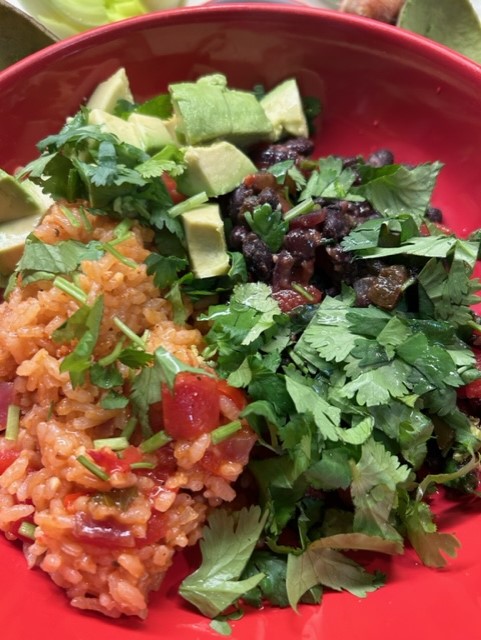
This is a black bean burrito bowl. It can be vegan, but I used chicken stock to make the Spanish rice.

With social media, magazines, and cook books, one can always find new recipes. Of course, magazines and cookbooks contain such beautiful illustrations of the process and the final product. I like to read ingredients lists, which I think are there for suggestions, but recipes are meant to be experienmented with and tailored to fit your favorite flavor profiles. Most cooks know what kinds of spices go with specific dishes. I like to change it up sometime, so I will share some of those here, too.

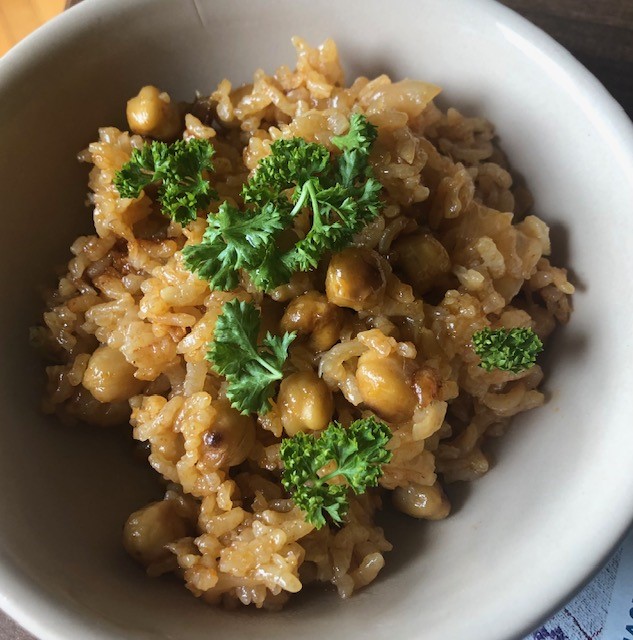
This is a take on Jollof Rice with seasonings given to me by a friend from Ghana! I used garbanzo beans instead of lentils, because I had no lentils in the house!

With the two illustrations of rice dishes, I found these recipes online. Remember, when you cook with dry beans (garbanzo or black), since they are likely not “new crop” means that you must soak the beans to re-hydrate them before cooking. I don’t have access to new crop garbanzo or black beans, so I do soak and rinse before cooking them. Always add boiling water to your cooking pot. It helps the beans maintain their color and it helps them hydrate quicker in the cooking process.

I make the distinction between older pulses (legumes), because I love pinto beans, and I only buy new crop. They do not have to be soaked. Simply rinse and add to boiling water, which makes for a quicker meal. I get my new crop beans (usually harvested in late September or early October) from a farm in Colorado. The variety of pinto beans that I love is called, “vibrant,” and vibrant they are!

Sometimes a simple lunch can be grilled cheese, with marinated cucumbers and red onions with sparkling water.
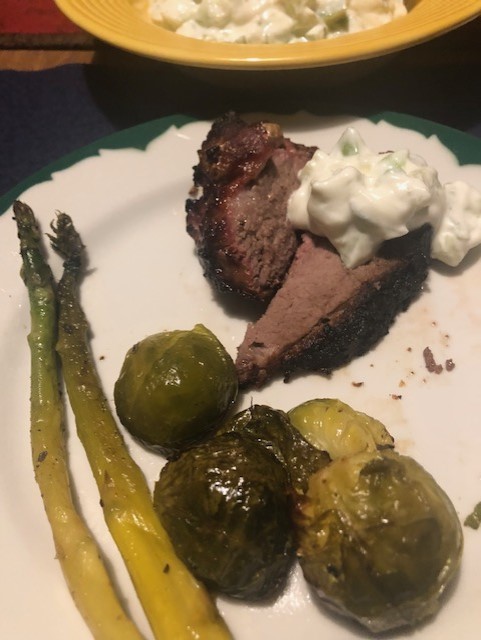
When my grandchildren visit, lamb, Brussels sprouts, and asparagus are always on the menu. They set the menus in these cases.
This simple supper of tuna patties with homemade tartar sauce and a light glass of buttery chardonnay makes for a lovely meal.

I did not share my recipes in this blog today, because I think it’s fun to explore your own preferred flavor profiles. You likely know that some herbs and spices combine with certain ingredients. For example, I never put green chili in my marinara sauces, but I do add green chili to my bean and corn soups. You figure it out, if it interests you.

I realize that cooking or baking does not appeal to everyone. I present this as something that appeals to me.

Thank you for reading my blog.
Reflections in the Heat of Day

I find it difficult not to reflect on the pain in the world, at present. How do we center ourselves in the face of such hurt? Well, here I go again touting the benefits of mindful thinking and about my outlook on life. These are some common question that I ask myself. Am I practicing gratitude? Am I practicing stewardship of the land, water, language, and preserving other parts of the natural world? I do realize that when we navigate in environments of poverty, exclusions, marginalizations, and living in the fringes, it becomes a great challenge to have gratitude for much of anything. But, what if we looked inside for what is going well for us? Are we able to stop for a minute and think about for what we can be grateful?

I know. Digging through your mind in the midst of conflict, deep emotions, and sadness may be the worst time to gather positive reflections. I do know that it works, however. My practice, which now is a habit, has been part of my life these past four months. Yes. I am facing some great life challenges, and I can tell you that focusing on gratitude and daily affirmations works! Challenges become navigable.

Bianka’s Hummer

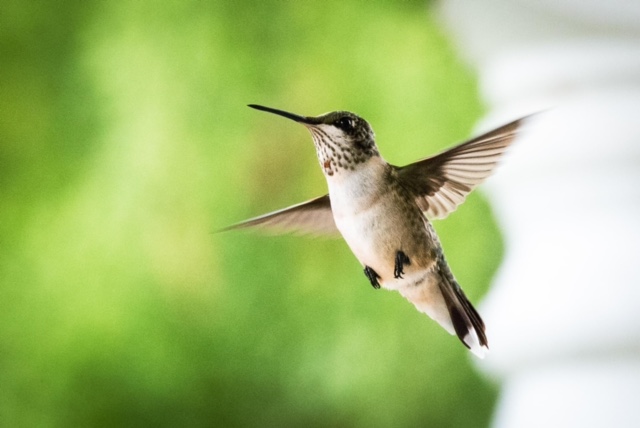
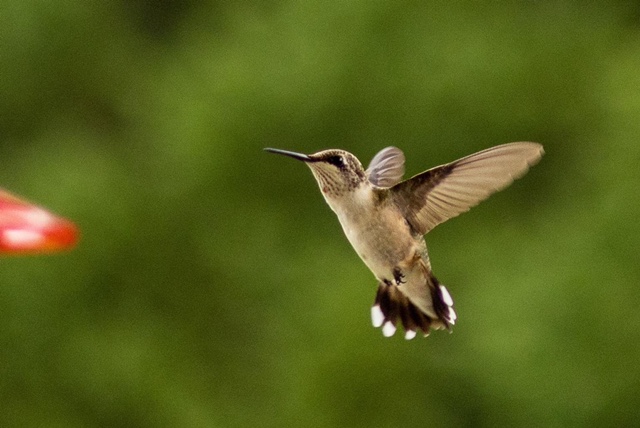
I find that nature offers the best self-care, meditative, and gratitude-giving opportunities. My sweet cousin, Bianka, a war veteran who now spends much of her time bike racing on BMX tracks with her twin brother, also a military veteran, who builds racing bikes, like his father did, now works to perfect her photography skills. That’s her hummingbird picture. It gave me time to stop to appreicate the delicate body, the exquisite little feet, the striations on the neck, and the moment in time when Bianka got this perfect photo of the little bird hovering near the sugar water feeder. When we take that time to appreciate the perfect details of the natural world, we begin to offer gratitude for what some may think of as mundane, but it helps us to be thankful for what we may think of as insignificant details of the world. Also, when we take time to offer thanks for the small things, it helps us to slow down from busy lives and be in a moment with ourselves. Try it.

Bianka Hummer 2

Consider camping as an outdoor activity where you get to interact with the natural world. Camping is one of my favorite pasttimes. It’s a time when I just allow myself to do nothing but breathe in the clean air, listen to the birds and other flying, loping, crawling, or jumping lives of the natural world.

Kelly’s Flock (a few of them)

My dear friend, Kelly, recently, acquired a flock of chickens to raise in his and his lovely wife’s backyard. Kelly told me about raising chickens, “It is therapeutic for me and I have peace when I am around them! I know they are just chickens to most people and is not a big deal, but I almost can’t put into words the joy these animals bring to me! I want many more, and one day, I will have chickens galore will be our theme!” I cannot imagine a flock of chickens being in more gentle hands!

Kelly’s Chickens at His Feet

Kelly went on to say, “I think the older you get the more you see the benefit of working to live and not living to work! We are in a world that is so disconnected from the natural things around us that we forget the incredible inner peace found in nature! We have lost the fact that nature is our kin and we have neglected that relationship.” Those are words that we Indigenous People live by, and those words coming from my dear friend Kelly mean the world to me.

I will end with a few of my daily affirmations that come from those around me who inspire me to improve:

  • I am curious to know something about everything and everything about something
  • I am thankful for…
  • I am courageous
  • I am living a great life
  • I am interested in everyone I meet (from my Dad)
  • I am valuable
  • I have wonderful friends who enrich my life
  • I learn great lessons from my loved ones
  • Today, I will learn something new

There are more, but I leave you with this great picture of a friendly kiss from Heidi, a dog who belongs to a business associate of my son.

Heidi Kisses!

Thank you for reading my blog.
Reflecting and Looking Forward

When we think of a year that’s passed, it can be a good time to reflect on the past and to look forward in a new year. We can think about the good things that happened and contemplate any of the negative happenings. Of course, it does not serve us well to focus on our misfortunes, mistakes, losses, and other events that made a negative impact. However, it could serve well to give each of those challenges their due. I want to spend this space for reflecting on the year past and looking forward to year unfolding before us. Every year, I learn something new, and I give myself grace when I come up short. I will share some things I’ve learned and ask you to reflect on your life as well.

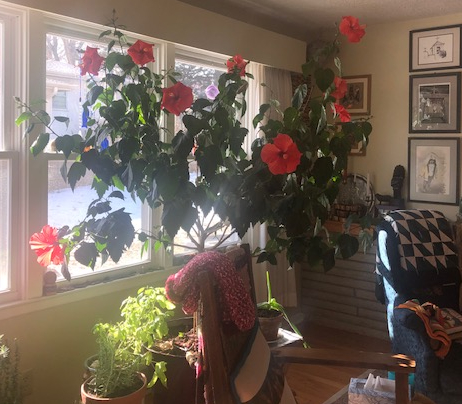
Blooming Hibiscus with Eight Blossoms

Reflecting on events of the past takes a Mindfulness approach. In the process, be a neutral observer. Think about what gave such an event a positive or negative impact. Notice how the event or interaction elicited emotions. How was that emotion navigated, or what was the response? The point in this reflection is to remind ourselves to be 1) a neutral observer to each experience, 2) Be patient with yourself: allow each experience to emerge at its own pace, 3) Have a “beginner’s mind” by experiencing the memory as if for the first time, 4) Trust and believe in your intuition and your ability to see things in a new way, 5) Take it as it comes without the need to win or avoid losing. At this points, just be; 6) Accept and see things as they are in the present moment; 7) Let go and detach from your usuall feelings and thoughts. Perhaps this is a way for us to slow down for a moment to recharge our senses.

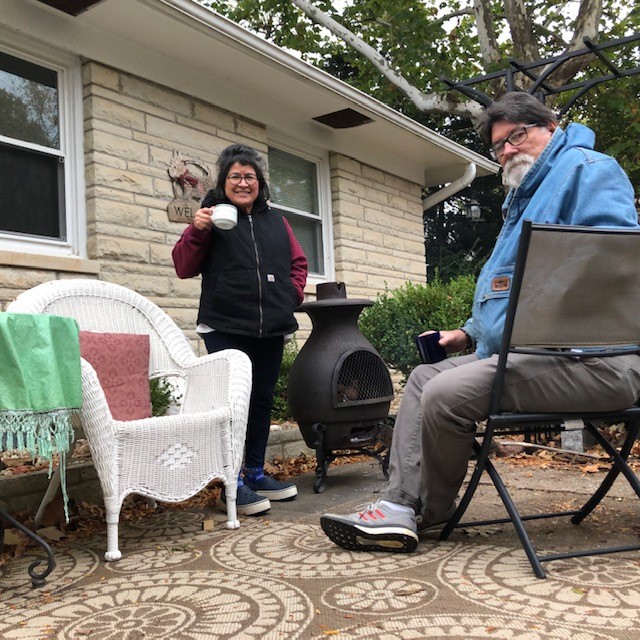
Enjoying a hot cup of tea on a crispy morning in front of the outdoor fire place

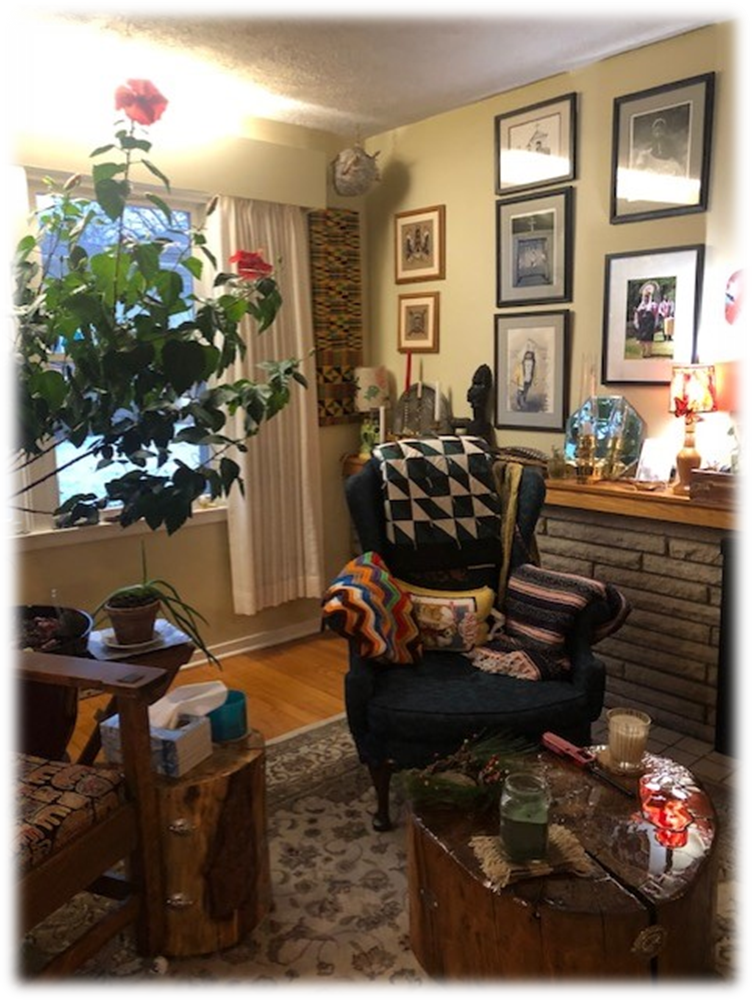
I’ve written about the “art of hygge.” Hygge is that danish word (Hoo-gah) that denotes comfort at the point of being cozy. Think of a hug! We get to decide on the characteristics of that hug. When the danish speak of hygge, they outline all the situations in which one can practice that coziness: our living spaces, our work spaces, and in outdoor spaces. I have designed my “living room” as a hygge corner.

Cozy Corner

Another way of practicing that sense of being hugged, is looking to the outdoors for rest and relaxation. Viewing nature as if for the first time can be exhilirating! Perhaps asking oneself, “Which season do I like best? Why?” I like to notice what birds are active in which season? For example, I’m seeing more juncos during the winter than in the summer. We see snow geese in the winter but not summer! Those are changes that are only noticed when one looks up or notices changes in nature. It such a thing is new to you, try it sometime. As another example, in the photo, one could ask, “Why is the sunset so red?” The answer: Dust and smoke in the atmosphere from fires and wind (in many cases).

A Kansas Sunset

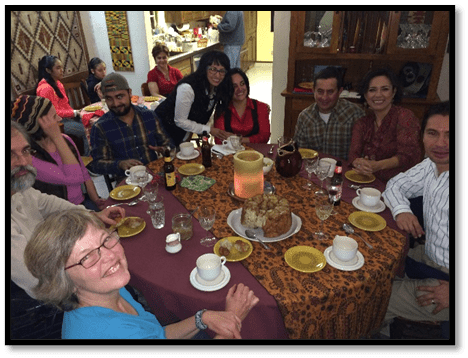
In a busy world where we are measured by how much we do, how much money we earn, and how we stand out as individuals (an individualistic society). I wonder if we would have less illness if we emulated that of a collective society (group oriented) and took the time to sit and talk, build relationships, and take more collective actions when it comes to governance. The concept of hygge supports that very thing, as does the Mediterranean way of conviviality. So what if we took three hours to consume our meals conversing around the table? Our lives would slow down, and we would take more time for ourselves and our loved one. I love the concept of “hygge with others,” which focuses on our relationships. While we have fewer opportunities to gether during this pandemic, and we’ve had to find new and different ways to connect with people, such as with on line platforms. When I think of “hygge” with others, I tend to think of gathering around meals. Sometimes it may be connecting through interest groups. Sometimes we attend a movie group, which meets online after participants watch the movie on their own. That is one way of connecting during a pandemic time. The meet up consists of questions by the facilitator. We found common themes through which we connected. A few years back, in a town where we spend nearly thirty years, we used to attend what we called, “Second Friday Cinema” at our local library. We picked nine movies for each of the months we met from September through May. We watched the movie together enjoying snack that each of us offered on a table. Unfortunately, that has gone away per safety measures. I miss those time, so I will share some photos of former gatherings and ways of enjoying our environments.

Friends at Table
My Home State

Setting a goal of practicing holistic well-being does take some discipline. For example, I made a pledge to myself to keep my house organized and free of clutter. That takes a lot of work! It seems that we get so involved in making a living, being a good employee, and meeting institutional goals that we forget to take care of ourselves. Now, all this sounds like I’m an expert at such things, I do teach about holistic well-being, but that means that I practice such things, and “practice makes perfect” as the saying goes. That’s the best we can do, and our best needs to be enough for us. That does not mean that we’ve reached a pinnacle. It’s just means that we keep trying. I saw a quote on practice the other day. The gist of it was that someone had asked the great cellist, Pablo Casals about his daily practicing at the age of 90 years. “After a stellar career and now at the age of 90, why do you practice the cello for the minimum of six hours per day?” Casals answered, “Because I think I am seeing progress.” Humans are not perfect. We work toward perfects, but perhaps too much, I wonder? I want to be the best for the world not the best in the world!

Thank you for reading.

Reflections on Native Boarding Schools

My featured image shows fall colors at my house.

As one who identifies as Indigenous, the latest findings of Indigenous children’s marked and unmarked graves on the grounds of Native Boarding Schools across Canada and the United States abhors me, which can feed into generational wounds. Lately, I have been invited to offer lectures on the topic. Here I share with you some of my reflections as presented to church groups. Remember, I only speak with my Indigenous relatives. I do not speak for all Indigenous Peoples.

Residential Boarding Schools: We must acknowledge what happened
to the First People of these Lands
at the hands of Colonial Settlers

To all my Relations…

Following in the ways of loving one another, as any faith journey tells us to do, gives us a framework for our way of life. Our works of truth and reconciliation must mirror that. Like baptism, we must face the truths of our past, even when they give us discomfort. When we learn some painful truths, we must reflect on those truths rather than deny, wallow in guilt or point fingers. The painful actions of history belong to all of us… together.  Again, the painful actions of history belong to all of us. I say that as one who is Indigenous to these lands to which I acknowledge: My homeland is the Uncompahgre Valley, Western Colorado, from where colonial settlers displaced my father’s people (Ute). My Mother’s people experienced the same atrocities in their homeland of what is now, New Mexico.  In Kansas, I live and work on the ancestral territory of many Indigenous Nations, including the Kaw, the Osage, and the Pawnee. Kansas is currently home to the Prairie Band Potawatomi, the Kickapoo, the Iowa of Kansas and Nebraska, and the Sac and Fox Nations.  

I am grateful to these Nations. I ask you to Please remember these truths

Bathe in the Beauty of Nature

Today, we take this opportunity, no matter who we are, and no matter from whom we descend, to face the pain of the past, to confess it, and above all, to learn from it and not repeat it. To tell the truth in love, as our Creator teaches, gives us pause to learn love’s excellent way of life and way of being.

What are the ways in which we can behave in actionable ways to follow the path of love rather than hate, rather than ignoring inhumanities, rather than justifying slavery and other exclusions and turning away from the practice of human hierarchies? We must recognize and acknowledge the wounds of Indigenous Peoples promulgated by governments, churches, and other institutions that join in the cause of separation and erasure.  Then we must remove the barriers to access for all historically excluded identities. Only love, honor, and respect can dwell in the Creator’s presence, and we must join our hearts and hands to rebuild our communities of faith. 

Let us move away from mere performance to authentic and measurable actions toward an equitable society where we honor and love one another as the Creator loves us. 

In reflection, what makes me hopeful today are the Indigenous youth who are learning the spiritual teachings and the folkways of our ancestors.  We promote generational healing through prayer and acknowledgement that we only survive in the light and love of our Creator and through the support of one another.  When this society begins to acknowledge the truths that segregation, torture, abuse, and separation of Indigenous children is, by design, meant to erase a people not love them, the healing will begin. 

A Healing Fire

Please note that of the 367 Native boarding schools in the U.S. 73 remain open, and 15 continue to board Indigenous children taken from their parents. Here in Kansas, we must acknowledge the following boarding schools and the atrocities fraught upon Native children: Haskell Indian Training School (now Haskell University), Great Nemaha Indian School, Kaw Manual Labor School, Kickapoo Labor School, Osage Manual Labor School, Potawatomi Labor School, and the Shawnee Mission boarding school. The goals of these schools promised to “take the Indian out of the boy or girl.” Graduation was never a goal, however survival remained a wish for the children.  Again, The children who were able to leave these schools did not graduate!  They survived!

We cannot heal in the places that make us sick. We can only heal, if the society complicit in Indigenous extermination can move away from greed and the concepts of superiority in order to teach a people that they are, indeed, inferior. I am hopeful because I am here today, with each of you, lamenting the wrongs of the past by governments and other institutions who do not follow the teachings of the Creator to “Love one another.”  I ask you,  How is genocide of a people, Love? How are exclusionary laws and policies, Love? How is justifying slavery, love?    

Rev. Linda Nicholls and Rev. Mark Macdonald note that:

“The wrenching legacy of residential schools is felt not only by those who survived. It lingers in the pain of families whose children died while at school. It lingers in the agony of not knowing why they died or where they are buried. It lingers in the inadequate record-keeping that does not tell the cause of death. It lingers in the neglect to even record the names of almost one-third of those who died. For a parent the death of a child is an unimaginable pain.”

I ask you to empathize with the parents. Can you imagine such a thing to happen to you and your family?

What Matters to Me and Why

I work at a university with a leadership studies college. The school invites varying faculty, staff, and administration to talk about personal priorities and interests. As I always say, the more we know about one another, the more that the lines of separation fade. I love this notion of inviting people to talk about themselves. It becomes the living libraries favored by many communities. Here is one of my stories.

My father used to tell me, “Know something about everything and everything about something, and you will always be able to find common ground with another person.”  I have a penchant for music, literature, geography, history, art, language, biology, architecture, travel, navigation in air travel, and people.  Curiosity was the most important thing to my father.  He taught me to be curious, always!  Actually, I think my varied interests greatly inform my work in intercultural development, or helping humans find common ground with one another. It’s what I live.  It’s what I love. I like to begin my classes, workshops, and presentations with a land acknowledgment:

My homeland is the Uncompahgre Valley in Western Colorado, from where colonial settlers displaced my father’s people (Ute).  

In Kansas, I live and work on the ancestral territory of many Indigenous Nations, including the Kaw, the Osage, and the Pawnee. Kansas is currently home to the Prairie Band Potawatomi, the Kickapoo, the Iowa, and the Sac and Fox Nations. 

  I am grateful to these Nations. 

Please remember these truths.

It can be quite enlightening to research and discover what Indigenous Nation occupied the land on which you live, work, and play. We can think about:

Who granted the land?​

Who held the land previously?​

What was the U.S. Homestead Act of May 1862?​ Who was given land, and who was removed from said land?

So, I begin all my teaching with this acknowledgment. I am honored and obligated to my ancestors to do it.

Next in my processes of teaching, I acknowledge myself and my identities. Here are a few of the things with which I identify:

•Native (Ohkay Owingeh/Diné/ Uncompahgré) •Human Ecologist/Geographer •National Geographic Society Explorer •Social Researcher •Banjo player •Mother, daughter, friend, spouse, aunt, grandmother, motorcycle rider, writer… •King Alfonso X enthusiast, the original pluralist! •Blogger •Craftsperson •Nature enthusiast.

I could also say, I’m a mother, daughter, friend, spouse, aunt, grandmother, motorcycle rider, and writer.

Embedded in each of these identities that I share with you denotes aspects of my of my culture. However, the most challenging part of working to educate students, especially those from a dominant identity (Anglo-European descent) about culture is that they possess a culture. Many of my students tell me, “I don’t really have a culture. I’m just an American.” That just tells me that they have not thought about their identities.

Each of us, if we think about it, has several identifying factors that contributes to our cultural identity. You have the same sets of identities – each with sets of verbiage, practices, and thought processes that are part of your culture.

Certainly, our environments influence our patterns of behavior, our ways of knowing, our ways of living. I grew up in a mountain environment, as pictured here. We learn certain behaviors to thrive in mountain valleys, which can be different than the tallgrass prairie where I live now. In humans’ cultural practices, we learn, adapt, and adopt, often maintaining our foundational family and community systems.

Prairie or mountains: both are beautiful, and we adapt and adopt the cultural aspects of each geography.

Speaking of geography, I grew up in a household where National Geographic magazine was honored as much as the family bible.  My father read them from cover to cover.  My brothers saw them as anatomy lessons.  I vowed to visit all the places imaginable.  My work with National Geographic Society, as an explorer, put me in company with the likes of Maria Mitchell, noted astronomer in the 19th Century, Munazza Alam, 21st century astrophysicist searching for Earth’s twin, Harriet Chalmers Adams, journalists in the French trenches of World War 1, and notably, traveled to Africa to see Haile Selassie’s coronation as emperor of Ethiopia.  Of course, everyone knows the names of Edmund Hillary, Jacques Couteau, and Alexander Graham Bell as NGS explorers, but I encourage you to seek out the females who made great strides in the name of discovery.  Being a NGS explorer is the greatest way I can honor my father’s love of knowledge.

Two of the great products of my NGS funding was developing introductory course in geography for females of color, now in its fifth year, also thanks to our Center for Engagement and Community Development’s incentive grants, I was able to study the women in the African diaspora in rural SW Kansas, which became a chapter in a book recently published.  Here’s a picture of the book. My chapter covers the women of the African Diaspora now settled in Southwest Kansas. It tells of the brave women, displaced from their countries by war, worked in the beef packing plants while raising families and navigating health care, educational, and faith systems.

If you have read previous blog entries of mine, you would know that I greatly esteem George Washington Carver, the great genius in botany, invention, music, art, and philosophy.

Carver had a small homestead in Beeler, Kansas.  As a child, his slave owners near Diamond, Missouri actually saw his genius in plant pathology.  He came to Kansas, finished high school, and applied and was accepted into Highland college until he showed up. Carver was denied a college education in Kansas, because of teh color of his skin.

He found his academic home, first at Simpson College in Indianola, Iowa.  Only being allowed to study the fine arts, his art teacher took great interest in his botanical illustration.  She connected Carver to her biologist husband who was teaching at what is now Iowa State University.  Carver received is Master’s degree there where his brilliance was duly noted by Henry Ford, who had invited him to work since Carver had created rubber out of golden rod. Thomas Edison tried to recruit him as an inventor since Carver was noted as a great inventor, having patents on wood stains made from peanuts and sweet potatoes.   Alas, he went to work at Tuskegee “Normal” Institute at the invitation of Booker T. Washington, because it was there that he’d “do the most good.” Carver taught chemistry, botany, and other biology at Tuskegee until his death. I found this picture on the internet with Carver’s rules to live by: “Education is the key to unlock the golden doors of freedom.”

Once a year, I pay homage to King Alfonso X, who ruled Castile-Leon (now Spain) in the 13th Century. Here are a few facts about the “Learned King.”

He ruled from1252 – 1284 13th C. Medieval – Father of Castilian language, which we now call Spanish.  During his time, his language was Galician-Portuguese, also called “Romance” 

420 songs, poems, and commissioned 3 dimensional pieces as a way to teach morality to his subjects. 

He had just missed being crowned the Holy Roman Emperor because he was “too learned!” according to the Pope of the Catholic Church at the time. I wrote a blog better examining the King last November. No doubt, I will write another about the king in the coming fall.

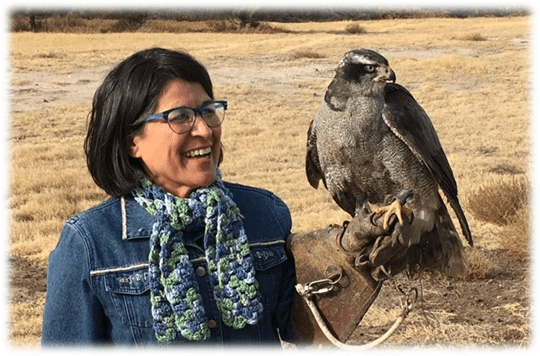
I like learning about different species in the animal world. I was a volunteer teacher at a zoo in Southwest Kansas. If you want to learn more about a subject, teach it! I was able to handle lots of cool animals. Here I am with a goshawk.

Finally, exploring my Indigenous roots remains an important part of my identity. I still practice the food, the songs, and the rituals of my grandmothers. The fire featured as my main image illustrates one of those practices of cleansing with smoke. I am born for the Ohkay Owingeh and the Dine and born to the Uncompahgre Ute.  I have DNA ties to the Athabascan, Alaskan Native.  My people, called the San Juan Pueblo by Spanish colonizers of what is now New Mexico. Spaniard plopped right on the Village at the confluence of the Chama and the Rio Grande Rivers.  Our villages straddled the rivers, so there was much struggle to keep our culture, our food ways, and our identities as The People of the Strong Land.  You can see a stature of our great leader, Popay, in the rotunda of the U.S. Capitol.  Despite the push toward erasure, we are still here!

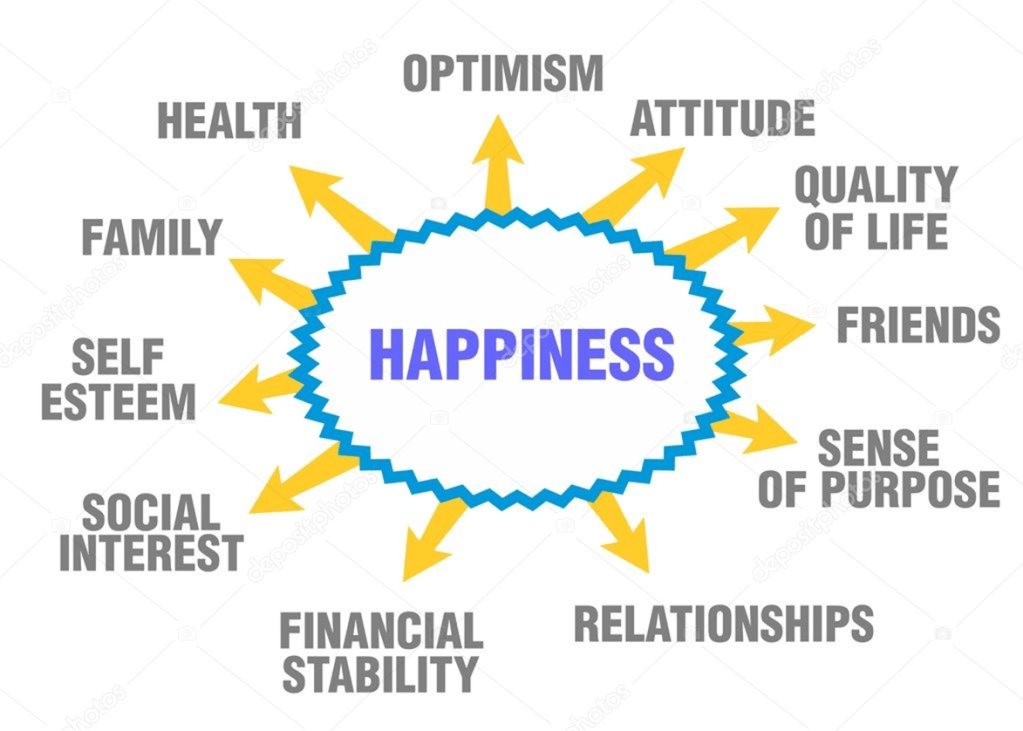
My family remains the most important, my children, grandchildren, spouse, parents, siblings, and extended family, natural and adopted, as I call my dear friends. Find what makes you happy, and develop curiosity about an array of subjects. For me, I can only think knowledge is the best brain food.

Thank you for reading.

In the Company of Kindred Spirits

Our friends joke about having a, “Covid bubble.” The Covid bubble contains a very small group of people who practice physical distancing, keep very serious sanitizing routines, and have little public exposure. We maintain a Covid bubble with a few friends. Since we still have to eat, often we choose to eat together…at a distance.

A few weeks ago, I had to travel to present a documentary in which I was involved. Humanities Kansas pays chosen speakers to talk about their projects. While I did not make the film, I was, somewhat, involved with its production. Strangers in Town. The film chronicles immigrants in a rural community and their positive impact on communities. Watch it and see what you think.

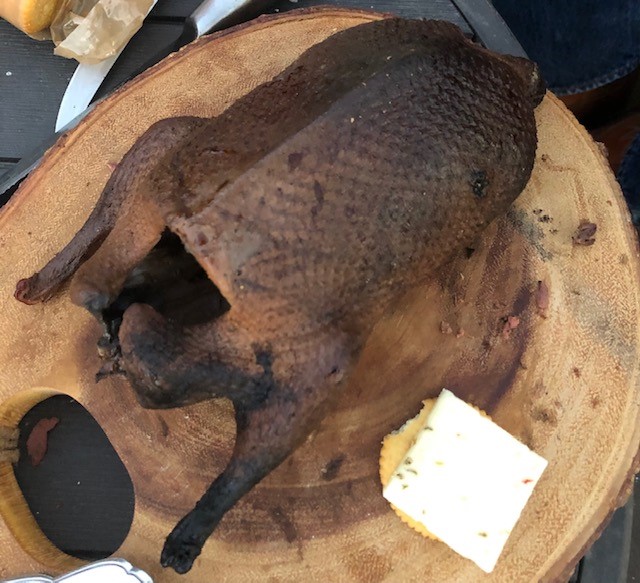
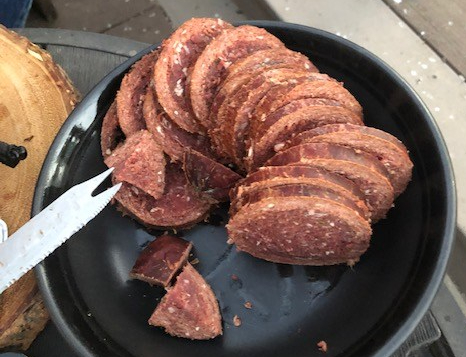
While I was in the area, we stayed with our good friends Mark and Kathy. The rest of the “Covid Bubble, ” Bob and Adrian, showed up for happy hour. Bob, an avid hunter, brought his smoked duck to the small gathering. Mark, another avid hunter, added elk smoked sausage. Adrian and Kathy added cheeses and crackers, and, voilà! We added gin and tonics to the menu for a lovely meal and great conversation. Here’s Bob with the duck:

He says the best way to smoke a duck:

Brine the duck in 1 cup (200g) brown sugar, 1 cup (273g) salt in 1 gallon (3.785 litres) for 24 hours.

After 24 hours, drain the duck. Pat dry, and place in smoker until the internal temperature reaches 155 degrees (68.33 Celsius). Cool and serve. The smoked duck and elk sausage offer nice changes in meats on a charcuterie board.

The next morning, Kathy served a wonderful breakfast of egg, bacon, and cheese on a multi-grain bagel. That delicious meal serves as my featured image for this blog. One of the many things I love about my friends is that we all like to cook/bake, and we all like to eat.
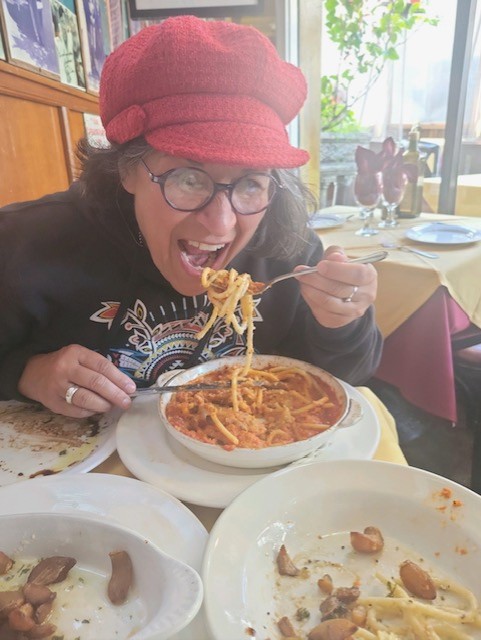
In this time of Covid, we work quite diligently at make our meals special. I know that I write on this subject quite often, but I cannot emphasize this enough. Find those moments where you can derive special pleasures even out of the most mundane things. That concept surely plays a key role in sound mental health during isolating and challenging times.
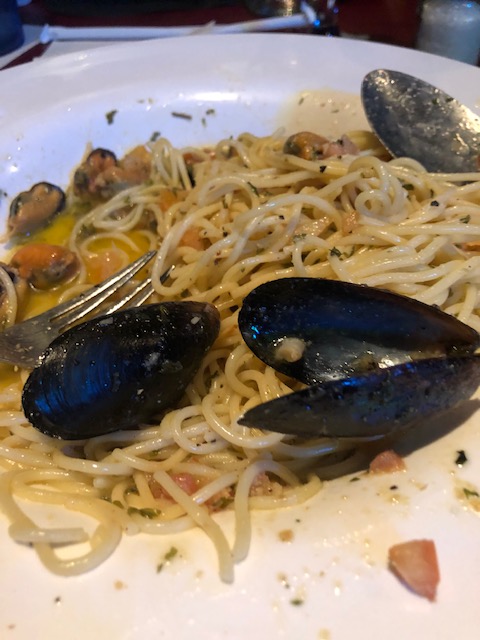
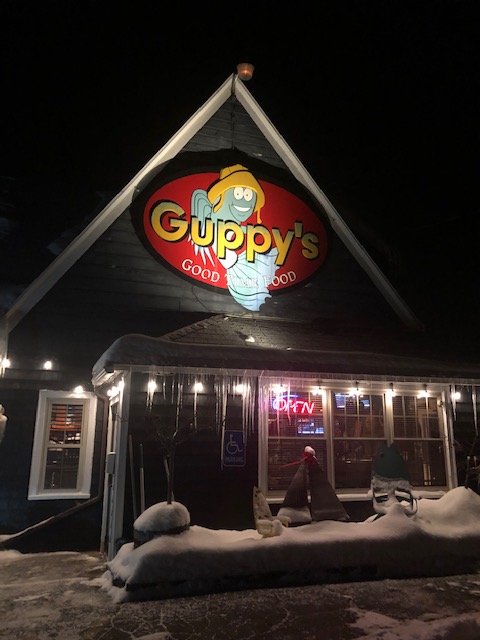
Weeks later, we took a special trip with Mark and Kathy. We drove to their second home in Western New York where lakes were frozen hard enough to land small aircraft and support hundreds of ice fisher persons. Of course, one cannot be near a lake and not partake in good things that come from water. We like to eat at a little place called, Guppy’s. They specialize in the bounties of lake, ocean, and sea waters. The evening we ate there, I had the mussels steamed in a delicate wine, garlic, and butter sauce. Come to think of it, one could steam an old shoe in white wine, garlic, and butter, and it would likely be yummy. I digress. The mussels in their sauce came with a side of linguine and a glass of chardonnay, naked, not aged in oak barrels, a specialty of a nearby vineyard.

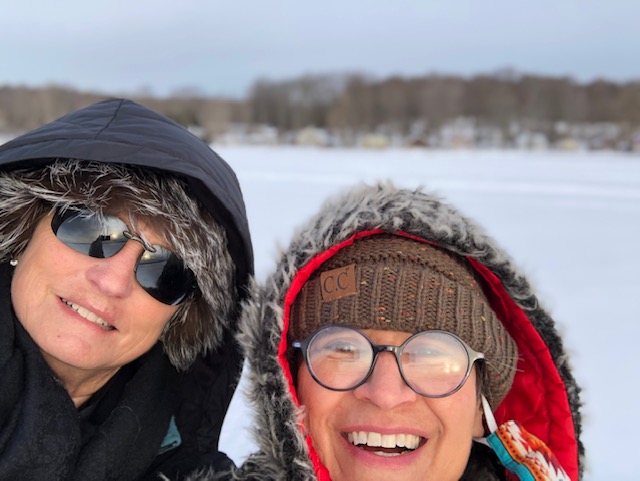
I should mention that the community posted 124 inches of snow had fallen since the beginning of winter. The frozen lake and all its charms were just one of the highlights. We traveled to Lake Erie one of the days. It had large snow cliffs where the waves had lapped up against the shore only to freeze in the process. Mark took this lovely picture of Kathy standing on one of the snow cliffs. It looked surreal at 3:00 o’clock in the afternoon. Later, Kathy and I trekked out onto the lake close to her house. I wore my vintage grizzly bear coat, popular in the 1970s, which protected me from the elements quite well.

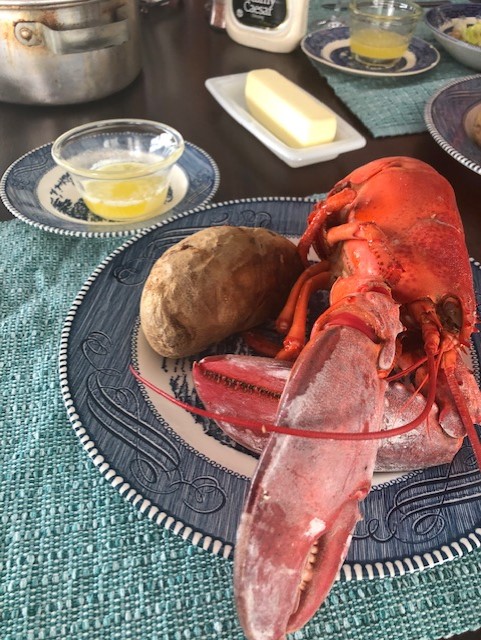
We spent Valentines Day with our Kathy and Mark at this auspicious lake cottage, so we decided to prepare a loving meal of lobsters, baked potatoes, drawn butter, and asparagus. We ate like queens and kings and washed it all down with, again, the local chardonnay. I loved it. I like a meal that makes me work hard for the sweet morsels of meat hidden behind an exoskeleton. Crusty bread made its way from Kansas to Western New York, so we had that, too.

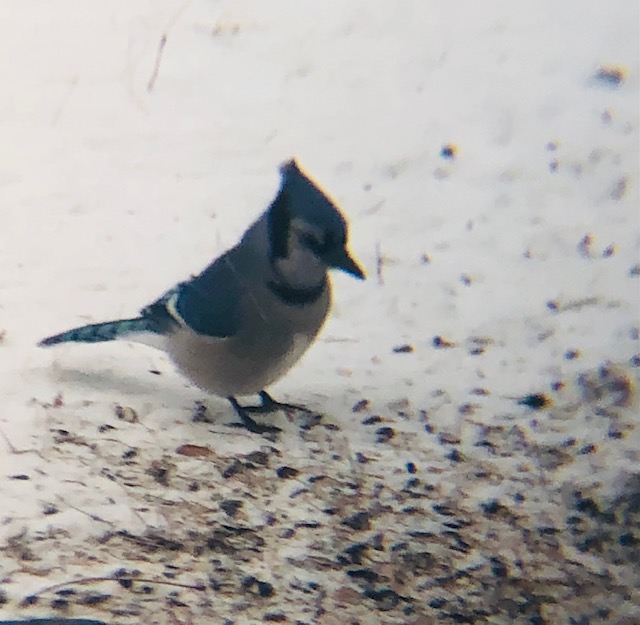
Back home again, we arrived just a few days after freezing temperatures had dipped well below zero (-15F). Our neighbors dripped the kitchen faucet for us, so we came home to a cozy house feeling lucky that no pipes had burst. We found the four bird feeders and heated water dish quite empty with only a block of feed, meant for deer, as the only remaining food for our yard visitors. They flocked back to the yard once feeders and waters dishes filled.

Thank you for reading.