As we draw near the 10th year of your passing, I want to tell you how we’re doing, because I remember that you called me every day to check on me. I know that you check on your children every day, too, even now. Today would have been your 44th birthday.
First of all, we miss you so deeply. We remember your sense of humor, your devotion to your three babies, your talents in the kitchen, your ability to draw people to you, your friendliness to everyone you met, your high vibrations, and your empathy toward others.
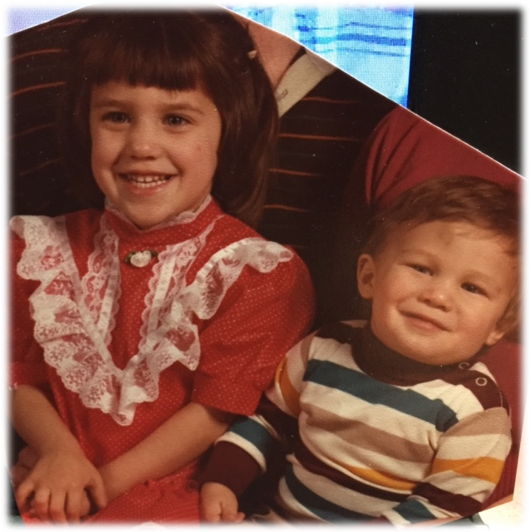
Your children are doing well. Korbin is moving up the ladder at Walmart, and he continues to cook at Coyotes, because that’s where his friends work. He loves cars, and he plays in Pokémon tournaments. Shawn is a wonderful daddy to his little girl, Nova. He is thriving at work as an HVAC expert, and he’s supervising a crew, too. He is going through a rough patch, and he tells me every time we talk, that he misses you dearly, and he wishes you were here to give him advice. Nova is thriving and seems to be a happy little girl.
Sam is in school and doing well. Her lowest grade is an A-. She is a wonderful mother to the happiest little boy I’ve ever met. His name is Finn.
I know you’d be the best grandmother for these babies. Finn loves to talk to the big portrait I have of you in my living room. He senses that you are his grandmother and that you are special.
As you know, we went through some terrible times last year, but we came through it, because we are strong. All of my GC friends were there to support us during the whole time. Your children have your strength. I see you in them every day. They learned how to be strong from you, and that is what has carried them through the tragedy of losing you, of watching their own daddy struggle with addictions, and through having a “grandpa” who only hurt them all with his deceit and selfishness. Oh, how I wish you were here to ease their pain. Please go to them in their dreams. That would help a great deal.
I know your friends miss you desperately, too! They continue to celebrate your birthday, and none of the Village misses your children’s big events, like graduations, birthdays, births, and the like. I still have some of your recorded voice, so I listen to that every now and again. I continue to ask why a wonderful young mother would be taken from her children in at the prime of her life and at the serious developmental stages of her children? You were the heart and soul of your family and of your friend group, the Village. That’s why they called you, “Mama Bear.”
Your Brother will likely light a fire in your memory tonight. The children and I will go out to dinner and reflect on your legacy.
Finally, I think of you every day. I ask for your guidance of your children. I love you, dearly, Riki, and I hope you are resting in Power!
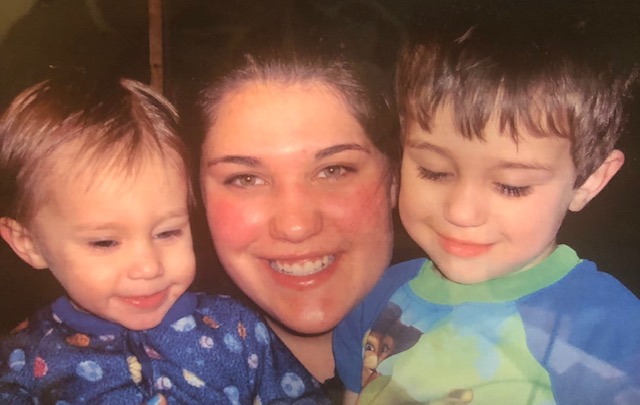
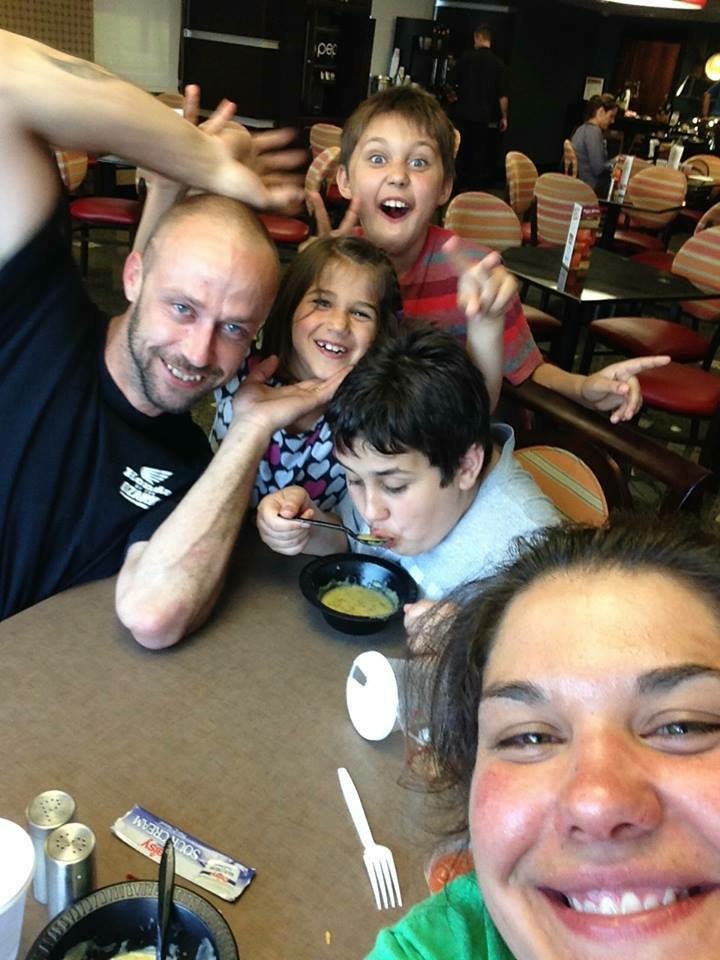
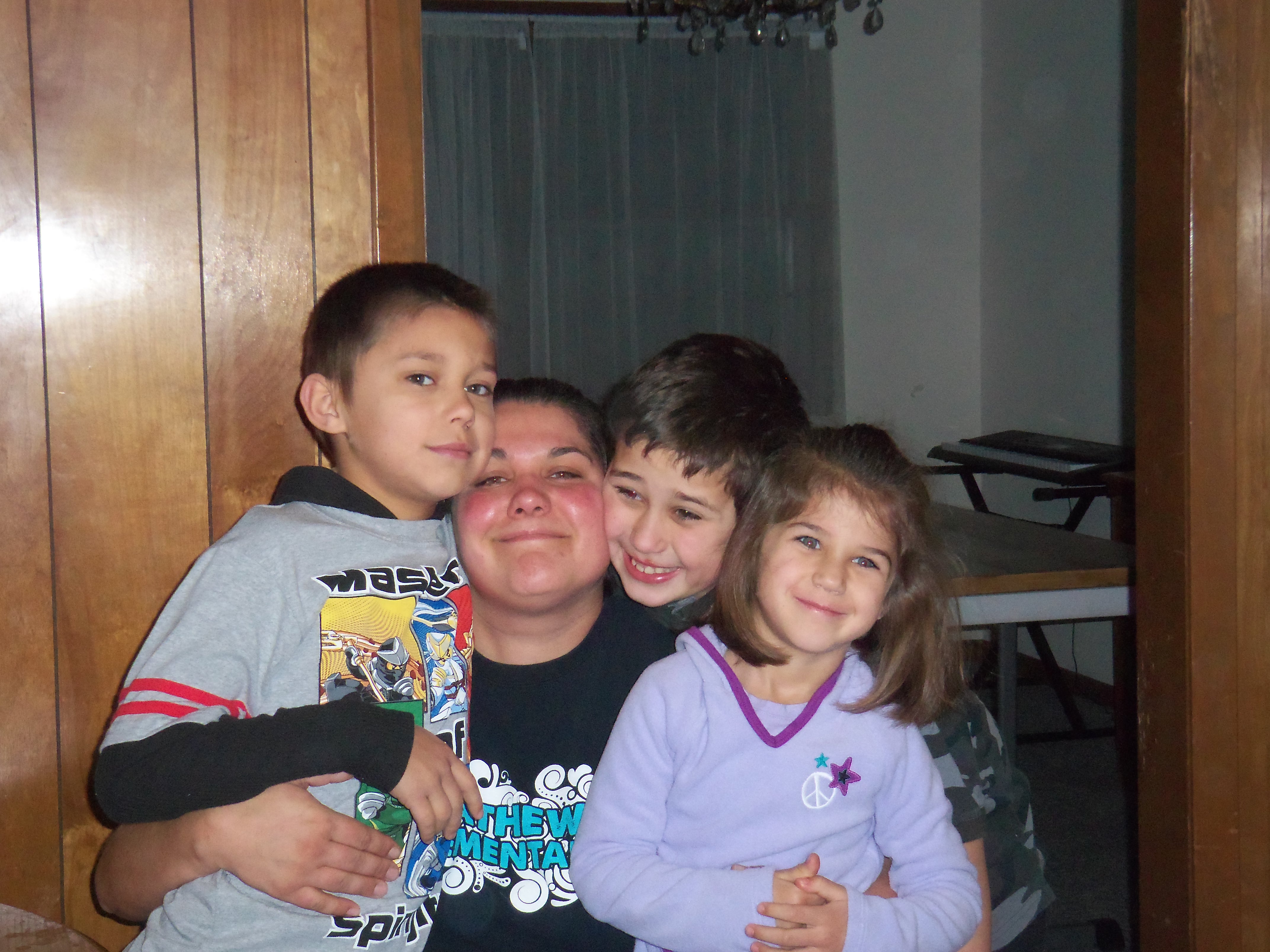
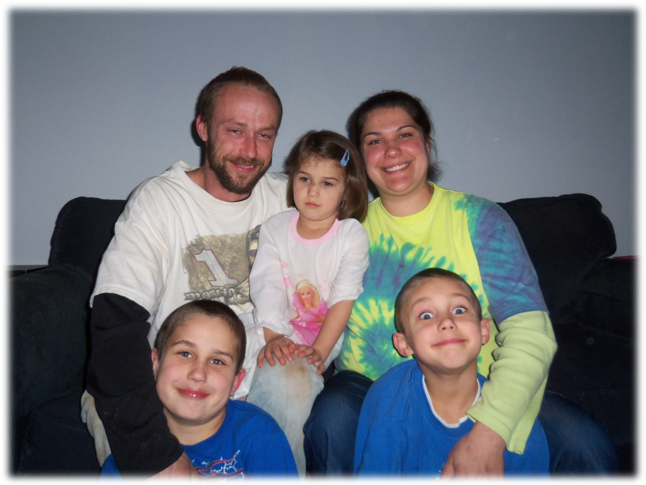
Today would have been Riki Lee Warner’s 43rd birthday. We, her family and other loved ones, continue to ask, “Why?” Why would this lovely young mother of three beautiful children, loving wife to Jonathan, best friend to “The Village,” sister, daughter, aunt, niece, and creative soul be taken from this earthly existence? Fortunately, we have our beautiful memories and photos that illustrate her never-ending smile.
Often when I think of Riki, I think of the talents that were silenced in her death. Nearly eight years ago, we embraced her before she drew her final breath. Never should a parent bid farewell to her child this way.
Today, Riki would be a grandmother. She would be thrilled to hold those babies in her arms. She would have made an excellent grandmother, as she was a loving mother. Her children were 7, 11, and 13 at the time of her passing. They continue to thrive as young adults, and I observe that they demonstrate the values taught to them by their mother, especially when it comes to resourcefulness, problem-solving skills, humor, and curiosity.
Riki loved to create in the kitchen. Some of her specialties were chicken with homemade noodles, homemade bread, “Build your own” taco bar, and other specialties loved by her children. Riki was director of nutrition for a school district, and she won a new recipe competition to add to the school lunch menus across the state, where she lived. Her recipe was chicken bacon ranch pizza. She took her then six-year-old daughter, SLW, to be her sous chef in the competition. I am confident that they made the best partners in this competition.
Riki was loved by her friends, who continue to celebrate her birthday. Now, we will celebrate this evening in a gathering promulgated by her, now, 16 years old daughter. Last year for Riki’s birthday, one of her friends, since middle school, reached out to me with a beautifully written memory. Joey closed by thanking me for “bringing this beautiful soul into this world.” Though Riki had been out of high school for 15 years, many of her teachers and school administrators reached out with beautiful memories and condolences after her passing. She made an impact in the many spaces and with the many people she encountered. She did not pass judgement and was kind to everyone.
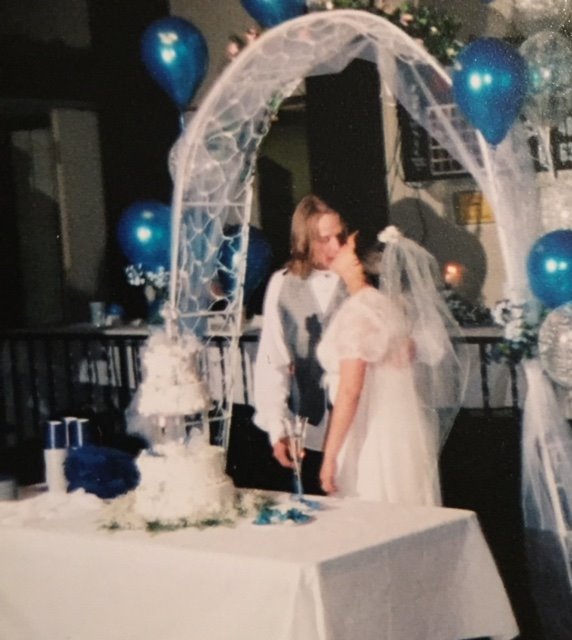
Riki and Johnny were best friends in 6th grade, a popular couple in middle school, and they tied the knot in 2003 when they were in their early 20s. They had three beautiful children who miss their mother dearly. Her brother, Stevie, who usually has his own birthday remembrance for this sister, will join us this evening, too.
My featured image is one taken on the patio next to my building on campus, which is two years old. The dear dragonfly landed on wet concrete, lost his life, but left a lovely image that one can enjoy when sitting on the table next to it. The dragonfly lives on…
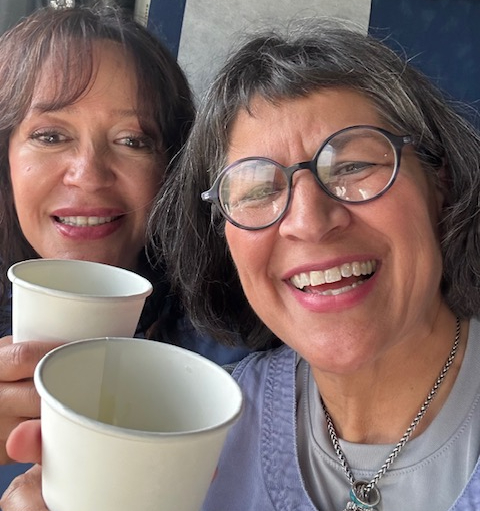
This long read functions as my trip diary. My summer began on May 13, 2023. The graduate school has its ceremony on the second Friday in May, so the next day, I headed to Colorado, to celebrate Mother’s Day. On Monday the 15th, my sister, Eileen, and I boarded the California Zephyr to head to San Francisco. I love riding the train, which I do quite often. It was my sister’s first time on the Amtrak. The train departed at 4:10 pm, and away we went. Before we embarked, I mixed a cocktail for us to have a toast to our journey. We settled for paper cups since I had no access to proper glasses.
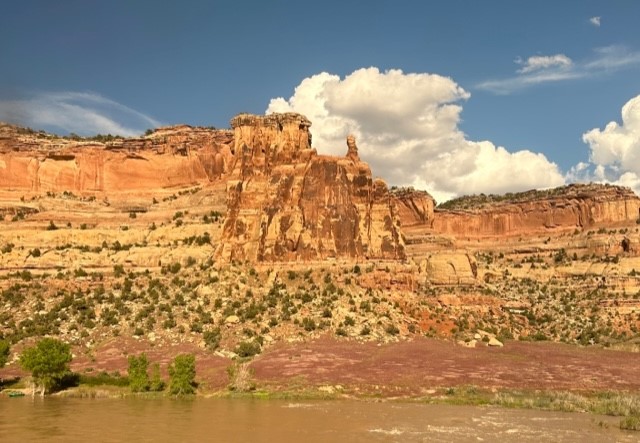
Some of the beauty seen along the way includes the magnificent Colorado River, fabulous geological structures, and brilliant colors. I care not for the rafters on the Colorado that insist on showing the Zephyr passengers their breasts and butts! None too impressive.
We had lovely meals on the train, as per usual. The meals come with the roomette, which is for two passengers. One of my favorite things about train travel includes permission to self to sit and enjoy the ride. I usually bring a book for the return ride, but my sis and I talked the whole way, both directions. I love meal times, too! There are four to each dining table, and when one’s party is two, one gets to meet two other people to be dining partners. This was my 10th train trip on the Amtrak system in the U.S., and I still think that the most friendly people ride the train. At least those remains my experiences in the dining cars and in the observation cars.
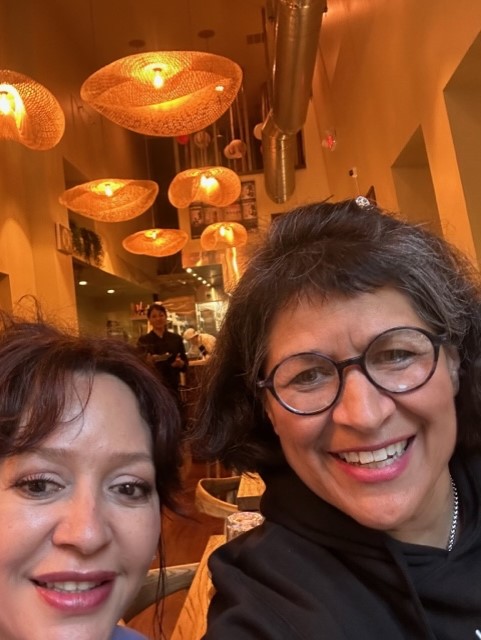
We arrived in Emeryville 24 hours from embarking in Grand Junction, CO. Passengers heading to San Francisco must take a bus across the Bay Bridge to get to the City. We lodged into our hotel by 6:00 p.m., cleaned up, and went hunting for our first dinner in SF. Not far from our hotel, at the entrance to China Town, we found a lovely Asian bistro, called, NOMA. Great staff, and great food. Here’s a glimpse:
We turned in early for a big day on our first, full day. I like to travel with a bit of food, just in case, so we made coffee in the room, and we ate energy bites that I made for the trip. One little “bite” has oatmeal, raisins, cinnamon, honey, and almond butter. Mix all the ingredients and form into spheres about the size of a golf ball. They taste delicious, and just one makes a great breakfast with a hot beverage. That gave us energy for a long morning until lunch.
Our hotel was not too far from Pier 1 on the Embarcadero, so we went the opposite direction on Bush to head toward The Golden Gate Bridge on the opposite side. We walked by retail spaces, auto repair and sale garages, beautiful homes, and tourist attractions. We walked past the homes on Nob Hill and the area surrounding Lombard street. We checked on the prices of those homes for sale. Even the most “simple” homes were priced at 9 million! We marveled at the gardens (a.ka. “yards”) in front of the homes with fruit trees, wild growing rosemary and fennel, and tropical plants. Once we gazed at the Golden Gate Bridge, we began to descend the many stairs toward the Palace of Fine Arts.
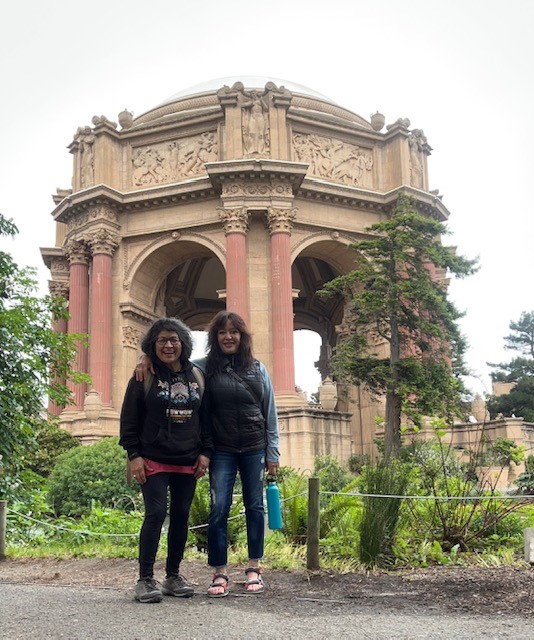
Travels with my sis, Eileen, proved to be a most marvelous time, because she is curious and interested in her environments of flora and fauna. We loved the beauty of the Palace of Fine Arts, built for the 1915 Panama-Pacific Exhibition. From there, we could see most of the peninsula that is San Francisco. All this walking, and a little bit of foraging on the edible flora, we became hungry, so we headed to Fisherman’s Wharf.
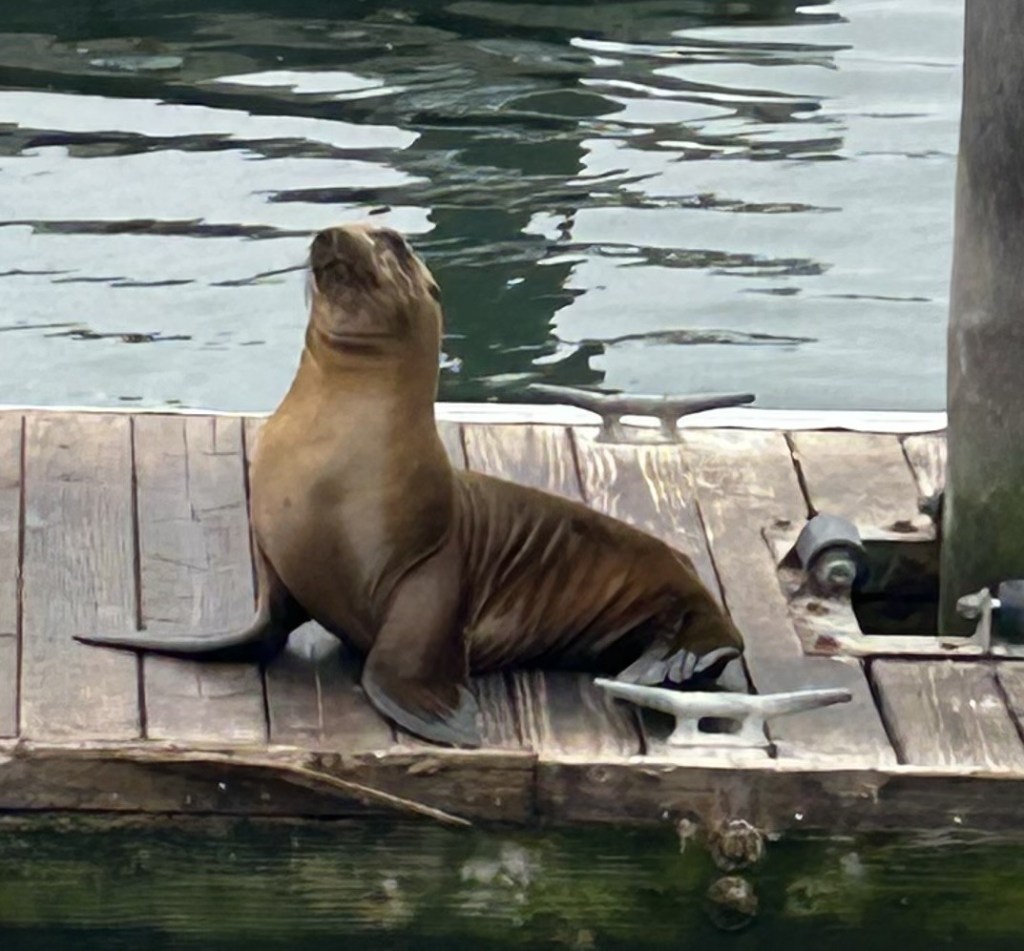
One of my favorite things about the Wharf is the Maritime Museum of once active sea-going vessels, such as the Balclutha, which was closed for “safety concerns.” Years back, I attended several Sea Shanty Sing-alongs, but those were not happening this time either! Of course, we enjoyed the sea lions at Pier 39, too. On to the food…
Fisherman’s Wharf’s fame lies in its many food and local memorabilia. We found one of my favorite open-air fish market/dining places that serves clam chowder in a sourdough boule hollowed out to make a bowl for the chowder. Delicious! Then we wandered over to Ghiardelli Square to chocolate. Most of it was closed for remodeling, so we just saw the small retail store selling the famous chocolates. The walk prepared us for the Hotel Buena Vista for Irish coffee and a most friendly bartender!
After the coffees, we headed to Columbus Ave to visit City Lights Bookstore, as I do on every visit to SF. As per usual, City Lights Bookstore was a haven for readers, and the second floor dedicates itself to the Beats and their literary progeny. We found some books, some by Lawrence Ferlinghetti, the father of City Lights. Sadly, the clerk that waited on us was one of the most sour individuals I’ve ever met! I wondered why he was so rude and dismissive. What is a person like this doing in this haven for literature? I thought maybe he was having a rough day, so I gave him the benefit of the doubt. Nope! We returned two days later only to find the rude guy waiting on us again. He was pleasant to look at, but he, apparently, has a black heart! On to purchase dinner…
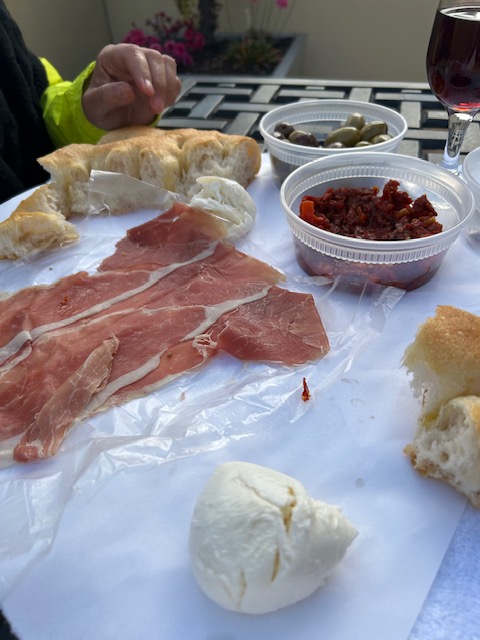
After City Lights and a picture-taking opportunity of Vesuvios (Featured in Mike Myers, So I married an axe murderer) we found Molinari deli with the most beautiful assortment of Italian cured meats, locally made mozzarellas, in-house made bread, and many delights.
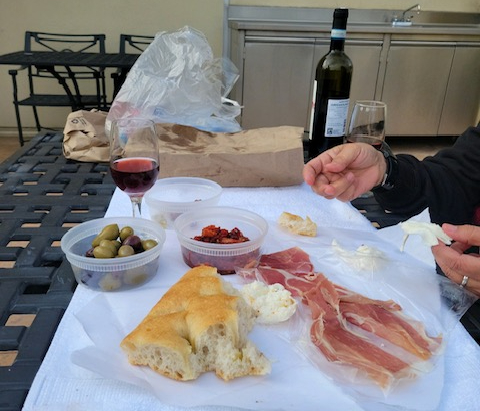
We procured a lovely supper of meats, cheeses, olives, sun-dried tomatoes, bread, and wine to enjoy on our hotel’s roof top. Oops! I failed to mention that we stayed at the Orchard Hotel near the entrance of China Town. It has a lovely roof top with tables, chairs, and views of San Francisco! We took our lovely dinner to the rooftop where we enjoyed a chilly evening with great food and wine.
We had leftovers, which we enjoyed at the train station in Emeryville while we awaited our east bound Zephyr on Saturday morning. We retired to bed after a day’s walk of 12 miles, great food, and breath-taking sights. On to Thursday’s adventures…
Early to rise, and after a small breakfast of my energy bites (1 cup oats, 1/2 cup honey, 3/4 cup raisins, 1 cup almond butter, all mixed and formed into a golf ball sized sphere!) and coffee before heading to the Embarcadero, Pier 31, to board the vessel that took us to Alcatraz.
My main interest in visiting Alcatraz was to honor the “Indian” occupation in the 1970s. We were protesting the generations of erasure pursued by congress. We are still here! From Alcatraz, one can only imagine the gorgeous vistas from this place of imprisonment for crimes ranging from theft of fewer than $100 to murder, all in the same place. Yes. People should be held accountable, but some who have done worse are still walking free.
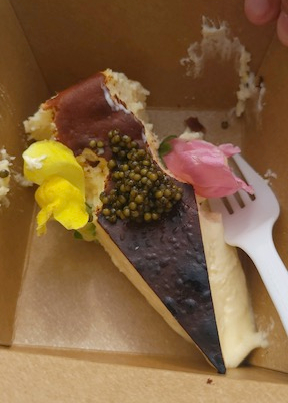
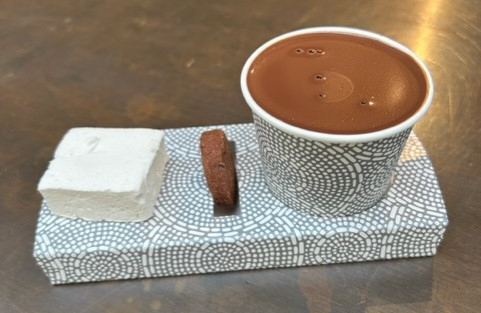
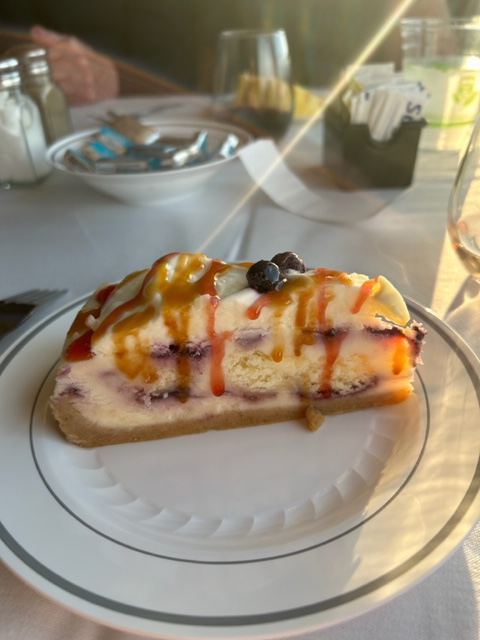
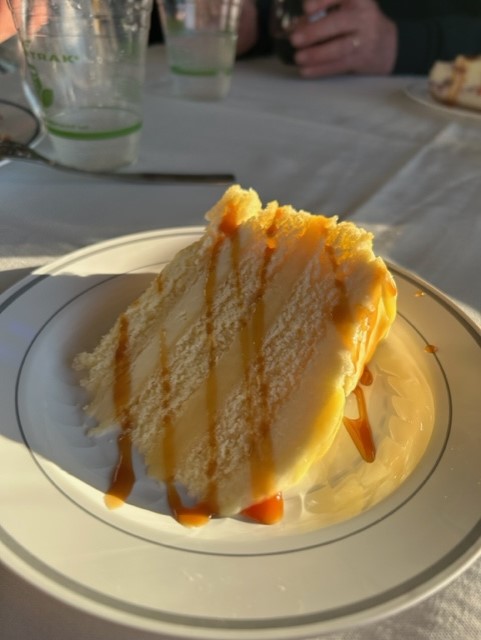
Back to Pier 31 by noon, we were ready for finding food! Luckily, The Ferry Building is near Pier 1, and though it was a bit of a walk, it was worth it! The Ferry Building, now the Ferry Building Marketplace, was built in 1898. While it had some decades of decay, it stands in a state of continual renewal and reimagining. It hosts vendors in an enclosed “farmers’ market” style of booths ranging from caviar to fungi, and all foods in between. For two foodies, it was hard to settle on one cultural food choice, so we combined different taste profiles. For some reason, I didn’t get pictures of our meal, only our desserts: cheesecake with caviar and Aztec chocolate with marshmallow! Yum!
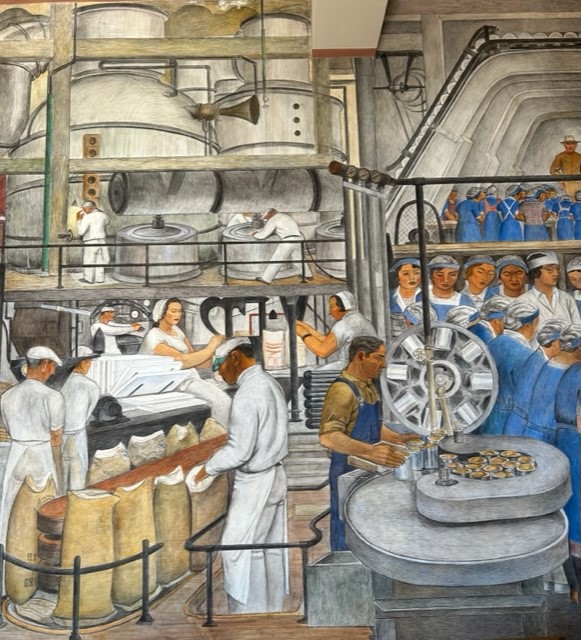
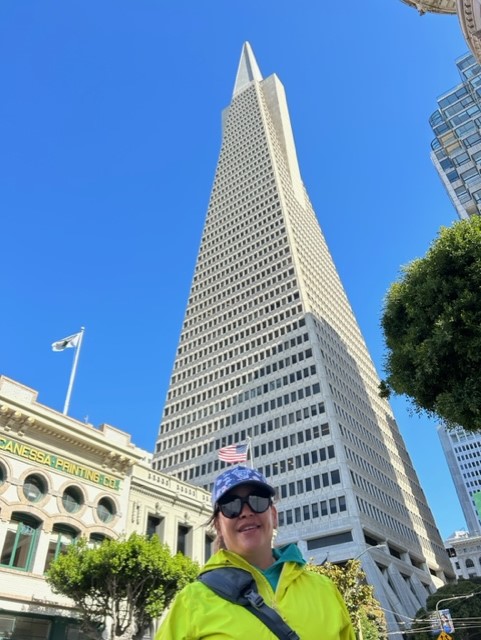
After lunches, desserts, and drinks at the Ferry Building, we headed out for more walking. We ascended the steps to Coit Tower, walked around in surrounding neighborhoods and headed back to the hotel after we took pictures with the Transamerica Building.
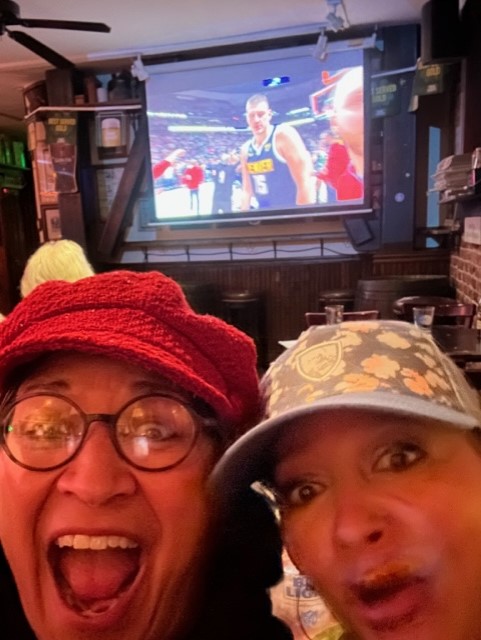
Since Eileen’s husband is a rabid Denver Nuggets fan, we had to find a place to watch one of the playoff games, and we found an Irish Pub with the game. We ate corned beef and cabbage with a nice Guiness while we watched the game. The Nuggets went on to become world champs!
After 9 miles of walking, we retired to sleep eager for our final, full day in San Francisco.
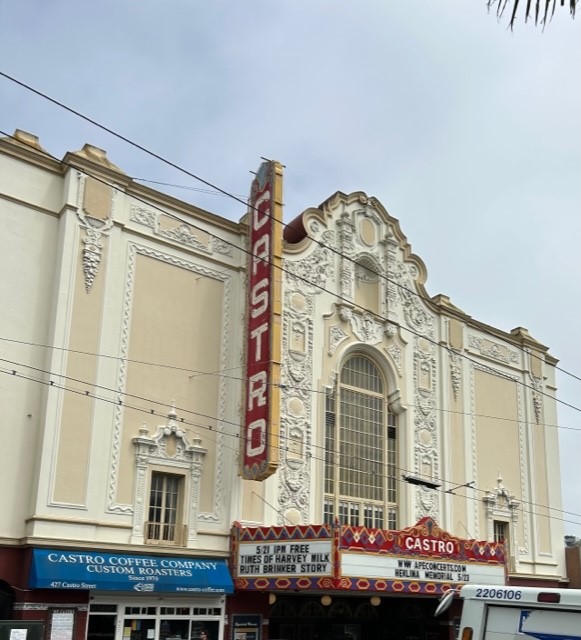
Friday, being our final day, we opted for public transportation since the cable and street cars are moving museums. First we went to the Castro District. Sadly, the theater was dark that week. We walked around, and had a snack.
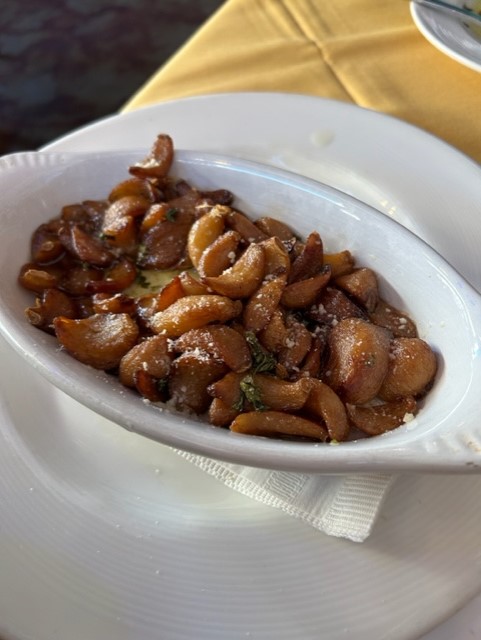
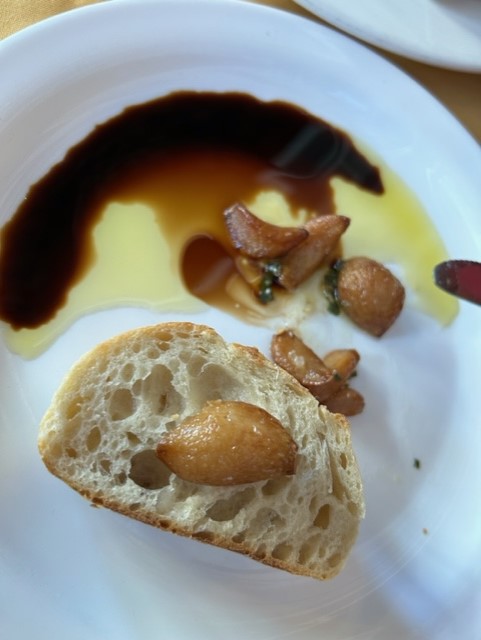
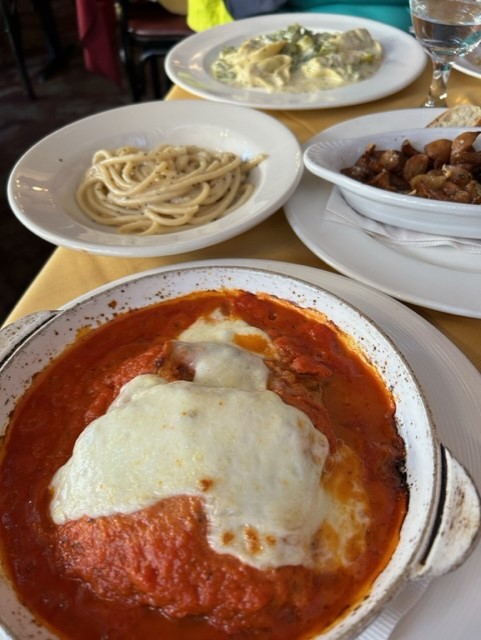
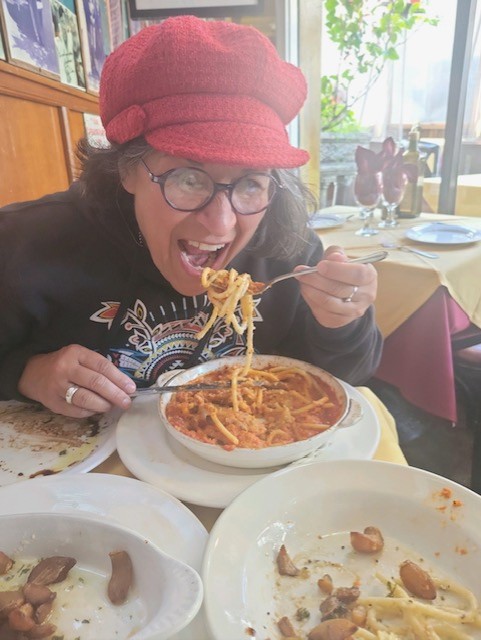
Then we rode the street car back to a point to catch the cable car to Fisherman’s Wharf, for some memorabilia. After much walking and site seeing, we headed to Columbus Ave. for our final big meal at the Mona Lisa, known for their Sicilian Caviar, which is garlic baked in butter and olive oil. I can just imagine how we reeked!
We returned to our hotel, packed our suit cases to prepare for our return trip, and fell into restless slumbers for an early morning departure on a bus from SF and across the bay to Emeryville to board the California Zephyr east bound.
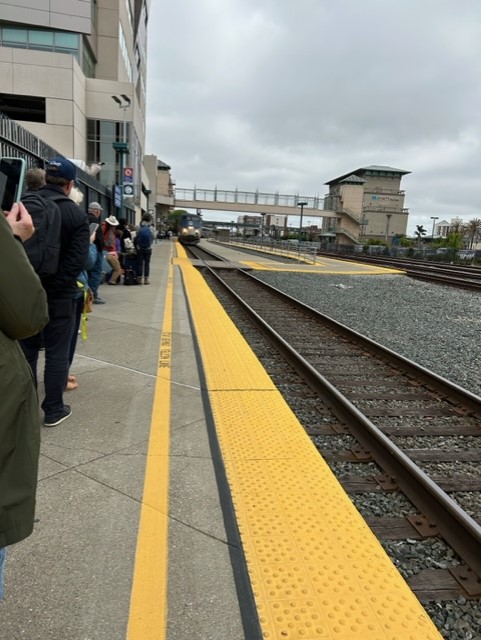
When we arrived in Emeryville, we learned that the train would be six hours late. That’s okay. I love the train! Since we were in for a long wait, we savored a nice breakfast of leftovers from Molinari and Boudin Sourdough, and I made bloody marys with tomato juice from the snack stand. It was a great feast! Is this a travel or a food blog?
We boarded the Zephyr and recounted the great stories of our adventure. Eileen is the best of travel companions. We compliment eachother’s travel styles. She does research on prospective experiences, and I fly by the seat of my pants! Here are some of our final sites.
Now that we’re shedding out winter blankets, in the Northern Hemisphere, it’s time to think about warmer weather. Often times, we tend toward a more sedentary life in winter weather. That means we may gain a few pounds, lose a little muscle mass, and our motivation decreases. How do we keep this all in line so that we experience optimal health year around? My answer? Holistic Self-Care.
About a month ago, I reached my 66th birthday. The day before my 66th year, I taught a self-care class for my co-workers. It was fun. I called it, “Finding Hygge and Other Emotional Well-Being Concepts.” I’ve written about hygge and other forms of coziness in previous blog articles. I had a co-worker take the picture you see in the “featured image.” That was for my “Meet Your Presenter” slide in the power point for my workshop.
Let’s get started.
I offer this lovely image that I call, “Sunset on the Flinthills” as a gentle reminder for you to bring the natural world into your time reading this and for engaging in self-care practices. Here are some learning objectives:
Self-advocacy promotes equity and belonging
Health and well-being practices promote physical, emotional, social, and occupational well-being
Long-term outcomes include increased confidence and overall well-being
“When we cultivate environments of well-being, we see each other as holistic beings who seek fulfillment through work, leisure time, and personal or professional development. We strive to engage in self-care when necessary and without judgment.” -Bolton
Let’s Breathe
I borrowed this image from social media promoting a Mastery of Self, a book by don Miguel Ruiz Jr.:
Sit quietly with all distractions muted as best as possible.
Circle arms above head while inhaling – then exhale. Do this 8 times.
Breathe in through your nose and out through your mouth: 8x
Inhale to the count of 5 – Exhale to count of 5: 8x
Place your hands on your diaphragm and breath out with a loud “ho!”: 8x
What is Holistic Health and Well-Being?
When we think of when we humans are at our best, there are many needs that must be met. I could bring in Maslow’s Hierarchy of Human Needs, here, but you likely know what those are, and this reflects that, too. I think most humans work toward self-actualization. Here is what we need:
Physical needs – Food, clean water, oxygen, elimination, clothing/shelter, sleep, and movement/activity for sensory and motor stimulation
Mental/psychological needs – attachment, orientation/control, self-esteem, pleasure, and avoiding pain
Spiritual needs – Meaning, purpose, to love, and to be loved
Social needs – Relationships, belonging, respect, affirmation
What under-girds each of these human needs, of course, is SAFETY?
Safety means, security of body, employment, resources, our moral codes, any type of family, optimal health, and a place of one’s own. Can you image what happens to humans who do not have the privilege of holistic health and well-being? Can you imagine what happens to the human psyche when one is displaced due to war, poverty, colonization, or no job opportunities?
We must feel safe and affirmed in any space in which we navigate. All of these needs move forward once safety has been met.
On another note of importance, we must understand others’ identities and how those identities may contribute to feelings of non-safety when others view them as lesser than, who don’t belong, or somehow don’t fit in. Remember, there are those who do not feel safe in certain environments. That happens when basic human needs are not met. Abraham Maslow was absolutely correct when he talked about basic human needs as critical to thriving.
Our Own Cultural Behaviors Contribute to Our Senses of Work, Rest, and Play
A dominant cultural behavior of the United States is work, work, work. Brené Brown tells us that “crazy busy is a great armor. It’s a great way for numbing. What a lot of us do it that we stay so busy, and so out in front of our life, that the truth ow how we’re feeling and what we really need can’t catch up with us.” I see this in my work place when my colleagues boast that, “I’m losing vacation days, because I don’t use them!” Unfortunately, that is an ethos that is honored in my work place. That is the opposite of praising for self-care.
Think About You:
What are some things you do to wind down after a hard day at work?
What are ways in which you balance work and rest?
Is “winding down” a practice you do?
Most of us are not in survival mode nor are we in subsistence mode. We tend to forget about “self-care” mode. Let’s change that practice!
Let’s Stretch
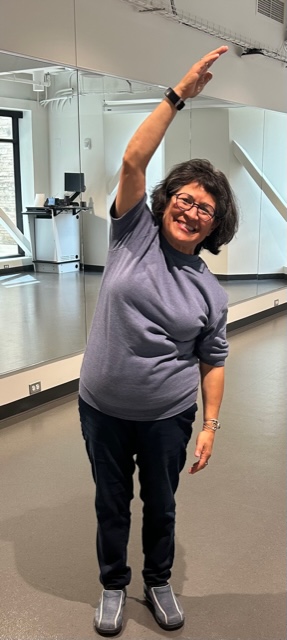
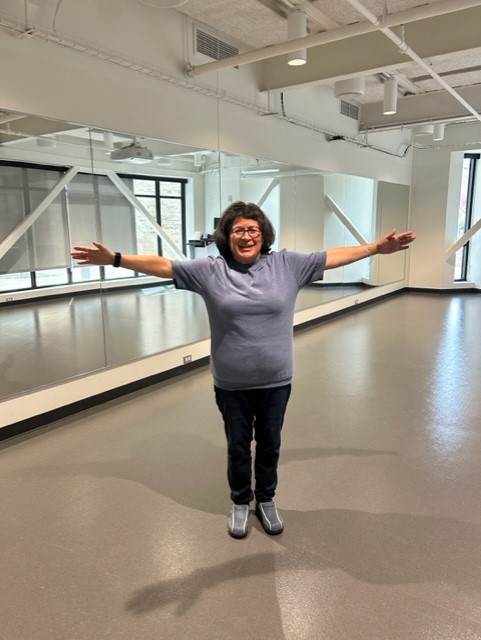
Stand tall and reach for the sky with a full inhalation. Drop your arms as you exhale. 8x
Stand tall and reach from side to side over your head. You will cross your right arm over to your left side and vice versa. 8 x
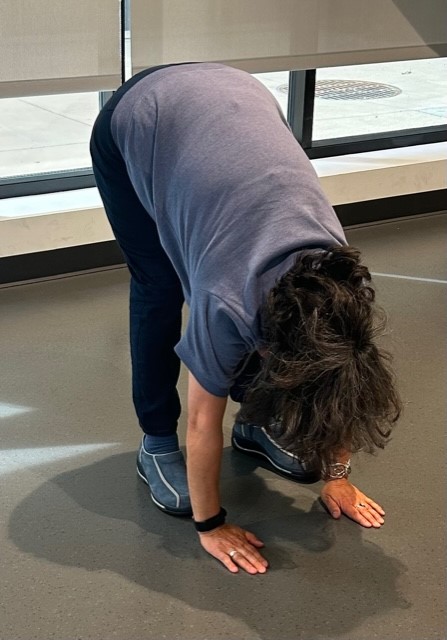
Stand tall and reach for the sky. Take deep breaths. Reach up, and then bend to touch the floor. 8x
Now, squat low and stretch your inner thighs to a ten count on each side. 8x
Take This Moment to Reflect
•What gifts or talents do you possess?
•What new characteristic did you discover about yourself recently?
•What are you grateful for?
–Looking to the future
•Which value or action would bring you closer to a vibrant way of living?
•If you have or would design a personal ritual, what would it be?
•Have you found a way to focus on your successes?
•What kind of person do you strive to be?
•Have you ever thought of naming what you want your life to be as a chapter in a book?
What is Mental Health?
“…a state of well-being in which the individual realizes [their] own abilities, can cope with the normal stresses of life, can work productively and fruitfully, and is able to make a contribution to [their] community.” (WHO, 2004, p.12)
= positive capacity = social and emotional wellbeing = behavior, thoughts and emotions
≠ mental ill-health* ≠ happiness
Open dialogue on Mental Health
In you own words, what does the phrase “Mental Health” mean to you? What definitions/connotations does this phrase evoke?
Mental Health Defined
Its important to recognize that mental health encompasses our recognition of adapting ourselves to our surroundings in a way the promotes our well-being, while still acknowledging the experience. I say this to note that mental health isn’t singularly about being “happy” (especially not all the time). That is an unrealistic or attainable standard for mental health and ignores that we utilize all of our emotions to make sense of our experiences.
Prioritizing mental health ensures we are taking the necessary steps to alleviating those stresses while retaining our functionality in life. We see this in
-Driving personal development
-Seeking out and maintaining relationships with others
-Positive & Affirming
-Speaking Up when in need / communicating our concerns/problems to others who can help
-Expressing our Emotions
-There is no such thing as a “bad” emotion, its how we understand them and express them
-We all feel sadness, anger, joy, etc. We need to see all emotion as natural, but learn how to cope with them as they come
-Last example is a continuation of development
-When we stop problem solving, or setting goals we can slip into states of ill-health that can perpetuate the stresses we are experiencing
So now, what is ill-health?
How Do We Maintain Our Balanced Mental Health?
Personal Development
Positive/Respectful Relationships
Open Communication
Identify/Understand/Expressing Emotions
Setting Goal / Problem Solving / Taking Responsibility
So, Then Ill Mental Health May Be…
“… a spectrum of problems that interfere with an individual’s cognitive, social, and emotional abilities including both ‘mental health problems’ & ‘mental illnesses’”
Reflect
Stress is a normal response to situations
It includes both eustress (“good” stress) and distress (“bad” stress)
Stress responses vary based on the person
What does stress look like during an infectious disease outbreak?
Fear or worry about your own health
Fear or worry about the health of a loved one
Changes in sleep or eating patterns
Difficulty sleeping or concentrating
Worsening chronic health problems
Increased use of alcohol, tobacco, or other drugs
Stress can impact your body, thoughts, feelings, and behaviors- it can effect so much!
Body- headaches, muscle tension, chest pain, tiredness, upset stomach, etc.
Mood (including thoughts and feelings)- anxiety, restlessness, lack of motivation, feeling overwhelmed, irriability or anger, sadness or depression
Behavior- changes in appetite, angry outbursts, drug or alcohol misuse, tobacco misuse, social withdrawal, exercising less often
Self-Care is More Than a Hot Bath or Taking a Day from Work
Here are two quotes from researchers who study human behaviors in societies that push for power and material wealth.
Thank you for reading me. I hope this can be a nice road map for returning to a healthy way of life.
The kitchen window over my sink gives me great pleasure, because I see beautiful juniper trees, and I’m looking through colored glass!
Every time I cook a meal for myself, I think, “I should write about this in my blog!” It seems like I hesitate to write. I like having written more than my desire to write, sometimes. Two of my favorite pasttimes are writing and cooking. It’s great to share these loves.
Many of my friends love to cook! We used to make it a common practice to take turns hosting dinner parties. Then I moved. Establishing oneself in a new community takes time. Perhaps I don’t know the “right” people for such a thing, but I will keep trying. I love to cook, and I love to entertain.
Many people do not like to cook for themselves. I find it relaxing after a tough day at work. I use my mind in a different way than what I do at work. Music always accompanies my time in the kitchen. Time in the kitchen and listening to music are one of the places and times where/when I find my coziness (Hygge).
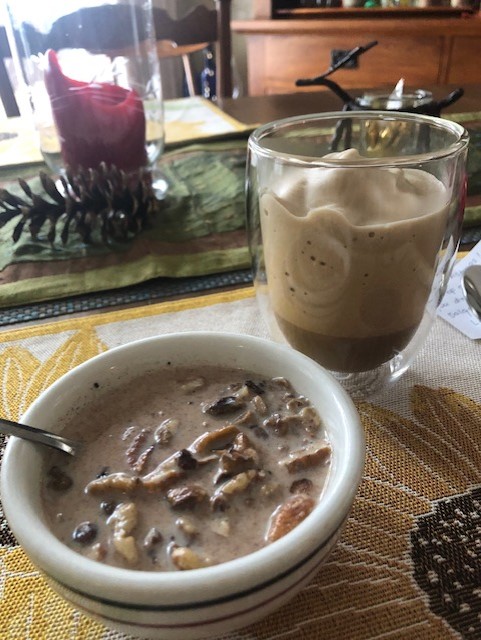
Let us begin with breakfast! My morning routine consists of drinking a lemon/olive oil system cleanser. I make it with 8 cups of water, two whole lemons, a dash of vanila, and four tablespoons of good olive oil. I blend it in 4 cups of water, and then I add the other four cups. Strain it into a half-gallon bottle. I drink 4-6 ounces before 30-minutes of exercise while listening to daily affirmations. Then I prepare my breakfast. Pictured here includes homemade granola (I think the recipe is found in a much earlier blog of mine). Some times I like to eat it was plain yogurt and honey, and other times I like to pour milk on it. I’m having this with a frothy coffee that I prepare in an electric milk frother.
The spices in my granola turn the milk a little murky looking, but the delightful flavor and crunch make it great!
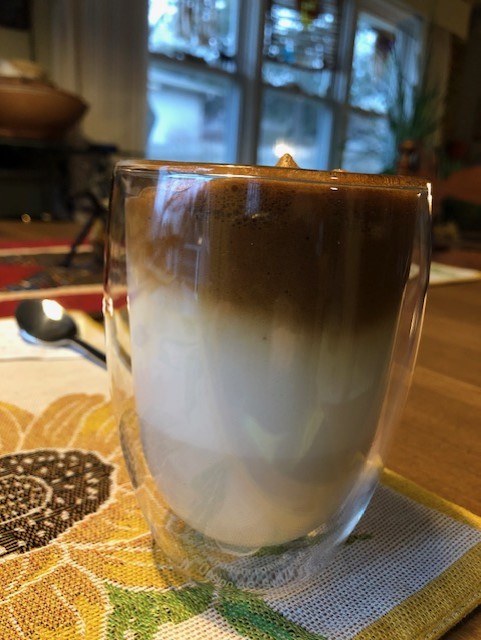
This “Dalgona” coffee was made by whipping the instant coffee in two tablespoons of hot water. The middle layer is frothy milk, and the bottom layer comes from the frothy milk and whipped coffee blending.
This breakfast features homemade bread for the toast, peanut butter, raisins, and hemp seeds for added protein. It tasted great with a steaming cup of chai!
Winter drags out, but spring will be here soon, and the weather will be more amenable to having breakfast, lunch, or dinner out on the back deck or the front patio. During the pandemic and working from home, I took many breakfasts al fresco so that I can watch birds. Two rivers flow on the outskirts of town along with a 30-mile long creek/reservoir. That means we have bald eagles flying over town. What a better way to eat breakfast?
Often times, my breakfast may consist of left overs from the previous night’s dinner. I tend to eat anything for breakfasts. My 93 year old mother finds that “really weird” that her daughter eats “odd” things for breakfast. She defines “odd” as anything that is considered a “non-breakfast” item, like what we ate the night before. I have no such restrictions on myself. Lunches often consist of dinner leftovers, too.
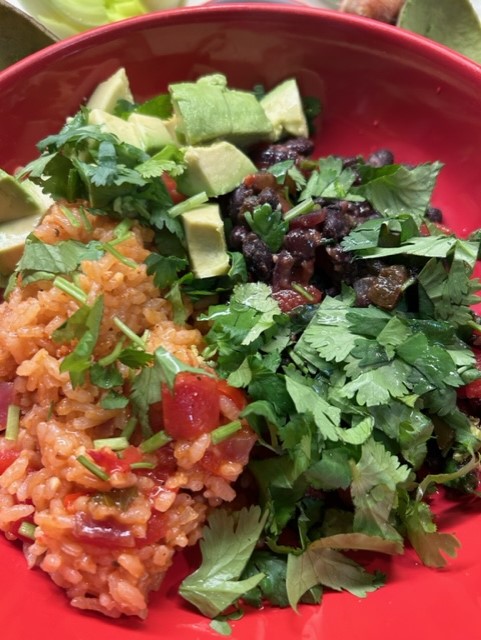
This is a black bean burrito bowl. It can be vegan, but I used chicken stock to make the Spanish rice.
With social media, magazines, and cook books, one can always find new recipes. Of course, magazines and cookbooks contain such beautiful illustrations of the process and the final product. I like to read ingredients lists, which I think are there for suggestions, but recipes are meant to be experienmented with and tailored to fit your favorite flavor profiles. Most cooks know what kinds of spices go with specific dishes. I like to change it up sometime, so I will share some of those here, too.
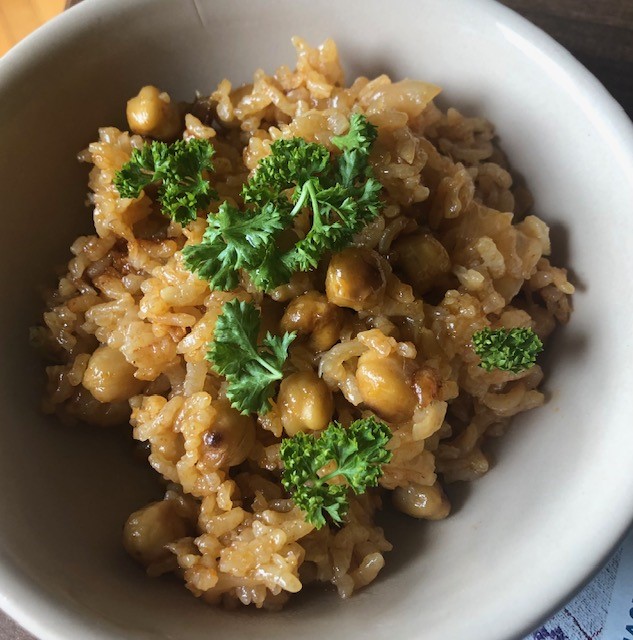
This is a take on Jollof Rice with seasonings given to me by a friend from Ghana! I used garbanzo beans instead of lentils, because I had no lentils in the house!
With the two illustrations of rice dishes, I found these recipes online. Remember, when you cook with dry beans (garbanzo or black), since they are likely not “new crop” means that you must soak the beans to re-hydrate them before cooking. I don’t have access to new crop garbanzo or black beans, so I do soak and rinse before cooking them. Always add boiling water to your cooking pot. It helps the beans maintain their color and it helps them hydrate quicker in the cooking process.
I make the distinction between older pulses (legumes), because I love pinto beans, and I only buy new crop. They do not have to be soaked. Simply rinse and add to boiling water, which makes for a quicker meal. I get my new crop beans (usually harvested in late September or early October) from a farm in Colorado. The variety of pinto beans that I love is called, “vibrant,” and vibrant they are!
Sometimes a simple lunch can be grilled cheese, with marinated cucumbers and red onions with sparkling water.
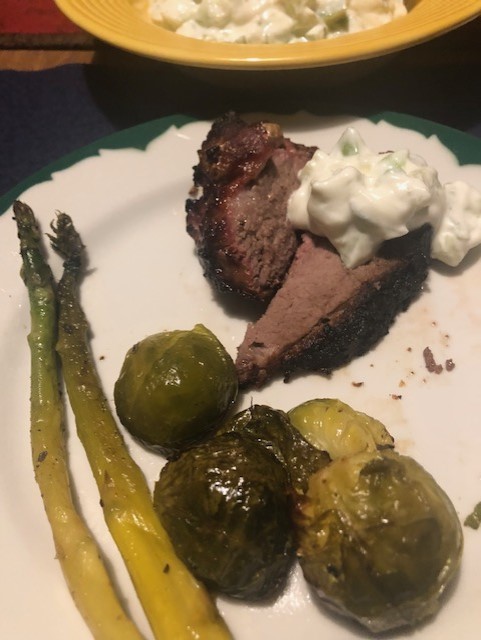
When my grandchildren visit, lamb, Brussels sprouts, and asparagus are always on the menu. They set the menus in these cases.
This simple supper of tuna patties with homemade tartar sauce and a light glass of buttery chardonnay makes for a lovely meal.
I did not share my recipes in this blog today, because I think it’s fun to explore your own preferred flavor profiles. You likely know that some herbs and spices combine with certain ingredients. For example, I never put green chili in my marinara sauces, but I do add green chili to my bean and corn soups. You figure it out, if it interests you.
I realize that cooking or baking does not appeal to everyone. I present this as something that appeals to me.
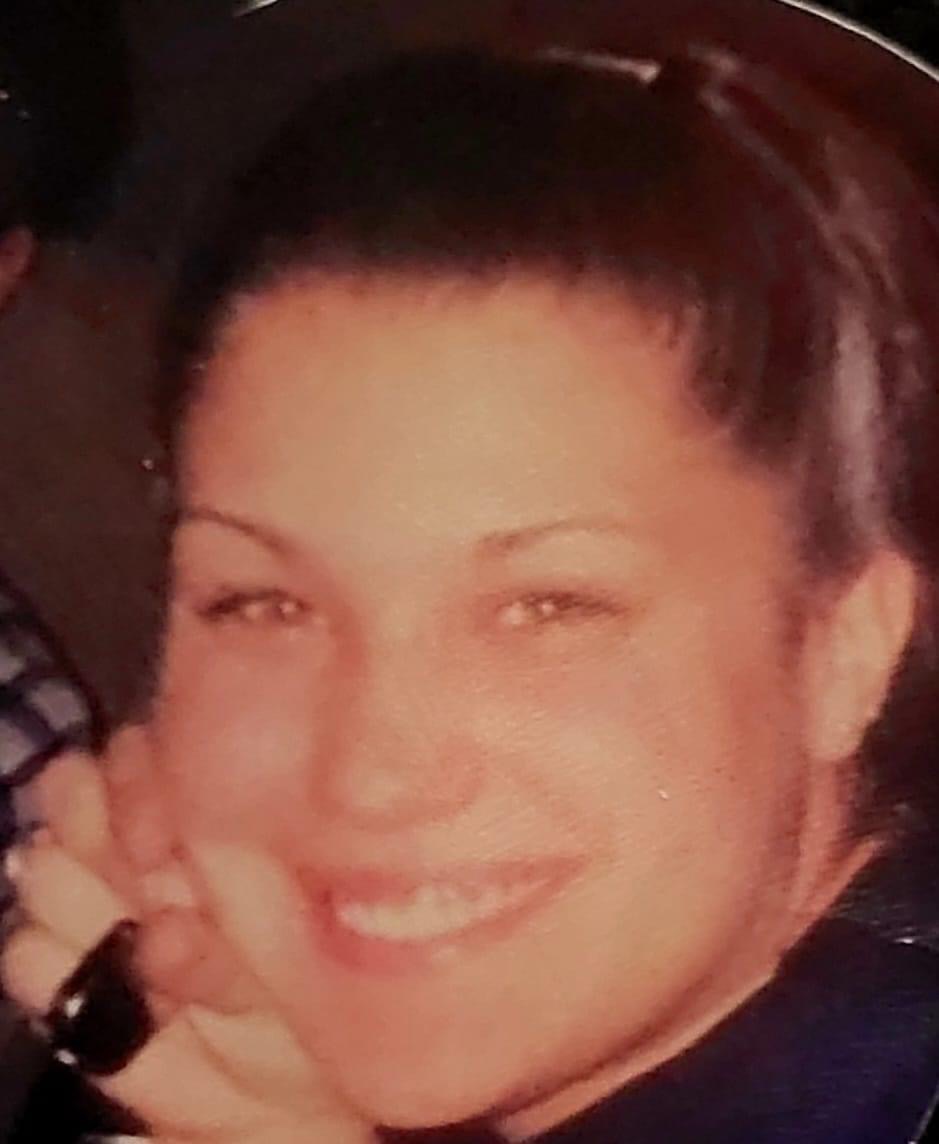
Today, I pay tribute and remembrances on what would have been my daughter Riki’s 41st birthday. As we near the seven-year anniversary of her passing, I observe that losing a child to death at an early age tends to stay fresh in my mind as if it happened yesterday. Riki made such an impact on those around her, and her tight friend group, “The Village” continues to honor her on her birthday. The Village, also, continues to offer emotional supports to the children left behind by the premature death of their mother, my daughter.
I loved watching Riki connect to people. She always paid special attention to those who were, perhaps, less fortunate. At her funeral, during reflection comments, a man stood up to tell about how she made him feel special when he met Riki for the first time. Many told similar stories. What made her special? She loved to laugh, and she had a quick and clever wit. Riki loved to engage in deep discussions with her friends. Before “google,” she would call us for answers to questions in these deep discussions. Mainly, the call would be for us to affirm her points of view.
Riki knew how to make moments special even in the most mundane of tasks. She directed nutrition in school food programs. Riki loved to prepare and share food with friends. Her children consider her “the best cook ever!” On Wednesdays, Riki used to prepare a “taco bar” for the Village. This year’s “Riki Celebration” will feature a taco bar for friends and family paying tribute to her memory.
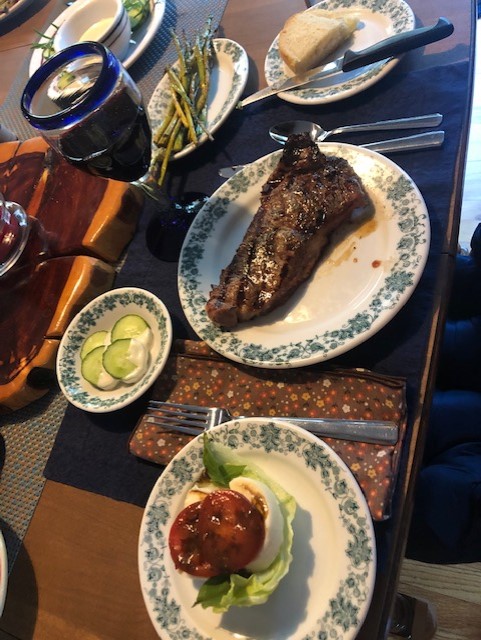
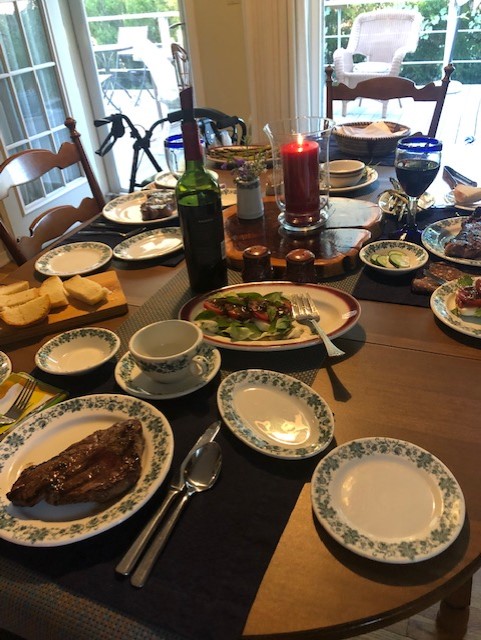
I took the day from work to pay tribute. My 92 year old mother and her 85 year old husband are visiting. My mother and I took the day to prepare a lovely meal of grilled steak, asparagus, caprese salad, and fresh cucumbers. We offer a toast to my daughter and my mother’s great granddaughter, Riki. We prepared foods loved by Riki.
We could have enjoyed a lovely meal at a local restaurant, but Riki loved to cook and bake, so Mother and I prepared a meal that Riki would have loved: steak, asparagus, caprese salad, and fresh cucumbers. A nice bottle of cabernet sauvignon rounded out the meal, and we had a lovely slice of peanut butter cake for a crowning glory to the “good eats!”
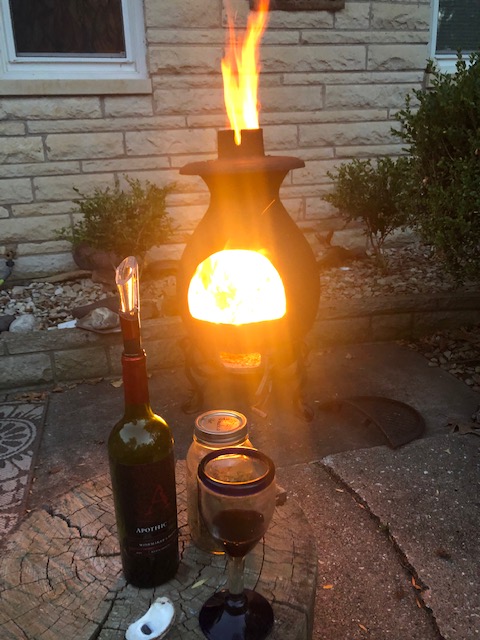
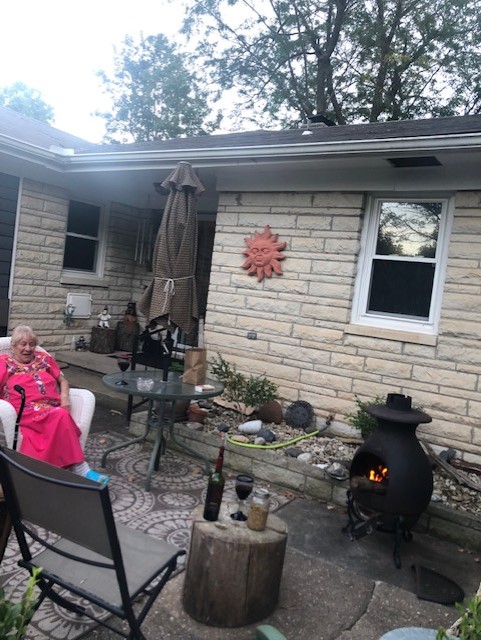
As Indigenous tradition would have it, at least for my tribe/nation, we sing songs and give thanks to Mother Earth and the Creator for what we have and for what we love. We built a roaring fire to which we gave sage and tobacco. We felt Riki’s presence. It was a great honor to be Riki’s mother. She gave all to those who were around her.
To that point, I received a lovely note from one or Riki’s high school friends. Joey thanked me for bringing Riki into the world, and he shared in honor in knowing her. That lovely note came at just the right time to give me a great blessing. Thank you, Joey.
I find it difficult not to reflect on the pain in the world, at present. How do we center ourselves in the face of such hurt? Well, here I go again touting the benefits of mindful thinking and about my outlook on life. These are some common question that I ask myself. Am I practicing gratitude? Am I practicing stewardship of the land, water, language, and preserving other parts of the natural world? I do realize that when we navigate in environments of poverty, exclusions, marginalizations, and living in the fringes, it becomes a great challenge to have gratitude for much of anything. But, what if we looked inside for what is going well for us? Are we able to stop for a minute and think about for what we can be grateful?
I know. Digging through your mind in the midst of conflict, deep emotions, and sadness may be the worst time to gather positive reflections. I do know that it works, however. My practice, which now is a habit, has been part of my life these past four months. Yes. I am facing some great life challenges, and I can tell you that focusing on gratitude and daily affirmations works! Challenges become navigable.
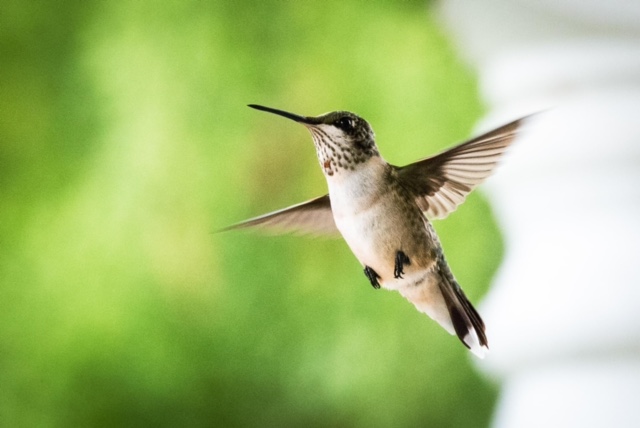
Bianka’s Hummer
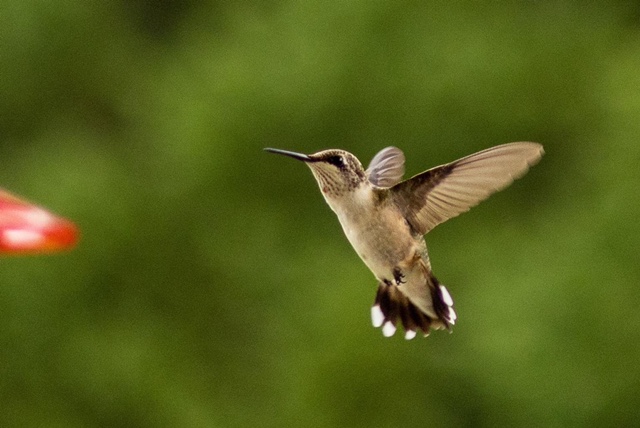
I find that nature offers the best self-care, meditative, and gratitude-giving opportunities. My sweet cousin, Bianka, a war veteran who now spends much of her time bike racing on BMX tracks with her twin brother, also a military veteran, who builds racing bikes, like his father did, now works to perfect her photography skills. That’s her hummingbird picture. It gave me time to stop to appreicate the delicate body, the exquisite little feet, the striations on the neck, and the moment in time when Bianka got this perfect photo of the little bird hovering near the sugar water feeder. When we take that time to appreciate the perfect details of the natural world, we begin to offer gratitude for what some may think of as mundane, but it helps us to be thankful for what we may think of as insignificant details of the world. Also, when we take time to offer thanks for the small things, it helps us to slow down from busy lives and be in a moment with ourselves. Try it.
Bianka Hummer 2
Consider camping as an outdoor activity where you get to interact with the natural world. Camping is one of my favorite pasttimes. It’s a time when I just allow myself to do nothing but breathe in the clean air, listen to the birds and other flying, loping, crawling, or jumping lives of the natural world.
Kelly’s Flock (a few of them)
My dear friend, Kelly, recently, acquired a flock of chickens to raise in his and his lovely wife’s backyard. Kelly told me about raising chickens, “It is therapeutic for me and I have peace when I am around them! I know they are just chickens to most people and is not a big deal, but I almost can’t put into words the joy these animals bring to me! I want many more, and one day, I will have chickens galore will be our theme!” I cannot imagine a flock of chickens being in more gentle hands!
Kelly’s Chickens at His Feet
Kelly went on to say, “I think the older you get the more you see the benefit of working to live and not living to work! We are in a world that is so disconnected from the natural things around us that we forget the incredible inner peace found in nature! We have lost the fact that nature is our kin and we have neglected that relationship.” Those are words that we Indigenous People live by, and those words coming from my dear friend Kelly mean the world to me.
I will end with a few of my daily affirmations that come from those around me who inspire me to improve:
I am curious to know something about everything and everything about something
I am thankful for…
I am courageous
I am living a great life
I am interested in everyone I meet (from my Dad)
I am valuable
I have wonderful friends who enrich my life
I learn great lessons from my loved ones
Today, I will learn something new
There are more, but I leave you with this great picture of a friendly kiss from Heidi, a dog who belongs to a business associate of my son.
My featured image comes from the drawing of my, then 7 years old, grandaugher! She had quite a long affair with unicorns. Now at the age of 14, I see different drawings of many different subjects. Interestingly, I see lots of mushrooms drawn these day. I hope the art work continues.
I love how our menus for the summer months change to meet environmental changes. Many of us may put lighter meals on the table during the hot days. Lately, I marvel at the versatility of chick peas (garbanzos or ceci beans), which makes them a perfect choice for a light meal packed with nutrients and protein. I do not always write down my kitchen creations. Many of them are what I dream up, and some are variations of dishes I’ve either prepared or eaten in other situations. Sometimes those recipes work, and somtimes they do not. I go with the flow, and there have been times, that I’ve thrown a failure out. The good news is that I have more great outcomes than I have failures in the kitchen, so that may be why it is a favored “medium” for this type of art.
Right now, my garden is not producing great things, but I am using garlic and onions from the garden. I allow dandelions to grow in one corner of the garden. The leaves are a great source of nutrients, and they add a satisfying crunch to any salad or sandwich with its slightly bitter flavor. The small leaves are not as bitter as the very large leaves. I like to walk around the yard to see if any purslane has grown around the sidewalks. It’s a great source of vitamins and add a special texture and flavor to salads. I love to forage in my yard and in the cemetery, a great source for wild garlic and wild onions.
Summer Salad
Cook quinoa as posted on the packaging. When quinoa cooks, pour into a bowl to allow it to cool.
If you used canned garbanzos, be sure to drain them well. If you prepare a small bag of the dry beans, know that it will cook up to three cups of the garbanzos. In that case, use one half of the cooked beans. Use the other half for your homemade hummus.
4- green onions diced
1- diced English cucumber
1- diced red pepper
1- small packge frozen sweet corn
1- batch cooked quinoa
1.5 cups well-drained garbanzo beans
4- chopped dandelion leaves (may use Romaine lettuce)
For the dressing, I use a simple vinegarette. One-half (106g) cup sherry vinegar, one-half cup (106g) of olive oil. To this, I add, 2 Tablespoons of molasses or date syrup (which helps in the emulsification process). For seasoning, add one-half teaspoon (2.84g) salt, one-half teaspoon chili powder, and one-quarter teaspoon of cumin. For an extra zing on the dressing, I add a few shakes of garlic and onion powders. Shake or whisk well, and set aside while you complete the salad.
Toss in the vinegarette about 10 minutes before you serve the salad. It serves well when the salad is chilled, too. It’s a great accompaniment to grilled shrimp, and a nice glass of buttery chardonnay.
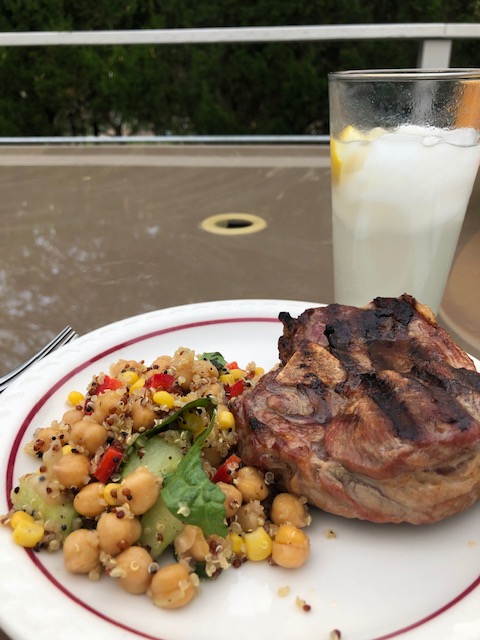
Actually, I had it with grilled lamb steak and a paloma drink made with tequila, lime juice, salt, and squirt grapefruit soda. Usually, I float a lime wedge, but the picture shows that I used a lemon wedge. It’s delicious and refreshing. Eating on the deck with singing birds and small wildlife flitting about makes it all perfect.
My Work and Why I Create in the Kitchen
My work as a cultural geographer with a goal of moving toward institutional equity for historically excluded identities is a great mission for me, but I realize the institution for whom I work has a goal, which is more performative (“look at what we do”) than authentic and action-oriented. The institution still sees that recruiting more student, faculty, and staff of color is more of a favor to us as opposed to the fact that human diversity stregthens institutions. That can feel like my work in intercultural learning is more for show since more and more programming is implemented toward a pereived deficit rather than building on the strengths of human diversity.
The feedback from the students I mentor is the great part, along with teaching, which I adore, however I am not paid what I’m worth, which brings me to why I create in the kitchen. After a hard day at work fighting politics and the, almost, daily feedback that I’m not enough (I have a great boss, but she has to fight the same kinds of negative pushback from her leaders), I find that an evening in the kitchen makes those negative parts of the day subside. I love to cook from scratch with the freshest ingredients. This is where it can get creative. Also, I love cooking with friends. Pictured here are my friends from India, who know the meaning of joy, happiness, and tasty foods. Now, for some ideas…
First of all, explore ingredients. Just like pairing a wine with a specific dish, spices can make or break the flavor profile of a meal. Learn what spices go best with what ingredients, such as meats, fish, vegetables, or fruits. For example, take a simple meal like spaghetti. You may choose a meat and tomato based marinara to go with your spaghetti noodles. Or you may choose a pesto sauce to pair with what ever pasta you choose. You can add shrimp to the pesto-based sauce. Be brave and experiment, if interersted in “kitchen therapy.” Also, there is no shortage of people willing to share their own secrets with you in a multitude of platforms.
If being in the kitchen does not interest, find that one thing that you can do to relieve stress. Give yourself permission to be you in however you show up. Is it art or cleaning the house (really!)? It could be decorating a room or your house. What ever interests you and you find it a way to relieve stress, take the time to heal yourself. I like to be in the kitchen, because it can be a very practical way to create something fun while I nourish myself and others, as the case may be.
Find those meals to prepare that are interesting and allow you to sit over them in leisure. Pictured above shows my English breakfast with Dalgona coffee. We take about two hours to consume this meal, because we want to take longer to eat it than what it took to prepare. Think of the all-day labor of, say, a Thanksgiving meal or other type holiday when special meals are presented at table. My mother used to say, “What took me all day to prepare, you’ve eaten in 15 minutes!” Many in the U.S. tend not to approach meals in a convivial manner, such as those in Mediterranean climates. Other advantages of consuming a meal slowly means that you know when your stomach is full, and there is no hesitation in pushing away from the table.
Sure, I have other hobbies that relax me. I like my “kitchen therapy” because it engages all the senses: smell, hearing, tasting, touching, and seeing. Yes. Other hobbies engage the senses, but I can’t eat my woodworking or jewelry projects.
Find your way. I will be a treat. Thank you for reading me.
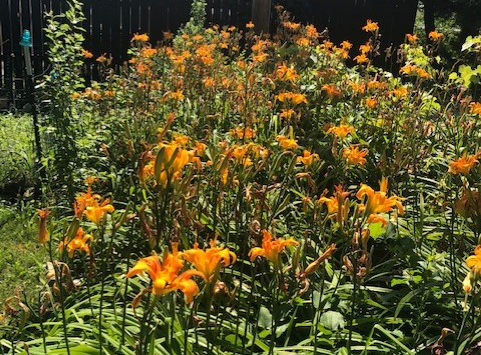
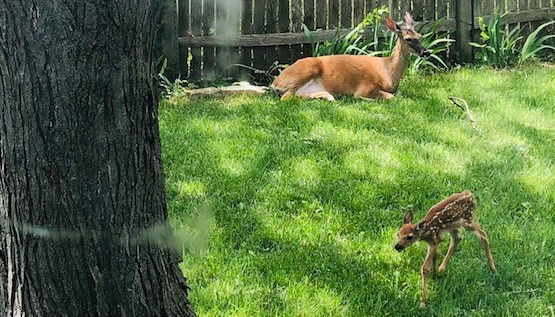
My featured image shows a doe and her fawn. When I took this picture, the fawn was about three days old. The doe gave birth in my day lily bed, and she parked her baby next to the house under a ladder. Now, two weeks later, the fawn has taken up residence in my front patio. Apparently, the doe comes at night to feed the baby and graze in the yard, a bit. We stay quite aware of the little guy’s presence and work very hard not to disturb. Also, as the Star Trek “prime directive” states, “Do not interfere in a life to change its course.” Hard as that is, I continue to worry that the doe will not return to nurse the fawn, but they have the instincts for survival and do what they need to do to survive as long as there is no human intervention.
What do you do to advance self-love? Many have been socialized to believe that self-love is selfish and wrong! That is likely a Puritan ideal, which very much permeates the dominant culture in the U.S. (Settler/Colonial culture). I’m not sure if there has ever a spiritual leader who’s asked us to hate ourselves. Of course, there are many political people, who call themselves “leaders,” who tell us quite often to dislike, hate, or exclude others who are considered “different.” I am happy to ignore them in this writing. What I do mean is that when we love ourselves, it’s nearly impossible to hate others, because true self-love helps us to love others even when they are not like us.
My point today is that unconditional self-love helps us to survive many things and may even be a support when tragedy strikes, such as recent school, church, and hospital shootings. Some of my past blog posts consist of other details in self-care, such as the Art of Hygge, cooking/baking, entertaining in your friend-circles, interactions in the natural world, and other activities in which we can engage to keep us from brain wiring and emotions ryfe with trauma.
Trauma does terrible things to emotional and physical health and well-being. All of us have likely experienced some form of trauma in our lives. That may mean that we spend many hours of our lives finding coping mechanisms and acquiring coping skills. We soon realize that coping/navigating skills are a life-long learning and behavioral journies. We do not take “training” and then we finish. Check box! No. Practicing self-love takes a life time. The key word is “practice” with the idea of not attaining “perfection!” I do think self-love is a choice, and I think when we have suffered adverse childhood experiences and forms of adult trauma, we tend to loose site of our abilities to choose a positive outlook. I do know that some have brain chemistry that can “hi-jack” that choice to have a positive outlook. Those instances require that we exercise great understanding and empathy.
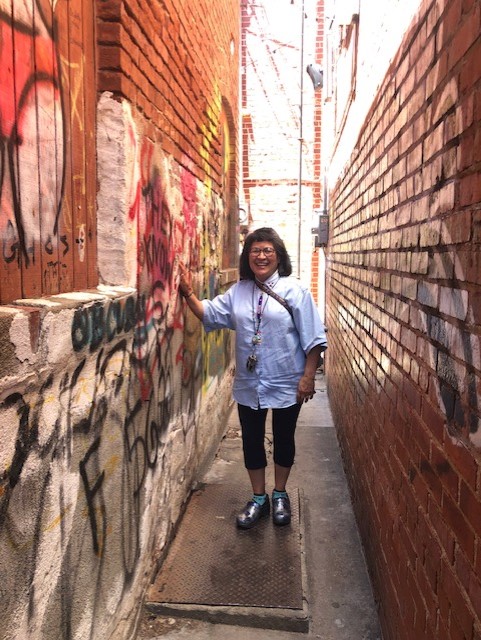
Enjoying a moment in the “secret” alley way to corn dogs
Not too long ago, I interviewed a man from Kerala, India. He’s a mathematics teacher at a high school. Mr. K has lived in the U.S. for many years. He and his lovely wife “R” have raised two beautiful daughers. This family has the most positive outlook on life of any people I know! Mr. K takes his family on excursions to visit all of the National Parks in the U.S. They know their geography very well! During the interview, Mr. K said, “You know. The world is so beautiful. The people are beautiful. The landscapes are beautiful. I believe the world is so beautiful.” It was at that moment that I realized that Mr. K lives a life of positive thinking and he will always see the best in people, in nature, and in his relationships, because he chooses to see his life that same way. I see this attitude reflected in his daughers and in his spouse, too. Mr. K models and eminates self-love and the love of others. It sounds like a simple, wonderful, and balanced way to live.
I work on the concept of balance every day. The practice comes in the form of morning affirmations, yoga stretching, and fresh air. I end my day with more affirmations and the hopes of a adequate sleep. Getting adequate sleep and staying positive throughout the day tend to be my greatest challenges. The world is hurting, and I navigate institutional inequities on a daily basis. My hope continues to be that we may strive toward a positive outlook on life, so that we may be a beacon of light in this world and its pain.
Thank you for reading my blog. Next time, I’ll write about food.
When we think of a year that’s passed, it can be a good time to reflect on the past and to look forward in a new year. We can think about the good things that happened and contemplate any of the negative happenings. Of course, it does not serve us well to focus on our misfortunes, mistakes, losses, and other events that made a negative impact. However, it could serve well to give each of those challenges their due. I want to spend this space for reflecting on the year past and looking forward to year unfolding before us. Every year, I learn something new, and I give myself grace when I come up short. I will share some things I’ve learned and ask you to reflect on your life as well.
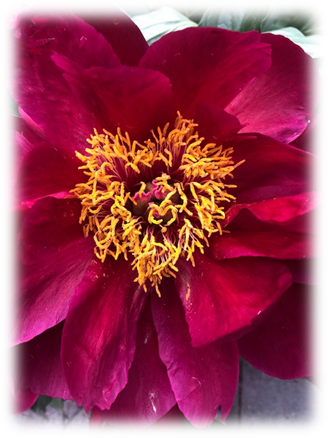
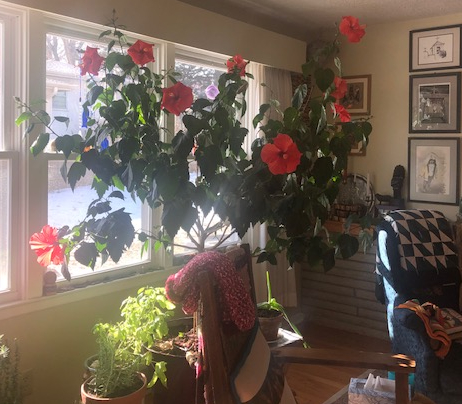
Blooming Hibiscus with Eight Blossoms
Reflecting on events of the past takes a Mindfulness approach. In the process, be a neutral observer. Think about what gave such an event a positive or negative impact. Notice how the event or interaction elicited emotions. How was that emotion navigated, or what was the response? The point in this reflection is to remind ourselves to be 1) a neutral observer to each experience, 2) Be patient with yourself: allow each experience to emerge at its own pace, 3) Have a “beginner’s mind” by experiencing the memory as if for the first time, 4) Trust and believe in your intuition and your ability to see things in a new way, 5) Take it as it comes without the need to win or avoid losing. At this points, just be; 6) Accept and see things as they are in the present moment; 7) Let go and detach from your usuall feelings and thoughts. Perhaps this is a way for us to slow down for a moment to recharge our senses.
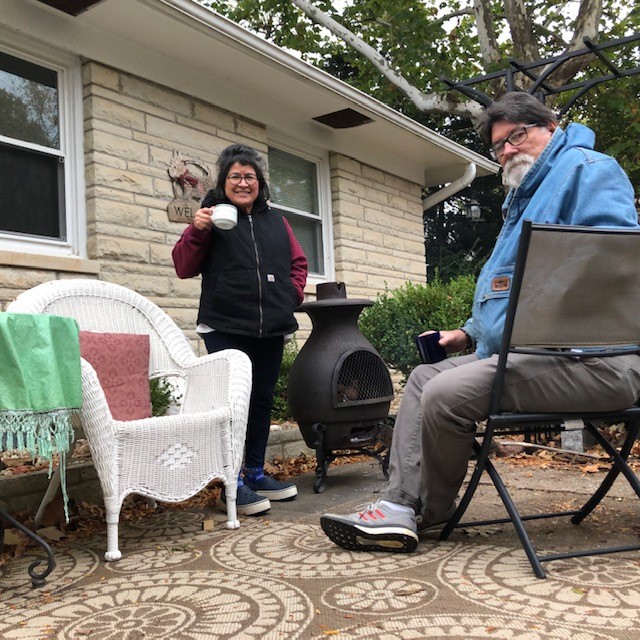
Enjoying a hot cup of tea on a crispy morning in front of the outdoor fire place
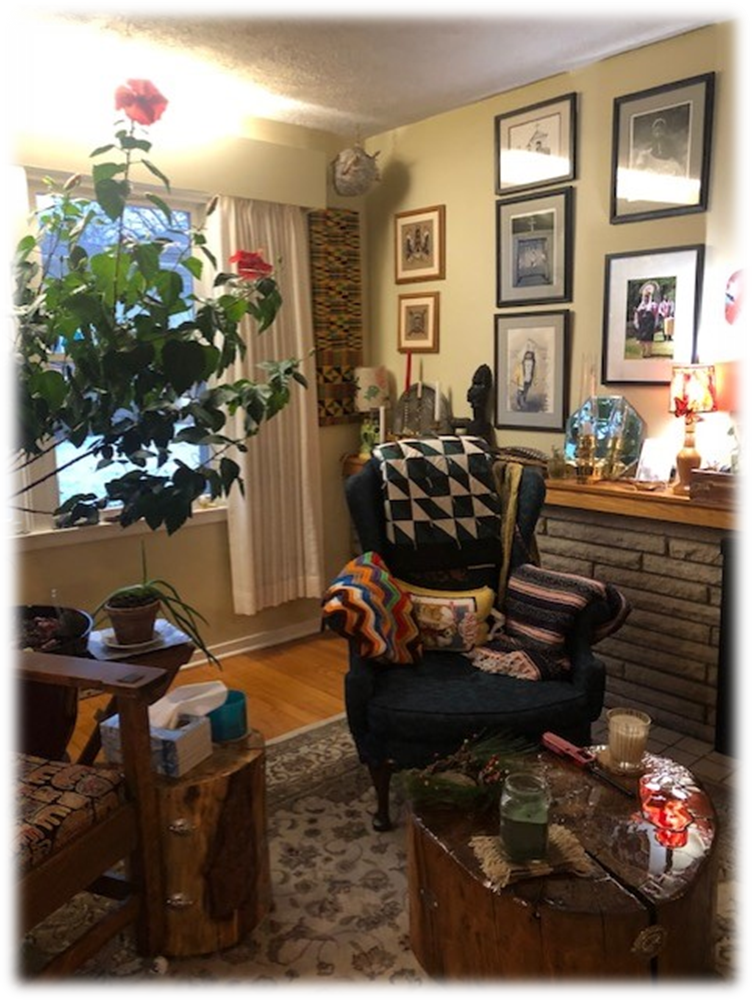
I’ve written about the “art of hygge.” Hygge is that danish word (Hoo-gah) that denotes comfort at the point of being cozy. Think of a hug! We get to decide on the characteristics of that hug. When the danish speak of hygge, they outline all the situations in which one can practice that coziness: our living spaces, our work spaces, and in outdoor spaces. I have designed my “living room” as a hygge corner.
Cozy Corner
Another way of practicing that sense of being hugged, is looking to the outdoors for rest and relaxation. Viewing nature as if for the first time can be exhilirating! Perhaps asking oneself, “Which season do I like best? Why?” I like to notice what birds are active in which season? For example, I’m seeing more juncos during the winter than in the summer. We see snow geese in the winter but not summer! Those are changes that are only noticed when one looks up or notices changes in nature. It such a thing is new to you, try it sometime. As another example, in the photo, one could ask, “Why is the sunset so red?” The answer: Dust and smoke in the atmosphere from fires and wind (in many cases).
A Kansas Sunset
In a busy world where we are measured by how much we do, how much money we earn, and how we stand out as individuals (an individualistic society). I wonder if we would have less illness if we emulated that of a collective society (group oriented) and took the time to sit and talk, build relationships, and take more collective actions when it comes to governance. The concept of hygge supports that very thing, as does the Mediterranean way of conviviality. So what if we took three hours to consume our meals conversing around the table? Our lives would slow down, and we would take more time for ourselves and our loved one. I love the concept of “hygge with others,” which focuses on our relationships. While we have fewer opportunities to gether during this pandemic, and we’ve had to find new and different ways to connect with people, such as with on line platforms. When I think of “hygge” with others, I tend to think of gathering around meals. Sometimes it may be connecting through interest groups. Sometimes we attend a movie group, which meets online after participants watch the movie on their own. That is one way of connecting during a pandemic time. The meet up consists of questions by the facilitator. We found common themes through which we connected. A few years back, in a town where we spend nearly thirty years, we used to attend what we called, “Second Friday Cinema” at our local library. We picked nine movies for each of the months we met from September through May. We watched the movie together enjoying snack that each of us offered on a table. Unfortunately, that has gone away per safety measures. I miss those time, so I will share some photos of former gatherings and ways of enjoying our environments.
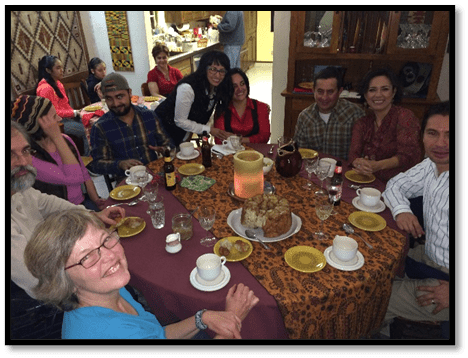
Friends at Table
My Home State
Setting a goal of practicing holistic well-being does take some discipline. For example, I made a pledge to myself to keep my house organized and free of clutter. That takes a lot of work! It seems that we get so involved in making a living, being a good employee, and meeting institutional goals that we forget to take care of ourselves. Now, all this sounds like I’m an expert at such things, I do teach about holistic well-being, but that means that I practice such things, and “practice makes perfect” as the saying goes. That’s the best we can do, and our best needs to be enough for us. That does not mean that we’ve reached a pinnacle. It’s just means that we keep trying. I saw a quote on practice the other day. The gist of it was that someone had asked the great cellist, Pablo Casals about his daily practicing at the age of 90 years. “After a stellar career and now at the age of 90, why do you practice the cello for the minimum of six hours per day?” Casals answered, “Because I think I am seeing progress.” Humans are not perfect. We work toward perfects, but perhaps too much, I wonder? I want to be the best for the world not the best in the world!






































 Human Ecology: People, Foods, Travel, Culture, and Social Justice