Socio-Ecological and Logic Models

If you’ve read any of Urie Bronfenbrenner’s work, you, no doubt, know about the socio-ecological framework.  In that Bronfenbrenner asserts that we have “spheres of influence” in which we develop who we are and what we like and do.  That’s an easy way to understand why we become that person we see when we look in the mirror.

Another framework that helps us to organize our thoughts, objectives, and ultimate results is called the “logic model”.  I love the logic model.  As an abstract-random thinker (as opposed to “concrete-sequential), the logic model helps me to think linearly.  As a historian, I have the ability to think linearly when I’m looking at time lines of events. But when I approach my day, linear can go out the door.  So the logic model helps us to see a situation that needs to be addressed, decide who and what the players will be (inputs), what the activities around addressing the situation will be (outputs), and the different levels of results (short-term, medium-term, and long-term).  Of course long-term results (outcomes) are the future we hope to see.  Long-term outcomes are the ultimate.  “I put $500 a month in the bank”.  It’s happening, and there is not future tense in the long-term outcome.  I have my logic model workshop participants either tie their shoes or get dressed for the day using a logic model.  Believe it or not, you use a logic model more often than you think!

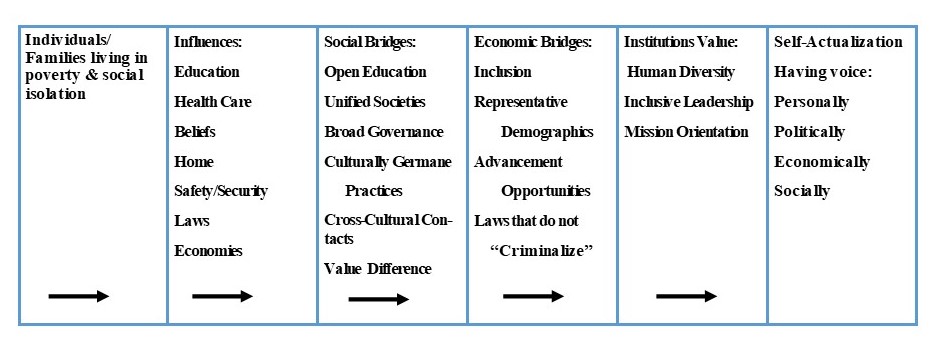
Now, I have a colleague who worked on a national nutrition program.  Her team, in their infinite wisdom, combined the socio-ecological and logic model in one document to address a working model to bring nutrition to the masses.  I love their model and have adapted it into a model that I call, “adaptive and culturally relevant practices”.  My first go at the title was, “culturally relevant and adaptive practices”, but you can see it made for a terrible acronym!

As some background, my work is to find ways to address inequities that exist among families living in poverty and families of color.  I say if we see a situation, we can find ways to address those inequities with the help of a logic model that’s been embedded with the socio-ecological model. My example is the featured photo today.

Thanks to Major F.M. Hernandez (U.S. Army) and Dr. Charlotte Olsen for collaborating with me on this.

Time With Grandchildren

The beauty of grandchildren is that they are such wonderful blend of us and our own children.  Our son gave us one grandson.  The little chap is independent, loving, and mature beyond his age of 11 years. Our late daughter gave us three children, ages 15, 14, and 10.  We get the great privilege of having all of our grandchildren for the summer.  They are bright, funny, and loving young people.

I believe children, today, have many challenges that we, boomers, did not have.  More children today live without one or both parents.  Children today have distractions that take them away from the learning processes in the schools.  So teachers tend to be more challenged by children who are distracted by life, video games, television, cell phones, and non-supportive environments.  My hope is that adults realize how precious children are and find ways to empathize with children who are not in ideal situations.  I’m lucky that all my grandchildren are in loving and supportive environments.

Now, this will be a short entry, because I’m preparing for a bake-off with our 10 year old granddaughter.  Tomorrow is the big day, and it is my hope that I have some pictures and I should have some pictures of our creations.  The brothers, grandpa, and  good friends will be the judges.

Stay tuned, and thanks for reading.


Human Ecology and Geography

I work on a campus that has a College of Human Ecology and a department of geography in the College of Arts and Sciences.  I often wonder if the two have ever noticed that their work is quite similar, especially when one looks at their descriptions of studying people interacting with their environments?  Well, I love the disciplines of human ecology and geography!

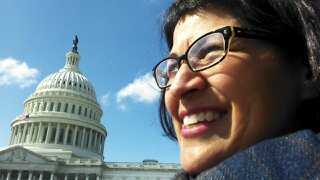
People fascinate me, and, given their environments, they act and re-act differently.  I like to study such things. I posted this picture of me visiting our Nation’s Capital (standing here in front of the Capitol!).  Next time you’re in Washington DC, go to the Smithsonian’s National Museum of the American Indian.  It’s one of my favorite places on earth.  When you enter the museum, there is an amphitheater on your left, and a grill/cafe on the right.  In the seating area for the cafe, there are marvelous photographs of varying groups including Alaskan Natives.  My favorite picture is of three Alaskan Native boys, about eight years of age, gathered around a white granite ware, sort of, tub from which they are happily eating.  They are shoe-less and have the happiest grins on their faces.  I took a photograph of that photograph, and I use it in my power point slides when I’m teaching about intercultural relationship building.  I did not show it here, because there could be some copyright restrictions.  When I ask workshop attendees to look at the photo then give me their impressions, I’ve noticed that middle class people will give me descriptions of “dirty”, “poor”, and “unkempt”.  Out of 23 times of presenting this workshop, perhaps, three people have noticed the absolutely delightful expressions on the boys’ faces.  I know that the Alaskan Native population does not have a word for “stress”.  When you study “simple” versus “complex” societies (the U.S. is a complex society, and many populations (Native to their lands) are often called “simple” societies).  Simple societies are less likely to live stressful lives, because they work to support a collective and are not caught up in acquiring things (read Jared Diamond’s, Guns, Germs, and Steel).

From a human ecology point of view, our environments determine how we live, how we meet our daily living needs, and those things influence how we develop as humans.  From the time we are born, our environments (family, church, schools, politics) influence our development of our preferences, our knowledge, our traditions, our points-of-view, and our paths in life (Bronfenbrenner).  Our geography has that influence, too.  I grew up in Colorado, in the mountains.  Being in the outdoors and  living in high altitude determined how we dressed and in what sorts of activities we engaged.   If one lives in a hunter-gatherer society, then one works in a subsistence culture, which tend to be collective communities (where everyone works for the common good).  If one lives in a capitalistic society, it tends to be more individualistic.  The gaps in wealth tend to be wider in a complex society than a simple society.   In terms of simple and complex societies, one is not better than the other.  They are different.  If simple societies were left alone (not colonized), they functioned quite well on their own.  It does terrible things to the psyche when people in a simple society are told they are wrong (“uncivilized, savage, heathens, etc.), and that “wrongness” carries through to the subsequent generations.  From my point of view, the effects of colonization has not been good for simple societies.  It’s caused many disparities among the colonized people, and it’s developed environments of inequalities.

I think I will come back to this, because I have not developed my thoughts completely.  Besides, my granddaughter wants a bedtime story!  Thank you for reading.

Everyday Mindfulness

Not too long ago, I collaborated with two of my extension colleagues to write a lesson on everyday mindfulness.  The lesson and leader’s guide can be found in the K-State Research and Extension online bookstore.

Our journey to present this information comes from the idea that we, as a society, are so very focused on earning a living, acquiring wealth, planning for the future, and the other worries of everyday life.

Leading this charge to write this was my colleague Donna.  She and her husband are devout followers of meditation and “Do-In”, also know as “self-Shiatsu”.

Personally, I had been following what the practice of mindfulness meditation was doing for building self-respect and “de-colonizing” thought for people on our Native reservations.  I had been following the work of sociologist and professor, Dr. Michael Yellowbird , presently, at North Dakota State University.

To describe the concept behind mindfulness, I will go to our publication.  (Here’s the URL for the pdf): https://www.bookstore.ksre.k-state.edu/pubs/MF3424.pdf 

Mindfulness:

  • Living in the present moment/awareness of
    the present moment — paying close attention
    to thoughts, physical sensations, and our
    surroundings.
  • Observing personal experiences of mindfulness,
    being completely focused on a project —
    reading a book, doing a hobby, or playing a
    sport. This heightened awareness is mindfulness.
  • Taking a few deep breaths — becoming fully
    aware of the present moment.
  • Having nonjudgmental awareness in which each
    thought, feeling, and sensation is acknowledged
    and accepted in their present state. This steady
    and non-reactive attention usually differs from
    the way people normally operate in the world.
  • Paying attention, precisely, to the present
    moment without judgment

This is a good start.  I think the idea behind mindfulness and meditation gives us the tools to take better care of ourselves.

Thanks to Donna Krug and Charlotte Olsen for the collaboration on writing this lesson.  Enjoy!

Community Cohesion

The concept of community cohesion continues to be a topic of importance to me.  What is community cohesion?  Communities that demonstrate shared visions for its people, common goals for the future, equal voice for all, common respect for difference, and promote a sense of belonging for its citizens, tend to be cohesive.  People in a cohesive community “stick together”!

As I was reading about different notions around community cohesion, I found a “Guidance to Promote Community Cohesion” written as part of a mandate on race relations for the schools in Great Britain.  Its focus was on “community cohesion”.  I will offer these quotes from the guide:

By community cohesion, we mean working towards a society in which there is a
common vision and sense of belonging by all communities; a society in which the diversity of people’s backgrounds and circumstances is appreciated and valued; a society in which similar life opportunities are available to all; and a society in which strong and positive relationships exist and continue to be developed in the workplace, in schools and in the wider community

Most impressive to me is the explanation of why the British Department on Children, Schools, and Families wrote such a guide. These were actually words recited on the floors of Parliament in 2006!

Schools have a duty to eliminate unlawful racial discrimination and to promote equality of opportunity and good relations between people of different groups.
Every school – whatever its intake and wherever it is located – is responsible for educating children and young people who will live and work in a country which is diverse in terms of cultures, religions or beliefs, ethnicities and social backgrounds.

Yes. This was 12 years ago.  I have not found further information to say if this “duty” continues to be recognized or enforced in British schools.  It’s just that I like the idea of  human diversity being valued for what it brings to communities.  Yes. The mainstream may be challenged to adjust, accommodate, and step outside its ethnocentrism, but an appreciation for plurality is key to community cohesion as the U. S. moves toward a pluralistic society by 2040, as suggested by the World Bank.

A sociologist friend of mine put it into perspective for me.  He said, “Boomers reached young adulthood in the 60s when White, middle class people were the majority, and immigration was at its lowest in the U. S.   Homogeneity was common for most communities.   Boomers, being born in the 40s, or so,  were too far away from the time when the U. S. was young and most were foreign born.  Remember, this country was “settled” by immigrants who displaced Native populations onto reservations in order to give the land to more settlers coming from Europe to grow a nation.

My point, and I do have one, is that when we find common ground with one another, we are more likely to live in a cohesive community.   How can we move toward cohesion?

The “guide” that I’ve discussed does have some suggestion on understanding the concept of community cohesion:

“Cohesion is therefore about how to:
  • avoid the corrosive effects of intolerance and harassment:
  • build a mutual civility among different groups, and
  • ensure respect for diversity alongside a commitment to common and shared bonds”

Again, I should tell you I live in a region of Kansas marked by Minority-majority schools and communities.  I love living, working, and playing in a region were I can experience coffees from Africa, foods from Asia, art from Latin America, and I can learn about other cultures.  I have found that some communities, in my region, have focused on integration of the different ethnicities and cultures.  Some have not.  Maybe, one day…


End of the Day Reflection

I’m always looking for ways to encourage and support myself.  It is my hope to encourage and support those around me as well.  Reading is a good way to do that  Do you have a favorite passage, book, or article that you like to read?

My dear friend, Mary Lake, gave me an “End of the Year Reflection”.  It has wonderful prompts for pondering a year in review.  Well, I’ve rewritten to help me reflect the end of my day, and it gives me something to think about for tomorrow.  I hope it’s useful to you.  Here is is:

End of the Day Reflection

What were the highlights of this day for you?

What were your greatest successes?

What gift(s)/talent(s) did you see in yourself today?

Which value did you honor the most?

Have you found a way to focus on your successes rather than any failures?

What new characteristic did you discover about yourself today?

What are you grateful for today?

Name what this day was about for you by giving it a title much like a chapter in a book: Your book!

Looking toward tomorrow

What did you learn today that you want to put into use tomorrow?

What kind of person do you want to be?

Which value or action would bring you closer to a vibrant way of living?

What will tomorrow be about for you, again, naming the chapter title or some other metaphor perhaps?

There are many traditions and rituals that humans practice.

If you were to design your own personal ritual for tomorrow and your future what would it be?

In and Beyond My Backyard: Cultural and Arts Observations in Daily Life and from My Educational Travels

We learn much about a people when we live among those who are not like us.  As a Native, not living on the reservation, most people with whom I interact daily are not like me, culturally and ethnically.    As a young person, I didn’t get to interact with a lot of people outside my developmental sphere with the exception of the kids at school.  As an adult, I think I’ve made up for lost time.  I live in an area of Kansas known for its cultural and ethnic mixes.  Of the 26 counties that make up Southwest Kansas, the three population centers (densely-settled rural) and one frontier-rural are Minority-majority.  In our region, we have about nine African, six Asian, 12 Latin American, and about three Caribbean countries represented. I’m sure I’ve forgotten some.  It is a lovely mix of varying faith beliefs, foods, dress, folkways, and mores.  I’ve made this area my home and my work as a researcher.

When we speak of culture, I cannot tell you how many times I’ve asked a group of Anglo, U.S. Americans to tell me about its culture, individually.  I become sad when people say, “I don’t really have a culture”!   So, I have to ask about their family traditions, foods, behaviors pertaining to their families, holiday, etc.  Then a light comes on about their own cultures.

So, what is culture, in the non-bacterial sense?  We social scientists might say it’s our attitudes, our customs, and our belief systems.  Humans build their cultures from the influences of place, time, socio-economic status, education, and belief systems.  Our cultures set us apart from one another in the fabric of humanity.  Every human population has a culture. We transmit our cultures through artifacts, language, rituals, and through the creative arts.

Think of your favorite artist.  Perhaps you have favorite artists across many disciplines: music (within or across genres), visual arts (within or across media), written word, and spoken word.  I know I’ve omitted a medium, but you get the picture (no pun intended!).

What have you learned from observing, listening, performing or, perhaps, owning a work of art from a culture different than your own?  Though I graduated high school 40+  years ago, I continue to be influenced by my high school music teacher, Mr. Bauguess.  Because of his talents as a teacher, I learned other languages, like Latin: by singing masses by Franz Schubert and Antonio Vivaldi; learned German by singing folk songs by Johann Sebastian Bach, and we learned French singing the music of Guillaume DuFay.  Learning those languages also sparked interests in me and my fellow students to learn more about the cultures of those composers who were touching our lives some 100 to 500 years later.

A perfect example of transmitting culture and chronicling history reaches way back to medieval Spain, then called Castile-Leon.  King Alfonso X ruled his kingdom by laying down laws and teaching morality through more than 420 songs/poems (written and commissioned by the King, himself) and corresponding works of art based on the teachings of the Virgin Mary.  He used the fine arts to teach a largely illiterate kingdom how to behave “properly”.   Fast forward to early 1800s to England, Scotland, and ultimately, Boston.  Harvard professor Francis James Child collected his “English and Scottish Popular Ballads”, some of which were broadsides, a sort of news clipping of the day, to tell the stories of broken laws, love, betrayal, and current events.  To this day, musicians and performers are still telling the stories collected by Child.  We call them the “Child Ballads”.  You’ve heard of Simon and Garfunkel’s “Scarborough Fair”?  Child called it the “Elfin Knight”.  Do you remember Led Zeppelin’s “Gallow’s Pole”?  They used the same name as it was collected by Child.  We learn much about a culture from its music and other forms of art.  Even more contemporarily, think of how music and other forms of art are used to express political views.  We can learn a lot from the arts and culture of others, and we transmit our own beliefs to our children and grandchildren.

I am working very hard to make sure our grandchildren know their ancestries. After all, they reflect the pluralistic society that demographers predict for the U.S. by 2040.  My wish is that we keep teaching our cultures through the arts and other forms of creativity and intellect.  The more we know about each other, the more it fades to lines of “difference” that separate us (humans).

If we do not have the luxury, or the good fortune, to live among those who are not like us, then the next best thing is to visit with an open mind, a sense of adventure, and without judgement.  In other words, leave your back yard at home!

I have had wonderful opportunities to travel with work and with my work-related organizations.  These include a cultural geography trip called, “North Plains to The North Woods” arranged and executed by the Kansas Geographic Alliance.  Seven educators, with two leaders, made up a microcosm in a Kansas State University van traveling 4,106 miles during a 10-day span.  We studied flora and fauna (my assignment), culture, Lewis and Clark (It was the 200th anniversary of the Expedition), food, art, history, and some architecture. Why did we do it?  To learn about other people who have a different story than each of my fellow explorers.

Why does anyone travel?  I travel because I am curious.  I want to know how other people function in their societies.  I want to know how other people interact with their environments. I want to learn from them.  I want to eat their foods.  I want to hear their music. There is so much to learn from other people in other cultures, other socio-economic backgrounds, and of other ethnicities.

My plan for this blog, is to intersperse my extensive journal notes from some of my travels.  I hope my notes and writings will both enlighten and entertain.  Though, I have not traveled widely, I do take notes on my observations, experiences, and activities. To this point, my writings will come from my educational travels to Canada, Spain, Gibraltar, Mexico, Peru, and Alaska.  I’ve even taken notes on some of the simple travels across the U.S. I learn something everywhere I go.  Stay tuned!

Children Separated from their Parents

My title as an extension specialist in family and consumer sciences (the old “home-ec”) at Kansas State University, means that I support, academically and programmatically, county extension agents on ways to reach under-served audiences in a region of Kansas marked by four counties that are Minority-majorities.

As a background note, for those of you who don’t know about Cooperative Extension, it was an act of Congress in 1914, called the Smith-Lever act.  The idea was that the Land Grant university would put educators in counties to address anything to do with families.   The concept of “extending” the university’s research and academic resources into communities was and continues to be a way to improve the lives of individuals and families.  Extension is alive and well, and we address many topics in Family and Consumer Sciences.  We offer educational topics addressing aging, family systems, financial management, food safety, natural resource management, health/well-being,  and other essential living skills.

So, we, extension specialists, were asked, “How can extension address the issue of children and parents being separated at the borders?”  The conversation ended with, “Unfortunately, we don’t have that capacity.”   At the risk of touching on a “hot” political subject, I beg to differ.

As sentient human beings, we have the capacity to empathize!  We have the capacity to care.  As human development experts, as in my professional life, we have the capacity to understand what a violent separation of a child from his or her parents might mean for that child’s development.  We now know that these children who are separated from their parents are not living in ideal conditions. These are conditions that we, as parents, would never want for our children!

It is here that I might suggest that you, gentle readers, familiarize yourself with ACES, Adverse Childhood Experiences Study.  The research was organized by Kaiser Permanente and the Centers for Disease Control and Prevention.  To determine an ACE score, a questionnaire asks questions about abuse, abandonment, unloving environments, substance abuse, etc.,  during the first 18 years of life, the developmental years.  A score of “10” may indicate disrupted neuro-development and/or social emotional cognitive impairment.  What does that mean? A life of fighting inner “demons”.  Do you know anyone fighting those inner demons?

Back to the separated children, may we ask ourselves, in terms of adverse childhood experiences, “What does this mean for the children separated from their parents?”  Some may say, “This is what happens when the parents break the laws!”  I’ve actually heard this.  Might we see these dangerous migrations as acts of love?  Might we see these parents, risking their lives looking for improved living conditions, using what they have (guts) to make better lives for their children?  That is how I see it.  I live and work among many families who have gone through the same process to seek improved living conditions.  They happily live and work in my community contributing positive human capital resources to the workforce and sharing their food, cultures, and capacity for joy.

It is here that I will, shamelessly, promote a recent publication of mine.  It’s called Build Intercultural Relationships for Better Understanding of Your Neighbor.  It can be found here: https://www.bookstore.ksre.k-state.edu/pubs/MF3340.pdf

Thank you for reading.  I look forward to your comments, and I don’t expect that all comments will be positive.  That is the risk I take for putting forth my opinions.  However, there is no need to be nasty.  Please remember that.

Women in Worship and Fellowship

Did you know that there is not a gender neutral or gender opposite of the word, “fellowship”?

Anyway, I have, long, been wanting to develop and execute a women’s retreat.  The idea is that women  would gather on a Friday evening to begin and, perhaps, end on a Sunday.  The goal would be loving support of one another, providing a space for creativity, meditation, worship, and “fellowship”.   Here’s a possible agenda.  Let me know if it’s too restrictive or academic.  Would you participate in such a retreat?  Make suggestions on the topics.  These are not “set in stone”.

“Women in Worship and Fellowship”

Ladies’ Retreat

Purpose: We retreat to strengthen emotional bonding, spiritual growth, and sisterly support while promoting understanding of human ecological systems that influence who we become.

Agenda

Friday –

6:30 p.m. – 10-ish:

  1. Bring a snack to share for a light meal
  2. Introduction to Ladies’ Retreat: Why? Objective, and Intended Outcomes
  3. “Getting to Know You” exercise
  4. Group nature walk
  5. Stretching
  6. Bedtime stories – and lights out

Saturday –

7:30 Morning Prayer to Welcome the Day

8:30 – Breakfast Smoothie and Breakfast Cookie Demonstration by Debra Bolton

Let’s eat the outcomes of the demonstration!

9:45 – Stretching 10 minutes

10:00 – Let’s take a nature walk to learn about:

Wildflowers

Scat

Birds

Geology

Other flora and fauna

Noon – Sandwich and Salad Luncheon

1:30 Nap or MeditationTime

2:45 Aroma Therapy and Foot Reflexology

3:45 Free time to explore, write, visit, or anything…

6:00 Dinner time

7:30 Story time, Chants, Music, Bonfire

10-ish – Bedtime

Sunday –

8:30 Breakfast

9:30 – Worship time (to be planned)

Noon – ??? (go home?)

Girl Power Geographical Information Systems (GIS)

About one year ago, I received funding from National Geographic Society to teach females of color geographic information systems.  Females of color are disproportionately represented in the world of geography and other STEM subjects.  Girls growing up in the Midwest are especially at risk for not entering science, technology, engineering, and math, because of the misconception that they are not prepared well enough.  Actually, it’s a vicious cycle, because educational systems decide who will be successful, academically, and who will not be.  That is my observation, and actually, as a female of color, I experienced it in my own schooling.

“Girl Power” GIS

The class had met twice in March, 2018 with spring break on the 13.  The final two classes will met on March 20 and 27.

Initially 18 females registered, but six did not show on the first night, and 13 continued.  Of the 13 students, three were male, though we targeted females, we did not want to turn away any who was interested.  Of the 13 students, they represented origins from Philippines, India, El Salvador, Mexico, the Yucatan Peninsula, Vietnam, Laos, and the U.S., which addressed targeting “females of color”.  While the bulk of our students were in high school, we had one who was in 8th grade (a very bright child!), and three who   were in their 30s, which addressed our focusing on “an inter-generational student body).

We had four instructors.  Especially exciting was that that we found two females who have chosen careers in which GIS is a majority of their daily allocation of duties. One of our faculty was from India and another was from Philippines, so they were able to bring a global perspective to the classroom, which was very exciting.

Class One:

We began with a pre-test to gauge student knowledge.  One knew that it had to do with maps (the 8th grader), and the remainder mentioned not knowing anything about GIS.  (Or so they thought!)

  • Our first evening focused on common and every day uses of GIS. To illustrate the point, the instructor demonstrated how Pokémon Go! engaged GIS to help players find their “awards”.  He went on to show the uses of GIS in geocaching, placement of park benches and trees in a community.
  • The instructor challenged the students to find any discipline in which GIS count NOT work, and discussion ensued.
  • Finally, the instructor showed how he’d created an Easter Egg Hunt for the City of Garden City, which linked children to the parks and to the technology.
  • Homework: “Draw a map of your bedroom”. One is included as part of this document.

Class Two:

  • Our second evening class began with each student showing her/his map of her or his bedroom. Some were drawn by hand while others used “shapes” in a word document. (one is attached to this report).
  • This was to help them know that they already have the ability to create a map using information (data) they have in their minds!
  • Our instructor focused on city planning through illustration and discussion. She introduced a city planning game called, Urban Plan by QWERD.  The students went into teams to work on and understand the details in planning a city.  After a half hour of city planning, each group showed its city, which included crime rates, infrastructure short comes, movement of people, and other cultural aspects of city design.
  • Homework: The students participated in a demonstration of “Sim City” before being excused with the charge to build a city on her or his own.
  • At the end of class, students had to name one thing learned in class that evening. Here are some of the comments:
    • “I learned the word, ‘demographics’”.
    • “Making maps is not that easy, because there are many steps and statistics.”
    • “About zoning and urban planning”
    • “I learned to plan ahead when planning a city”
    • “I’m not sure I learned it, but starting a city is really hard! I want to learn how can a city stand and how can it keep functional?”
    • I learned about zoning, city planning and a local, interactive GIS map called, “Explore My Community”, which was created by our teacher!”
    • “I learned that I like planning and ‘building’ a city.”
    • “There are many different zones, some being very specific depending on what they are, such as being downtown or in a neighborhood.”
    • “I learned new words, which adds to my vocabulary.”
    • “There is a lot of detail in making a map.”
    • “I learned that GIS is a geographic information system that allows us to present data on maps and these data can be: parcels, roads, postal codes and other.”

These daily “post-tests” are saved in their written form.  Next, you may read the class process and hear from the students on their own learning paths/processes.

Class One:

We began with a pre-test to gauge student knowledge.  One knew that it had to do with maps (the 8th grader), and the remainder mentioned not knowing anything about GIS.  (Or so they thought!)

  • Our first evening focused on common and every day uses of GIS. To illustrate the point, the instructor demonstrated how Pokémon Go! engaged GIS to help players find their “awards”.  He went on to show the uses of GIS in geocaching, placement of park benches and trees in a community.
  • The instructor challenged the students to find any discipline in which GIS count NOT work, and discussion ensued.
  • Finally, the instructor showed how he’d created an Easter Egg Hunt for the City of Garden City, which linked children to the parks and to the technology.
  • Homework: “Draw a map of your bedroom”. One is included as part of this document.

Class Two:

  • Our second evening class began with each student showing her/his map of her or his bedroom. Some were drawn by hand while others used “shapes” in a word document. (one is attached to this report).
  • This was to help them know that they already have the ability to create a map using information (data) they have in their minds!
  • Our instructor focused on city planning through illustration and discussion. She introduced a city planning game called, Urban Plan by QWERD.  The students went into teams to work on and understand the details in planning a city.  After a half hour of city planning, each group showed its city, which included crime rates, infrastructure short comes, movement of people, and other cultural aspects of city design.
  • Homework: The students participated in a demonstration of “Sim City” before being excused with the charge to build a city on her or his own.
  • At the end of class, students had to name one thing learned in class that evening. Here are some of the comments:
    • “I learned the word, ‘demographics’”.
    • “Making maps is not that easy, because there are many steps and statistics.”
    • “About zoning and urban planning”
    • “I learned to plan ahead when planning a city”
    • “I’m not sure I learned it, but starting a city is really hard! I want to learn how can a city stand and how can it keep functional?”
    • I learned about zoning, city planning and a local, interactive GIS map called, “Explore My Community”, which was created by our teacher!”
    • “I learned that I like planning and ‘building’ a city.”
    • “There are many different zones, some being very specific depending on what they are, such as being downtown or in a neighborhood.”
    • “I learned new words, which adds to my vocabulary.”
    • “There is a lot of detail in making a map.”
    • “I learned that GIS is a geographic information system that allows us to present data on maps and these data can be: parcels, roads, postal codes and other.”

These daily “post-tests” are saved in their written form.

It does not end here.  My own university, where I work, funded me to offer classes to a second cohort.  Some time in September, 2018, we will offer a mini course to teachers as a professional development in-service.  Stay tuned.