Conviviality and “Hygge”

The goal today is not to be another foodie blogger, though I love to cook, bake, and, often, I get to do those things in a social settings with family, friends, and acquaintances.  I do want to talk about an aspect of nourishing our bodies along with our spirits and our lives, as in “Joie de vivre” (joy of living).

As a word collector, one of my favorites is conviviality, the quality of being friendly and lively or friendliness. Merriam-Webster takes a different approach in its meaning by connecting conviviality, specifically, to food and feasting in “good company.”  Whatever the definition of conviviality, I love the concept, and I love engaging in the act of being convivial.

A few years ago, I went to a food science conference at the University of Arizona in Tucson.  The focus of the conference was the Mediterranean Diet: Eating fresh, non-processed, omega rich foods and having a small amount of red wine each day.  What I found to be the most intriguing was the emphasis on convivial eating: sharing food with family or friends and taking your dear, sweet time to allow slow, digestible consumption of food while enjoying each other’s company.  The food scientists at this conference emphasized that the food choices play an important role in healthful eating, but went on to say that the slow, deliberate sharing of food and conversation is equally as important.  It made me wonder if there is a word in the Italian vocabulary for “fast food”.  I hope not.  I can’t help but connote the notion of fast food with un-healthful eating.

The food writer, Michael Pollan said, “The shared meal elevates eating from a mechanical process of fueling our bodies to a ritual of family and community, from mere animal biology to an act of culture”.  To that I think of the holiday meal that takes a full day to prepare, and most eat it in a matter of moments.  Perhaps a healthier thing would be to take at least half of the preparation time for consuming the meal.  So, if it takes 8 hours to prepare the meal, take 3-4 hours to eat it.  Okay, that may be excessive!  What if we took 2 hours to consume our holiday meal?  It would certainly honor the hands that prepared it.  In addition, the slow consumption of the meal would keep us from overeating, because our brains would know when we’re full sooner.

Opposite of convivial meal times is observing our grandchildren eating in the school lunch room.  The students must consumer their meals in as few as 15 minutes. The lunchroom “monitors” highly discourage conversation as well.  I know children are highly adaptable, but I can’t help but think that the daily school lunches may add some unnecessary stress to the developing mind and body. From all appearances, the children don’t seem to enjoy the process.

The Danish have the word “Hygge” (pr. Ooga or hee-gah).  Likely the word from which we get “hug”, hygge is the feeling of coziness, fun, or contentment.  The intimate setting of a small dinner party or an impromptu gathering with family or friends makes me think of hygge.  One of my favorite places for that feeling of hygge is around the camp fire in the mountains or sitting with family or friends near a body of water.  The word, “delicious” comes to mind.

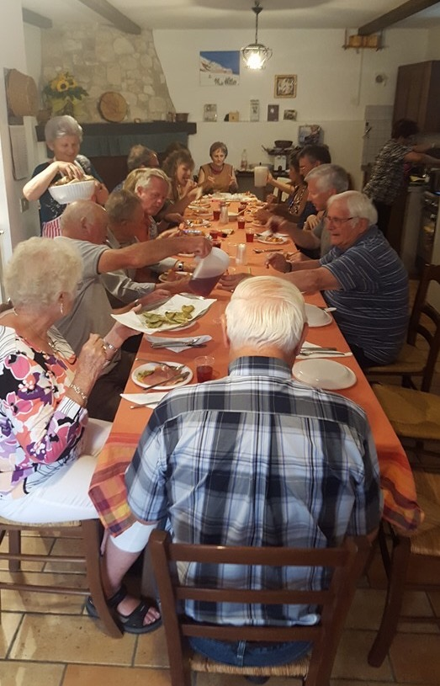
The featured photo in today’s blog is that of my sister’s in-laws in Italy.  My Sis is at the far end and cannot be seen from this vantage point.  Please notice that the family is gathered around a table that seats 18.  My sister tells me that the hostess prepares fresh mozzarella and bread every day.  When I gaze at this photo, I think I can smell the flavorful food, and I marvel at the wine being poured from pitchers.  Sis tells me that the meals there take two to three hours to consume; even when everyone at table does not speak the same languages.

Thank you for reading.


Another Exciting Day in Peru

Yesterday, I introduced the topic a trip I took to Peru as part of a leadership program focused on agriculture and rural life.  Our first stop was Lima, which was the central travel point to each part of our journeys across the country.  So, from Lima, we departed to Chincha by bus, to Tarapoto (the jungle region), by airplane, to Cusco (the high Andean region) by plane, and back home, by plane.  Those trips will be outlined in due time.

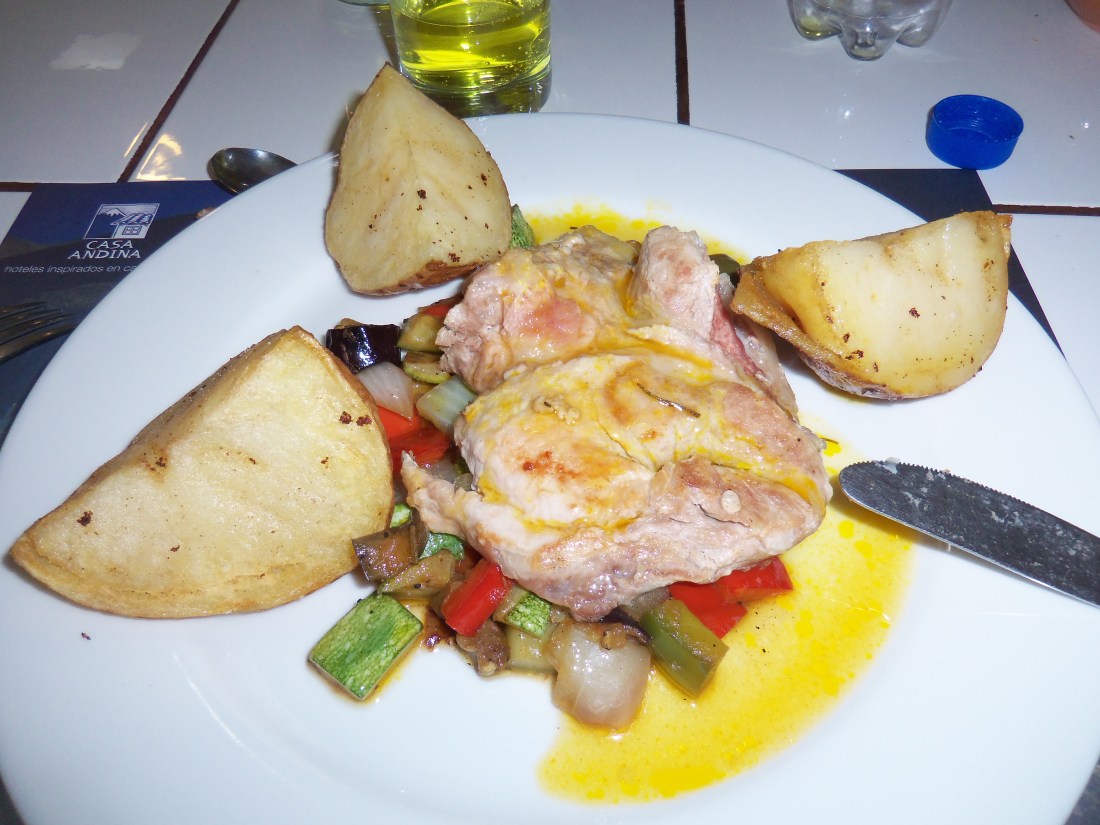
As previously mentioned, our first day included a U.S.D.A. country briefing at the U.S. Embassy with Ambassador Rose M. Likins and her staff.  After the briefing and tour of the U.S. Embassy – Peru, we departed for lunch at the Casa Andina.  We were fed one of Peru’s favorite dishes, chicken. We ate chicken in many dishes.  This was a delicious baked chicken place atop a sautéed vegetable medley of onion, eggplant, zucchini, and sweet red pepper all lightly touched with a savory butter sauce. A baked and quartered potato accented the dish, which we washed down with Inka-Kola, a cotton-candy-flavored cola (caffeine) drink.  This dish is my featured photo today.

We departed for the Corgono S. A. flour mill in Callao.  It was a fascinating tour.  It made me think of the sugar factory at Ayala, in the state of Morellos, in Mexico where very old equipment was handled with the most care and “babied” to get the most out of it.  Similar to that sugar factory, the flour mill in Callao ran three shifts per day, and one shift was set for maintenance of the milling machinery and equipment.  Otherwise, the grain went through all of the steps that one might imagine in any flour mill.  Before the tour, we were asked to wear long pants, no open-toed shoes, and to bring no cameras.  Apparently, I didn’t take copious notes as I look back to my journal.  I do remember great pride that each person had in his work at the mill.  It was very loud, and there were no women employed on that day.  One wondered if that was the rule for this mill.  I neglected to ask.

After the flour mill tour, we boarded two buses to Chincha Province.  Our bus journey was along the coast line running south from Lima.  Interestingly, the coast line was dotted with what looked like chicken houses.  Remember, Peru eats a lot of chicken.  Also memorable was lots of eating establishments named for their proprietors: Restaurant Betty, Restaurant Oscar, Restaurant Wilbur, etc.  I delighted in the entrepreneurial spirit of the Peruano (How they refer to themselves.  We had been saying, “Peruvians’).  We stopped for snacks at a gas station along the way.  One could buy a bag of puffed corn, sweet potato chips, or lima bean “nuts” (similar to Corn Nuts) with a bottle of beer.  That was interesting, so most everyone availed themselves of the opportunity.  Our scheduled two-hour bus ride took a bit longer as one our buses had a flat tire.  I didn’t mind.  It gave us time to get out for a look about.  We watched automobiles and “Moto-Taxis” whiz by.  The salt-filled air was comfortable, and many aromas arose in the evening air.

We made it to our hotel in Chincha that evening.  We cleaned up and stayed in for dinner at the hotel. We ate lovely chicken or beef dishes and drank Pisco Sours.  We were first introduced to the Pisco Sour when we had visited the Embassy of Peru in Washington, D.C. the previous year.

I hope you found this story interesting.  Thank you for reading my blog.


Travels to Peru

I had the great fortune to travel to Peru a few years ago.  It was part of a leadership program that focused on agricultural and rural living.  I did learn a lot while in the two-year program, but I felt like it was more like conservatism 101.  I am grateful for the opportunity, however.  It was an investment made in my by the institution for which I am on faculty.  So, I will tell you a bit about my trip.  When I’m not trips, I take copious notes, so my plan is to share those with you, sporadically.  I should tell you that my journal notes were mandatory reading for a U.S. Army Command who had an assignment in Peru about three years ago.  That was very exciting!

“If you smile at me, I will understand; ‘cause that is something everybody, everywhere does in the same language.”    That is David Crosby’s first line of his song, Wooden Ships, and it was my greeting to security at Wichita Airport, and thus began my 4,234-mile (one-way) adventure to Peru.  The quote was on the paper liner in the plastic boxes where travelers put their personal items to go through x-ray while they step through the metal detector.  Other than being greeted by one of my all-time-favorite songs,  I thought, “What a perfect way to begin a trip!”

My philosophy of travel is to view every experience as an adventure, and I’m always grateful for whatever happens.  I think it’s important when visiting other countries to go without expectation and to leave the lenses through which I see my middle-class life at home.  If I expect that every part of the world should be just like home, then I should stay home.  What would be the point of travel?

With that said, I must say that Peru was absolutely delightful.  The food was marvelous no matter what part of the country we were in.  The people were beautiful, happy, and welcoming.  They were eager to share their culture, their food, their drink, and mostly, their country.

I will use this space, occasionally, to tell you about what I learned in Peru.  We were greeted at the Lima (the capital of Peru and its largest city with 9 million people) airport by many people waiting for loved ones to return from trips.  When we loaded the bus, an ambitious young man helped us load our luggage.  I appreciated his ambition, and I was glad to offer a tip.  You see, Peru is a country of working poor.  One-third of the population lives in poverty.  Most affected are rural and inner-city people, so one becomes ambitious and entrepreneurial at a young age.  Nationally, poverty is measured at 100% when a family of three earns the U.S. equivalent of $2,640 annually.  Compare that to U.S. where a family of three is at 100% of poverty earning $19,530 annually.  However, we must remember that poverty is relative to average earnings in a country.

In Lima, we visited the U. S. Embassy, where we heard from the Ambassador and had a USDA briefing.  In the years since the horrors of Alberto Fujimori’s “reign”, Peru has seen a 6.4% annual growth in its gross domestic product, and it’s had a 1-2% budget surplus.  Poverty is pervasive, because many people are still not convinced that democracy and prosperity are real.  Right now, the Peruvian currency is appreciating against the U.S. dollar.  The greatest booming economies are agriculturally related.  Right now, the U. S. is not exporting as much wheat as usual because of the drought.   Peru has a moratorium on genetically modified organisms, so that hurts some U.S. exports to Peru, too.

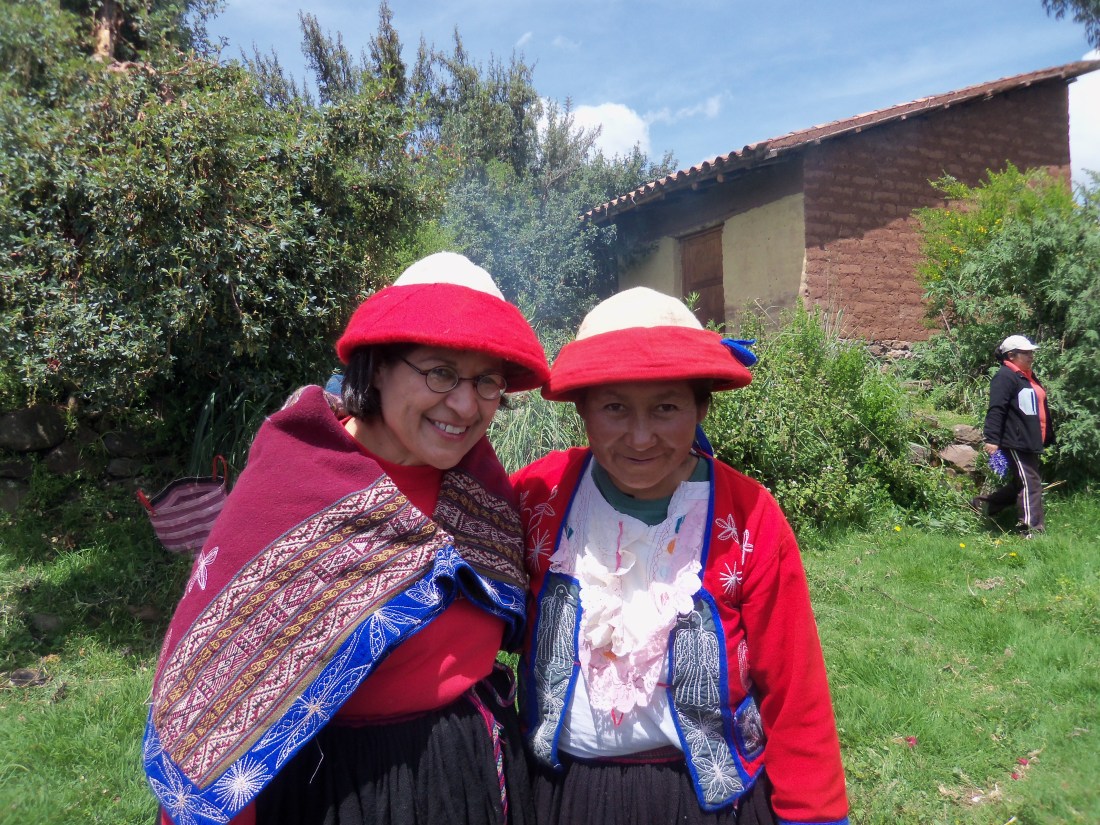
I am sharing a photo of a moment I share with a lady in the village of Urubamba.  The people there still speak their native language, Quechua.  Luckily, the village escaped colonization by Spain those centuries ago.

A Ute Prayer: Earth Teach Me to Remember

I can’t remember where I found this, but it comes from my father’s people, the Uncompahgre a.k.a. Northern Ute.

Earth teach me stillness
as the grasses are stilled with light.
Earth teach me suffering
as old stones suffer with memory.
Earth teach me humility
as blossoms are humble with beginning.
Earth Teach me caring
as the mother who secures her young.
Earth teach me courage
as the tree which stands alone.
Earth teach me limitation
as the ant which crawls on the ground.
Earth teach me freedom
as the eagle which soars in the sky.
Earth teach me resignation
as the leaves which die in the fall.
Earth teach me regeneration
as the seed which rises in the spring.
Earth teach me to forget myself
as melted snow forgets its life.
Earth teach me to remember kindness
as dry fields weep in the rain.

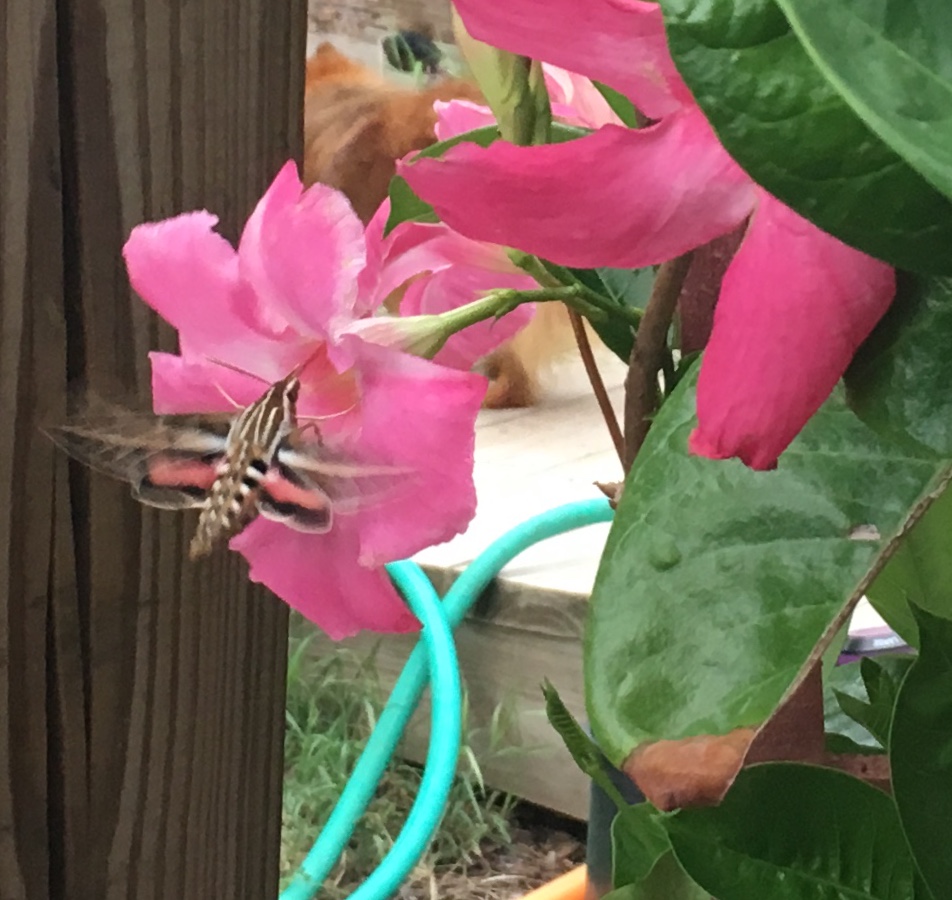
p.s. I posted a picture of a hummingbird moth (sphinx moth) feeding on an umbrella plant.  It reminds me of the beautiful wonder of nature.

Thank you for reading.

Making Your Own Fun

We just spent the past month with our grandchildren, which is the height of our summer months.  They like to eat different foods, so we focus a lot on the evening meal, and the eldest, KDW, has given himself the job of choosing the menus (grilled lamb, lasagne, fried chicken, shrimp fried rice, macaroni & cheese,  and spaghetti).  We try to have one meal with mussels, which is our only granddaughter’s favorite.  All meals end with some sort of ice cream or other frozen dairy product and games, such as Monopoly, bowling, swimming, and movies.  Never a dull moment!

The children have returned to their homes, and we are alone again, naturally.  So now,  we turn our focus to our friends.  My hubby is out of town, so I’ve been seeing our friends a lot this past week.   I just said goodbye, for the evening, to some ladies who came for dinner.  I’ve heard the phrase, “There’s nothing to do around here!”   Perhaps, it’s the non-creative mind that says such a thing.  There is always something to do.  When you’re used to making your own fun, it can be most stimulating.

This weekend has been especially busy for me, in terms of interacting with friends.  Friday, we had happy hour on the back porch.  There was lovely food, conversation, beverage, laughter, and getting to know some new friends.  On Saturday, I went to Lynn’s, house for some interesting fun.  We sat in a stock watering talk, filled with water, which was delicious on a hot, muggy day.

The point is that we can make our own fun.  I have wonderful friends, and all of us are easy “entertainers”.  That is, we fix some food, and have some friends, who usually bring more food, come to visit.  We share these evenings, evenly, among one another.  I suppose it helps that we all like to entertain, we love to cook, and we love discussing our lives with each other.  Half of our group is retired and some of us still work.  That’s another story, however.

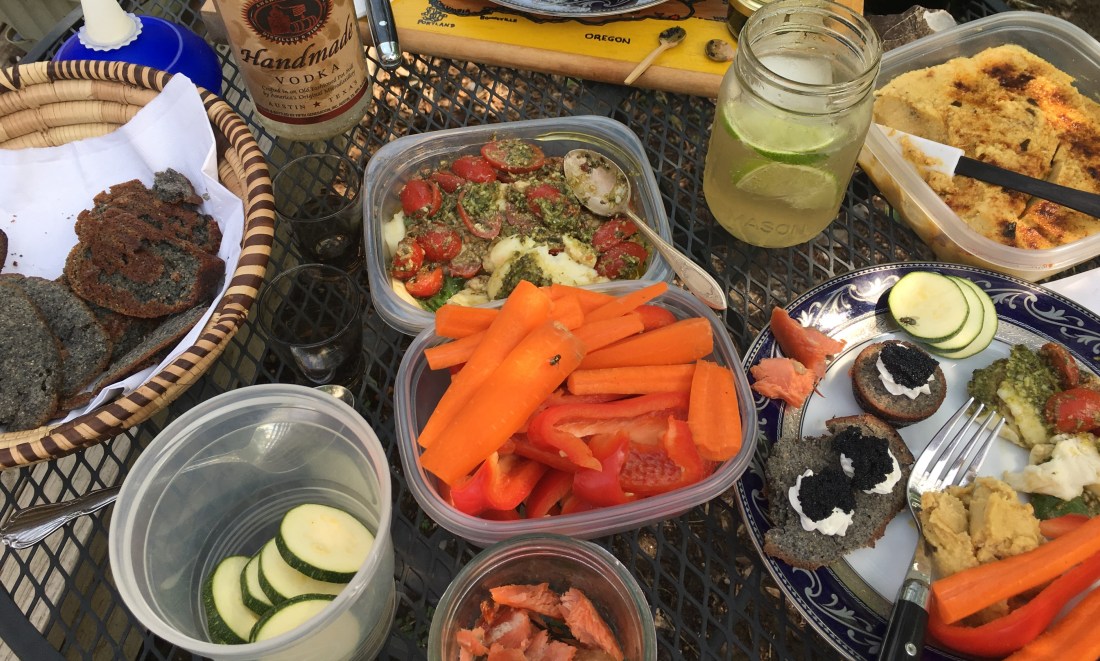
The picture that I’m featuring here, is the Saturday afternoon on Lynn’s back porch with her “spa” made from a livestock tank.  We filled it with water, set out the spread of smoked salmon (caught in Alaska by Mark & Kathy), blue corn cakes, cavier, sour cream, hummus (made from scratch with my own cooked chick peas), caprese salad (fresh basil, fresh mozzarella, tomatoes, and pesto sauce), and some cut up veggies. Lynn made Moscow Mules, and we soaked in the water, and passed the time.  It was marvelous.  Water is such a healing element.  We put our lawn chairs in the water tank so that we could sit next to the food table and help ourselves.  The afternoon was lovely, and before we knew it, five hours had passed.

Tonight, we had a girls’ night the featured ground lamb kabobs, veggies with dip, Brussels sprouts sauteed with bacon, fresh corn on the cob, and watermelon.  The great thing about summer is that one has access to fresh fruits and vegetables.  Our conversation centered on music and the arts.

I’m not sure what motivates one to be around friends, or not to have those types of relationships.  I realize there are some people who simply do not entertain guests in their homes.  I’m sure it’s a preference that either we have or do not have.  I was raised by a mother and father who fed a lot of people when I was growing up.  Mostly, it was relatives who ate at our house, but I remember the interactions and conviviality with great affection.

What are your thoughts on entertaining people in your home?

Financial Opportunities and Micro Loans

Some friends and I were discussing building financial opportunities for women.  It made me think of the micro-loans that were championed by the Grameen Bank many years ago.  One of my colleagues, a Bangladeshi engineer, was personal friends with Grameen founder, Muhammad Yunus, Nobel Laureate.  The concept of micro-credit and micro-finance has worked in many places to help people build financial security.

Our discussion centered on ways to help women, specifically, to build financial security.  It made me think of a study trip to Mexico, a few years ago, when I was able to learn from people who were using micro-credit to run very small farms called, ejidos (Eh-hee-tho).  Looking back at my journal notes, I will describe their process for growing tomatoes (tomates).

We visited several farms in the county (municipio) of Ayala.  An ejido farm can be compared to a parking lot. When you go to a parking lot, you just know there will be a place for you to park. And as long as you do not abuse your parking privileges, you can continue to park in a spot in that lot. An ejido farmer does not own his/her “lot”, but as long as he or she wants to farm there, and as long as it is used properly, the farmer can be on the land indefinitely. Like paid parking lots, there are only small fees to be paid, or food can be supplied to municipios.

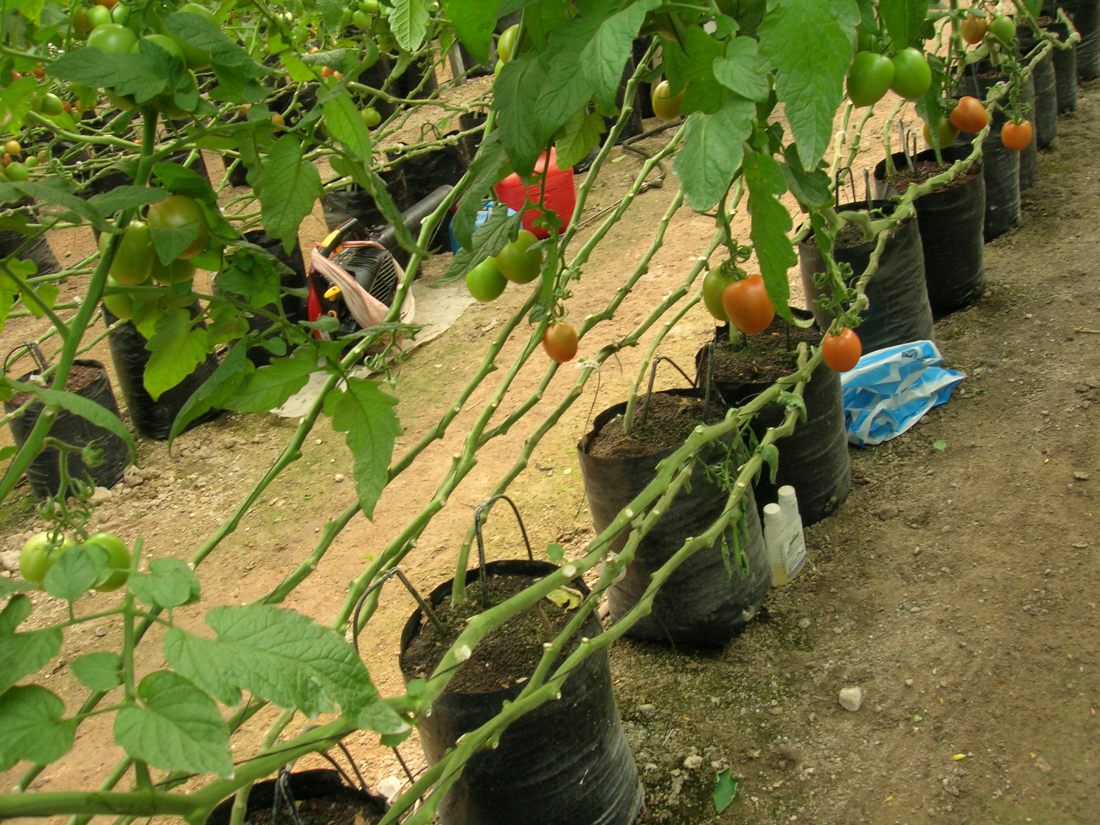
My colleagues and I visited a wonderful tomato farming operation, which had been in production for about five months. It took about one month to begin to produce significant quantities for sale. Before entering the facility, we had to step inside a sunken, concrete box holding chlorine bleach.
Situated on approximately one-fourth hectare, which is about 2,500 meters, which is about .62 acres, is a screen-enclosed structure holding about nine-thousand tomato plants. The plants’ soil and root systems sit inside heavy, pliable, black plastic bags, which are approximately 13 inches in diameter and 14 inches high. The stems of the plants are three to six inches in diameter. The plants vine up strings rising 12 feet above to horizontal wires running parallel to each row of plants. The tomatoes nearest the bucket-like bags, holding the dirt and root systems, ripen first. As tomatoes are harvested, the green tomatoes nearest the horizontal wires are lowered to run more parallel with the ground. Then the top of any given plant will be hanging over buckets 10 spaces away. Every 15 days, the strings are lowered, and the tomatoes nearest the ground ripen first. This Loreto-variety of tomatoes takes a lot of nitrogen, we were told. If you want to see pictures, please let me know. You would love seeing this operation.
The plants take 20-thousand liters of water a day, which is about 5,265 gallons. The farmer harvests 200 boxes of tomatoes per week. The boxes held about two bushels, which is about 106 pounds. There is not much exporting, but this operation supplies several grocery stores (tiendas) weekly. The picked fruits are sold to the stores, and the fallen fruits are sold in the barrios (neighborhoods).
The producer told us the next thing to be learned is composting so that something useful can be done with the organic waste, which is one other by-product of this operation.

All this was built from a micro-loan, and the farmers told us they thought they’d begin to see a profit just after the second round of purchases.

Here’s another:

“EJIDOTARIAS” (EH-HEE-THO-TAR-EE-AHS)
Don’t forget to roll the “Rs”.  Okay, so I already introduced the ejido farm producer. The community or municipio owns the land. You stake a claim, of sorts, to some land, and you farm it. As long as you do not abuse the land or other farms around you, you can work that land as long as you like. There is a small usage fee to help the community. The county (municipio) government usually helps with initial seeding, reclamation, and improvements.

We visited the farm of two women near the minicipio of Ayala, state of Morelos. The señoras farmed their ground together. They produced corn, green beans, squash, and sugar cane. Their corn seed came from the U.S., and they grew both grain (maiz) and sweet corn (elote) – pronounced “my-eese” and “eh-lo-tay.”

Farming 3,000 feet above sea level, the ladies planted, irrigated, and harvested by hand and with the use of oxen and horses. Small irrigation ditches ran through the land. It is up to the farmer to flood her fields from the ditches with dams and canals. They farmed four hectares (about 10 acres) per year. It costs about 5,000 pesos per hectare (2.48 acres) including 200 pesos for fertilizer and 350 pesos for insecticide. They pay their water usage annually. The ladies gave us an estimate that it took about 29,000 pesos to get their produce to the market. That is about $2,900.

In the ejido system, producers help one another plant and harvest. For example, the sugar cane was harvested with a machete. It takes strong arms to swing a machete. The crops go to market in Mexico City. Visiting this particular farm held a few contradictions. Everything was done by hand, which took us back in time. The power lines above had electricity surging through them, audibly. That brought us back to reality.

Thank you for reading.

My Teaching Philosophy

Okay, so I’m not in a formal classroom anymore.  However, I do have a teaching philosophy through which I see an educational setting.

I think that every day humans seek to achieve personal, tribal, familial, institutional, and community well-being. Actions may differ from place to place because of varying cultural patterns, environmental conditions, geographical locations, political capital, natural capital, cultural capital, social capital, and other resources that affect human lives.  The teacher, be it formal or informal, affects the lives of his or her students’ thinking by leading them toward seeing the world through unbiased lenses, and to see each human being for what he or she contributes to the fabric of humanity.

A passionate teacher does everything in her or her power to build learners.  How can we make our classrooms a level playing field so that each learner engages within his or her own abilities.  Does that means that we have to employ a variety of methods that speak to varying types of learners: visual, auditory, and kinesthetic.  Do teachers have this luxury, or is their day proscribed for them?  I would like to see feedback for this notion.

Though the classroom, naturally, employs a variety of textbooks, I believe that students learn from encouraged self-discovery so that they see themselves in the contexts of educational settings, the family, the social arena, in cultural arenas, the workplace, the community, national arena, and the world.  These contexts help the students to visualize how cultures, ideals, and preferences are built.

Other concepts and questions:

I love geography, because it employs geographic inquiry, which helps students understand local to global issues in physical and human systems.  This inquiry also helps students to ask questions about the past, understand present issues affecting community, and to envision a future that includes individuals and families who are emotionally, socially, healthfully, financially, and civically-minded.

Other elemental themes in teaching could include meta-cognition tools that encourage students to understand their own thought processes that shape personal, cultural, and world thought.

Spatial orientation and thinking encourages students to think about environments, where they live, work, and play (habitats), and the world in spatial terms.  Spatial thinking gives students a sense of place in history, presently, and the future.  How do we go beyond thinking to describing our “spaces”, relationships of objects to one another, and going from the large (macro) to the small (micro)?  A possible question: Beyond thinking, can you describe your “spaces” using direction, employing mental maps, describing scale (size), and other relational vocabulary?

Places and Regions:  Does where you live affect how you interact with your environment? Does where you live affect your way-of-knowing?  Does where you live influence your health? Does where you live influence your economic well-being?  Can people have different points-of-view living in the same community, region, or family?  Do your places/regions change?  How does that affect you?

Not sure if I’m repeating myself, but I love education, and I hope that each students walks away better for it.


A day in the lives of refugee and other immigrant families settling into new cultures

In this text, I have borrowed from myself.  I was attempting to write a white paper to help educators better understand the students in their classrooms.  I think it’s always best to back up and start at the beginning to understand a journey.

Why do people emigrate?  That is, what makes a family leave its own country and venture into an unknown land, in many cases, across oceans?  In most cases, this movement is considered a “Forced Migration”, which is displacement because of persecution, armed conflict, generalized violence, human rights violations, natural or environmental disaster, famine, ineffectual government, or lack of financial opportunities (Baker, 2014; Goetz, & Rupasingha, 2007).  Often times, the process of migrating is dangerous and may take up to 10 years with many stops along the way (Salgado de Snyder, 2007).  Humans have always migrated, and it, likely, never will stop because of constant changes in governments and other political policies, food supplies, societal mainstream notions, and religious views.

For the past 25 years, immigrants of all statuses, have been part of my daily life living in Southwest, Kansas, both professionally and personally.  I’ve worked with Southeast Asian and African refugees.  I’ve worked with immigrants from all of the Americas (Meso, Central, South and North (I call them economic refugees), and with immigrants who come with professional careers from India, Mexico, Peru, Philippines, China, Africa, Brazil, the Caribbean, Canada, and different parts of Europe.  It is an enriching experience to learn from those who come from other backgrounds.

All the immigrants who have come to Kansas in the past 30 years have one thing in common. They’ve come to the United States to seek better ways of lives.  Lives without conflict and strife.  Lives filled with hopes for their futures.  While their stories of how they arrived on the shores or across the borders into the U.S. vary, there are common denominators in the challenges of which they face.  The greatest challenge, possibly, is that of acculturation.  That is, fitting into a new land, learning the folkways and mores of the people, and understanding how their own cultures either blend or clash with the “mainstream”.  They do all this while trying to learn a livelihood for their families’ survival and hoping to move to a place of thriving in their lives.   There are many struggles and challenges of acculturating to new lives in new cultures. Granted, the Canadians with whom I’ve worked don’t have as many challenges because of a common language and European ancestry as the U.S. mainstream. However, the most obviously “different” immigrants do have challenges. For example, these are some of the question and comments that I hear along the way:

  • How and where do our children go to school?
  • Is there a place for me to learn English?
  • Where do we get an identification and address immigration status?
  • What are rules for driving a car?
  • Where do we get the foods of our traditions?
  • What are the rules for schools regarding age of entry, immunizations, school readiness?
  • Where do we find child care provider for our children?
  • Where do we find a doctor?
  • Is there public transportation?
  • Are we safe to walk to where we need to go?
  • “We are starting all over, and I need to purchase items for my home, again, and I don’t know anybody, so I have to make new friends, too.”


The United States is heading toward a demographic where there will be no one majority of population by the year 2040 (World Bank).  My observation is that this notion strikes fear in people.

After nearly 30 years of living, working, and playing alongside the immigrants who have come these past three decades, my observation is that they have not come to colonize these lands and the mainstream.  They (immigrants) have come for better lives for their children.  Historically, most are the victims of colonization on their lands of origins.  If you get the opportunity, hear their stories, share their foods, understand their laughter, and most importantly, empathize with the fears that pushed them out of their home soils.

Thank you for reading.

Community Engagement and Social Connectedness

I’m wondering if the phrase, “social capital” has run its course.  Robert Putnam, in his Bowling Alone certainly moved the discussion along about the effects of isolation and not building relationships within and across groups.  Even then, Putnam isolates social capital without looking at community environments, which contribute to whether or not we build human connections.  If you look at the work of Flora, Flora, Fey, and Emery’s framework called, “Community Capitals”, you would be treated to a more holistic framework, which helps us understand human development.  (This “team” did much of this work while at Iowa State University).

I like the concept of community capitals, because we are led to talk about humans in their environments in terms of: social, financial, built, natural, human, cultural, and political capitals.

Remember, capital, of any kind, is a resource in which we invest to create new resources down the road. For example, our cultural capital begins at birth.  In childhood, we learn how to act, how to speak, what to value, and we acquire certain symbols that partly define us.  That is our cultural capital.  It belongs to us individually and as part of a group.  When we are employed, we are part of the human capital for our employers.  We offer our human capital (talents, education, skills, etc.) to our employers out of which some kind of product is produced.

Ogallala Commons is a non-profit organization that trains community interns for service (2 months in the summer, usually).  The community, being served, invites an intern based on a community need.  “OC” (the acronym for Ogallala Commons), uses a “12 Key Assets of a Commonwealth” as a framework for addressing human capital needs in a community: education, health, leisure & recreation, history, sense of place, water cycle, arts & culture, wildlife & natural world, soil & mineral cycle, foodshed, renewable energy, and spirituality.  Every community has these assets, which can be understood as a foundation for building new careers for the interns while the community reaps the benefits of the interns’ human capital.

This brings me to “social capital”, our relationships with those within our immediate circle of friends, family, and colleagues and those relationships we build outside our closest associates.  I think it’s all about relationships.  Relationships matter!

Think about your relationships.  Are they beneficial to you? Perhaps, it’s not a deliberate notion; how we build our relationships. But, as I look back on my past years, I realize that I’ve built some rather wonderful relationships and great friends these past 30-some years.  Each of my friends delight me in different ways, and I’m a richer person for it.  My friends are my support system, and they all accept me for my weird self!  All of us don’t think alike.  We don’t have the same political views.  We don’t all have the same level of financial security (some have planned better for their futures and some have not). I think we learn from each other at many different levels.  I think mutual respect, among my wide circle of friends, is the hallmark of our relationships.  The opposite of my level of social engagement is isolation.

What does isolation do to people?  Think of that elderly person who sits at home without friends and family around him or her.  An isolated person is more likely to display a tendency toward sadness, more physical illnesses, and cognitive degeneration.  I once visited a federal penitentiary.  The “tour guide” said that people who go into the penal system at a young age, like early 20s, are more likely to display symptoms of dementia by mid-40s since a prison environment is not one known for its stimulation of cognitive function.  Relationships matter!

If you think about your community, do you see well developed personal relationship among those who live in your neighborhood or your town?  Here are qualities of a well developed community:

  • You know your neighbors
  • You feel attached to your neighborhood
  • You are politically active and feel like your voice is heard
  • You have trusting and reciprocal relationships
  • You are involved in your community (volunteer…)

What happens when you live in a community with well-developed, intercultural relationships:

  • Crime rates are lower
  • Have better health outcomes across the generations
  • Experience more collective actions
  • Increase in shared resources
  • Mutual respect across groups of difference

Yes.  It may seem like a utopia, but wouldn’t it be great to live in such a community?

Thank you for reading.  I do have references for much of what I say, by the way.

Creativity and the Joy of Music

Humans create to adorn themselves, to express themselves, to release emotion, and to elevate their senses.  Of course, there are other reasons humans create.  I think of the arts, especially music, for these thoughts today.

I live in a town where the municipal band has performed, continuously,  since 1874.  Since the 1930s, this municipal band performs under a WPA (Works Progress Administration) band shell in a town square surrounded by WPA brick streets.  Though evenings in Kansas tend not to cool off, it’s a lovely time to hear people from the community performing new and old compositions.  All which culminate with a “grand march” where people in the audience, mostly children, march waving small flags.

Last night, which was the last for the season, which begins the first Friday in June, there was the addition of a community choir.  I was excited to be in that choir.  My love of performing in a choir goes back to four years of high school choir under the direction of my mentor and best teacher, ever, Mr. D. W. Bauguess. I’m unsure about using people’s whole names in this venue.  Anyway, our choir, last night, sang three songs: Boogie Woogie Bugle Boy (a WWII favorite performed by the Andrews Sisters), Don’t Get Around Much Anymore (A Duke Ellington gem), and a Porgy & Bess medley (the “folk opera” by the beloved George Gershwin).  They are wonderful old songs, and it was with great delight that we presented them, complete with a first soprano solo by a local, professional, coloratura soprano.

This makes me think of the joys of music.  We know that music helps us develop our brains, when classical music is played for infants.  We know that singing releases endorphins, which make us happy.  We know that music helps us to use that part of the brain that supports mathematics.  And, of course, we know that music uses that part of the brain that supports creativity.  Every culture has its music.  Most humans respond to music.

I’m in a little folk music band.  Our band consists of four people: three females and one male.  Our instruments include guitar, bass, ukuleles, banjo, mandolin, harmonica, and the occasional percussion instruments.  My favorite saying:”We only play the best nursing homes in town.”   We’re not a great band, but we make up for it in enthusiasm!  When we sing at the retirement homes or at the senior center, our music brings joy to the people, and we stay to visit when the musical hour has come to its end.  I’ve been trying to get my band, who doesn’t like to practice much, to set up on the street downtown and play music.  You know: like buskers!

Do you have music in your head?  Do you walk around with a song repeating itself?  I come by my constant flow of music in my head honestly.  I remember my maternal grandmother whistled while she was in the kitchen cooking and doing laundry.  She whistled all the time.  My brother, Lee, hums, and so do I.  We, including our nephew Dylan, like to hum while we eat!  It likely annoys those around us, but what do you do?  It’s such a joy to hear our granddaughter and one of our grandsons singing quietly to themselves while they do tasks.

Music is joy, and I find a way to incorporate it into my day in one form or another; whether I’m listening to it or performing it.  What’s your musical “power”?

Thank you for reading.