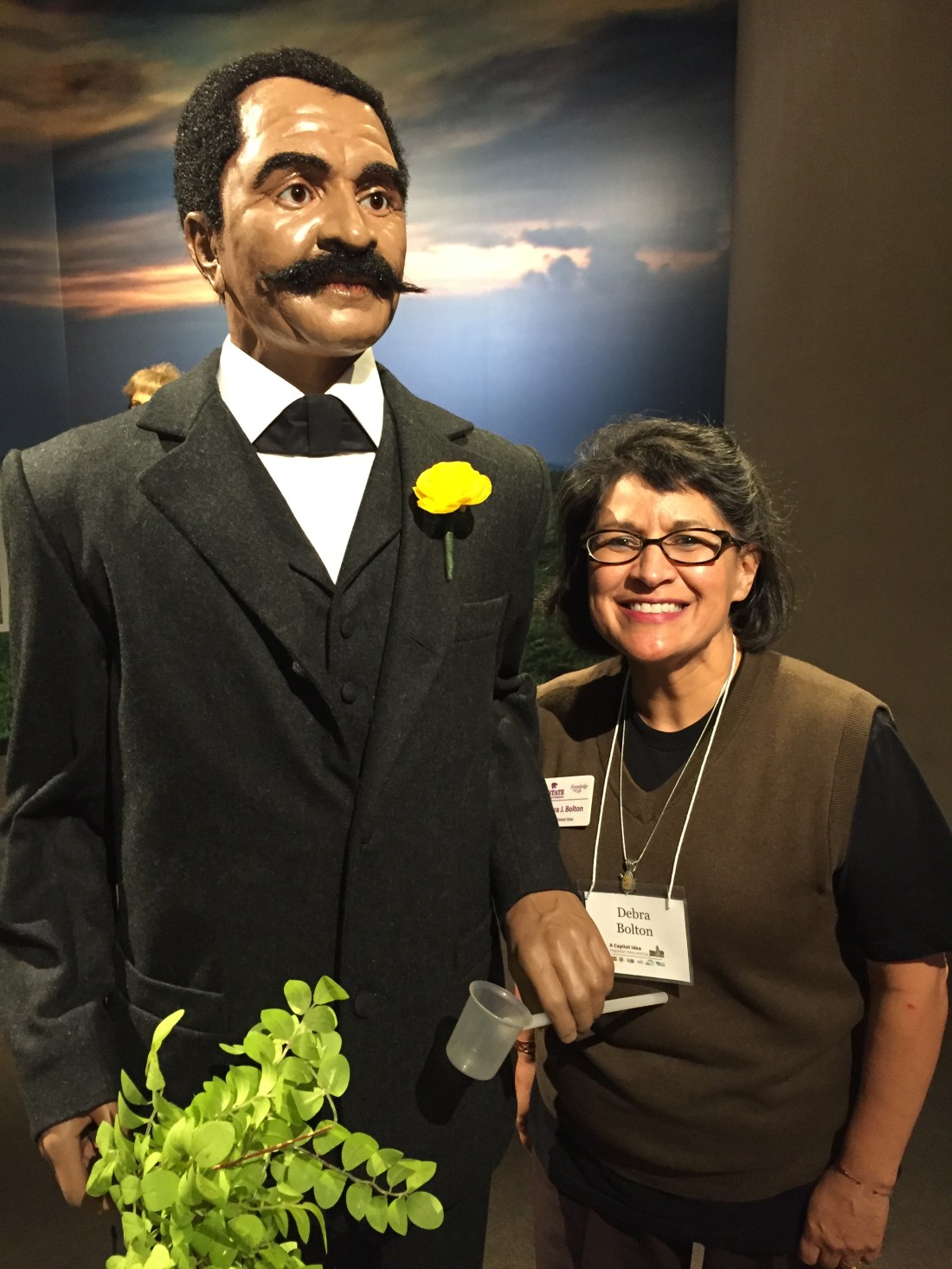
George Washington Carver

Today, I want to tell you about one of my heroes, George Washington Carver, agricultural chemist, inventor, professor, artist, pianist, violinist, and singer.  If you enjoy peanut butter, you have GWC to thank for finding more than 326 uses for peanuts, including wood stains.  He was equally inventive with the sweet potato, which garnered many uses, like the peanut, including medicines to mitigate the effects of syphilis.  Remember, Carver was a professor at Tuskegee Normal Institute, now called Tuskegee University.  Many of his students were part of the infamous, “Tuskegee Experiment” that injected syphilis into “Negro” males to watch and record the devastating effects.  That is one of the reason why we, social researchers, have to register our research plans with institutional review boards monitoring research on human subjects.

Well, let’s back up a bit.  If you’re ever traveling in Southwest Missouri on Interstate-44, you will see an exit for Diamond, Missouri.  That’s where “The Plant Doctor”‘s life began.  He and his mother went to live on the Carver Plantation.  One night, George and his mother were kidnapped.  She was killed, and the little, sickly boy was returned to the Carver Plantation, which is now a National Monument, operated by the Department of Interior.  The Monument was established in 1930 by President F. D. Roosevelt, who gave $30,000 toward the building of the Monument.  FDR had met Carver, and greatly admired him.  I had already adored Carver, but after my visit, my adoration deepened.

Because little George was sickly, he was able to stay in the main Carver home while the other slaves worked in the cotton and vegetable fields.  It was there that George learned to sew, knit, crochet, wash clothes, and where he became a musician.  He mastered the violin, piano, and sang, beautifully.  He had a natural with plants, and was able to help the sharecroppers to make their fields more productive while maintaining the integrity and health of the soil.  Carver taught the people about crop rotation.  For example, when the cotton stripped away soil nutrients, GWC helped them to use sweet potatoes and peanuts as a source for money and a source to feed the soil nitrogen and other nutrients.

When George was a teen, (about 15ish), he was denied admission to schools in Missouri, so he headed west to Kansas stopping first in Fort Scott in Bourbon County, Kansas.  He soon found his way to Western Kansas in Ness County, and then to Minneapolis, Kansas and homesteaded near Beeler, Kansas.  He supported himself by taking in laundry while he studied to graduate high school.  When it was time for college, Carver had been accepted into a Kansas college until he arrived for actual registration.  He was told that he could not attend college since he was a “Negro”.

Not to be deterred, Carver headed to Iowa where he was admitted into Simpson College.  His art teacher noticed his great detail when sketching plants.  She suggested that Carver talk to biologist at what is not Iowa State University.  After graduating with his Master’s Degree, Carver taught chemistry and biology at Iowa State.  The young professor and inventor caught the eye of Henry Ford after making rubber out of golden rod plant.  He caught the eye of Thomas Edison who want Carver to come to New Jersey to work for him.   An idealist, Carver accepted the call from Booker T. Washington, then the head of Tuskegee.  Carver wanted to go where he’d “do the most good”.  It was at Tuskegee that Carver lived out the rest of his life teaching, inventing, and helping farmers increase yields and their incomes.  Carver is best known for his work with peanuts, sweet potatoes, and pecans.  Carver lived a simple life and never had living quarters larger than one that held a twin-sized bed, a bureau, and a small desk.  Most of his days were spent in the laboratory and finding ways to help his students “make a mark in the world”.

Carver’s Honors include:

  • Named Fellow, London Royal Society for the Encouragement of the Arts
  • ‘Springarm Medal for Distinguished Service
  • Collaborator – Division of Plant Mycology: USDA
  • Roosevelt Medal for Contributions to Southern Agriculture
  • Popular Mechanics Top 50 Outstanding Americans
  • National Inventors’ Hall of Fame.

I do have a reference list if you’re interested.

I work at an agricultural experiment station.  If Carver were alive today, he’d be one of my colleagues!  If you want to know more, do some research on his Jesup Agricultural Wagon, on which he’d take his research to the farmers to show them the latest in crop and soil research.  You can see a replica at the GWC National Monument near Diamond, Missouri.

Thank you for reading.
Financial Opportunities and Micro Loans

Some friends and I were discussing building financial opportunities for women.  It made me think of the micro-loans that were championed by the Grameen Bank many years ago.  One of my colleagues, a Bangladeshi engineer, was personal friends with Grameen founder, Muhammad Yunus, Nobel Laureate.  The concept of micro-credit and micro-finance has worked in many places to help people build financial security.

Our discussion centered on ways to help women, specifically, to build financial security.  It made me think of a study trip to Mexico, a few years ago, when I was able to learn from people who were using micro-credit to run very small farms called, ejidos (Eh-hee-tho).  Looking back at my journal notes, I will describe their process for growing tomatoes (tomates).

We visited several farms in the county (municipio) of Ayala.  An ejido farm can be compared to a parking lot. When you go to a parking lot, you just know there will be a place for you to park. And as long as you do not abuse your parking privileges, you can continue to park in a spot in that lot. An ejido farmer does not own his/her “lot”, but as long as he or she wants to farm there, and as long as it is used properly, the farmer can be on the land indefinitely. Like paid parking lots, there are only small fees to be paid, or food can be supplied to municipios.

My colleagues and I visited a wonderful tomato farming operation, which had been in production for about five months. It took about one month to begin to produce significant quantities for sale. Before entering the facility, we had to step inside a sunken, concrete box holding chlorine bleach.
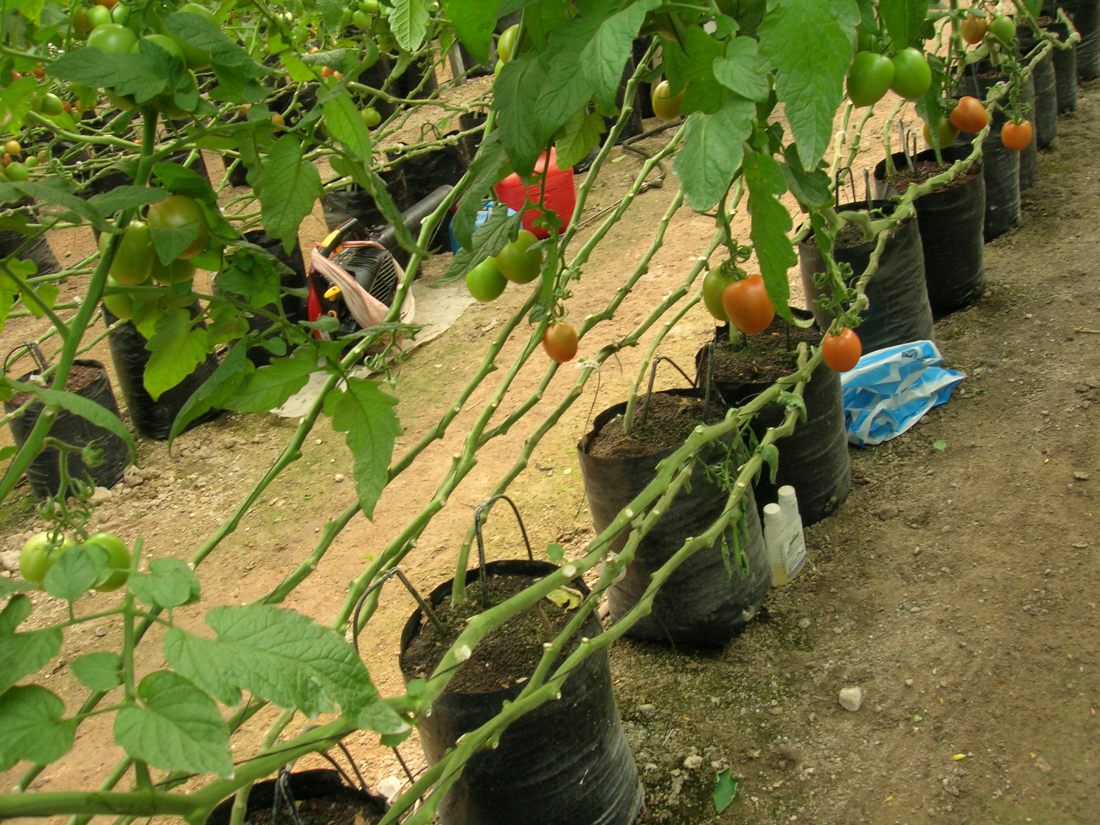
Situated on approximately one-fourth hectare, which is about 2,500 meters, which is about .62 acres, is a screen-enclosed structure holding about nine-thousand tomato plants. The plants’ soil and root systems sit inside heavy, pliable, black plastic bags, which are approximately 13 inches in diameter and 14 inches high. The stems of the plants are three to six inches in diameter. The plants vine up strings rising 12 feet above to horizontal wires running parallel to each row of plants. The tomatoes nearest the bucket-like bags, holding the dirt and root systems, ripen first. As tomatoes are harvested, the green tomatoes nearest the horizontal wires are lowered to run more parallel with the ground. Then the top of any given plant will be hanging over buckets 10 spaces away. Every 15 days, the strings are lowered, and the tomatoes nearest the ground ripen first. This Loreto-variety of tomatoes takes a lot of nitrogen, we were told. If you want to see pictures, please let me know. You would love seeing this operation.
The plants take 20-thousand liters of water a day, which is about 5,265 gallons. The farmer harvests 200 boxes of tomatoes per week. The boxes held about two bushels, which is about 106 pounds. There is not much exporting, but this operation supplies several grocery stores (tiendas) weekly. The picked fruits are sold to the stores, and the fallen fruits are sold in the barrios (neighborhoods).
The producer told us the next thing to be learned is composting so that something useful can be done with the organic waste, which is one other by-product of this operation.

All this was built from a micro-loan, and the farmers told us they thought they’d begin to see a profit just after the second round of purchases.

Here’s another:

“EJIDOTARIAS” (EH-HEE-THO-TAR-EE-AHS)
Don’t forget to roll the “Rs”.  Okay, so I already introduced the ejido farm producer. The community or municipio owns the land. You stake a claim, of sorts, to some land, and you farm it. As long as you do not abuse the land or other farms around you, you can work that land as long as you like. There is a small usage fee to help the community. The county (municipio) government usually helps with initial seeding, reclamation, and improvements.

We visited the farm of two women near the minicipio of Ayala, state of Morelos. The señoras farmed their ground together. They produced corn, green beans, squash, and sugar cane. Their corn seed came from the U.S., and they grew both grain (maiz) and sweet corn (elote) – pronounced “my-eese” and “eh-lo-tay.”

Farming 3,000 feet above sea level, the ladies planted, irrigated, and harvested by hand and with the use of oxen and horses. Small irrigation ditches ran through the land. It is up to the farmer to flood her fields from the ditches with dams and canals. They farmed four hectares (about 10 acres) per year. It costs about 5,000 pesos per hectare (2.48 acres) including 200 pesos for fertilizer and 350 pesos for insecticide. They pay their water usage annually. The ladies gave us an estimate that it took about 29,000 pesos to get their produce to the market. That is about $2,900.

In the ejido system, producers help one another plant and harvest. For example, the sugar cane was harvested with a machete. It takes strong arms to swing a machete. The crops go to market in Mexico City. Visiting this particular farm held a few contradictions. Everything was done by hand, which took us back in time. The power lines above had electricity surging through them, audibly. That brought us back to reality.

Thank you for reading.

My Teaching Philosophy

Okay, so I’m not in a formal classroom anymore.  However, I do have a teaching philosophy through which I see an educational setting.

I think that every day humans seek to achieve personal, tribal, familial, institutional, and community well-being. Actions may differ from place to place because of varying cultural patterns, environmental conditions, geographical locations, political capital, natural capital, cultural capital, social capital, and other resources that affect human lives.  The teacher, be it formal or informal, affects the lives of his or her students’ thinking by leading them toward seeing the world through unbiased lenses, and to see each human being for what he or she contributes to the fabric of humanity.

A passionate teacher does everything in her or her power to build learners.  How can we make our classrooms a level playing field so that each learner engages within his or her own abilities.  Does that means that we have to employ a variety of methods that speak to varying types of learners: visual, auditory, and kinesthetic.  Do teachers have this luxury, or is their day proscribed for them?  I would like to see feedback for this notion.

Though the classroom, naturally, employs a variety of textbooks, I believe that students learn from encouraged self-discovery so that they see themselves in the contexts of educational settings, the family, the social arena, in cultural arenas, the workplace, the community, national arena, and the world.  These contexts help the students to visualize how cultures, ideals, and preferences are built.

Other concepts and questions:

I love geography, because it employs geographic inquiry, which helps students understand local to global issues in physical and human systems.  This inquiry also helps students to ask questions about the past, understand present issues affecting community, and to envision a future that includes individuals and families who are emotionally, socially, healthfully, financially, and civically-minded.

Other elemental themes in teaching could include meta-cognition tools that encourage students to understand their own thought processes that shape personal, cultural, and world thought.

Spatial orientation and thinking encourages students to think about environments, where they live, work, and play (habitats), and the world in spatial terms.  Spatial thinking gives students a sense of place in history, presently, and the future.  How do we go beyond thinking to describing our “spaces”, relationships of objects to one another, and going from the large (macro) to the small (micro)?  A possible question: Beyond thinking, can you describe your “spaces” using direction, employing mental maps, describing scale (size), and other relational vocabulary?

Places and Regions:  Does where you live affect how you interact with your environment? Does where you live affect your way-of-knowing?  Does where you live influence your health? Does where you live influence your economic well-being?  Can people have different points-of-view living in the same community, region, or family?  Do your places/regions change?  How does that affect you?

Not sure if I’m repeating myself, but I love education, and I hope that each students walks away better for it.