Love to Cook and Eat with Friends

It’s good to be back.  While away from my blog these past many days, my attentions focused on lots of writing for my job and preparing presentations around building relationships in multi-cultural, multi-lingual, multi-ethnic populations.  My “lessons” and publications target educators who work with multicultural populations.  So, I have not sat down to write in this blog, but I still have to eat, and I still have many friends who stop by for a meal.

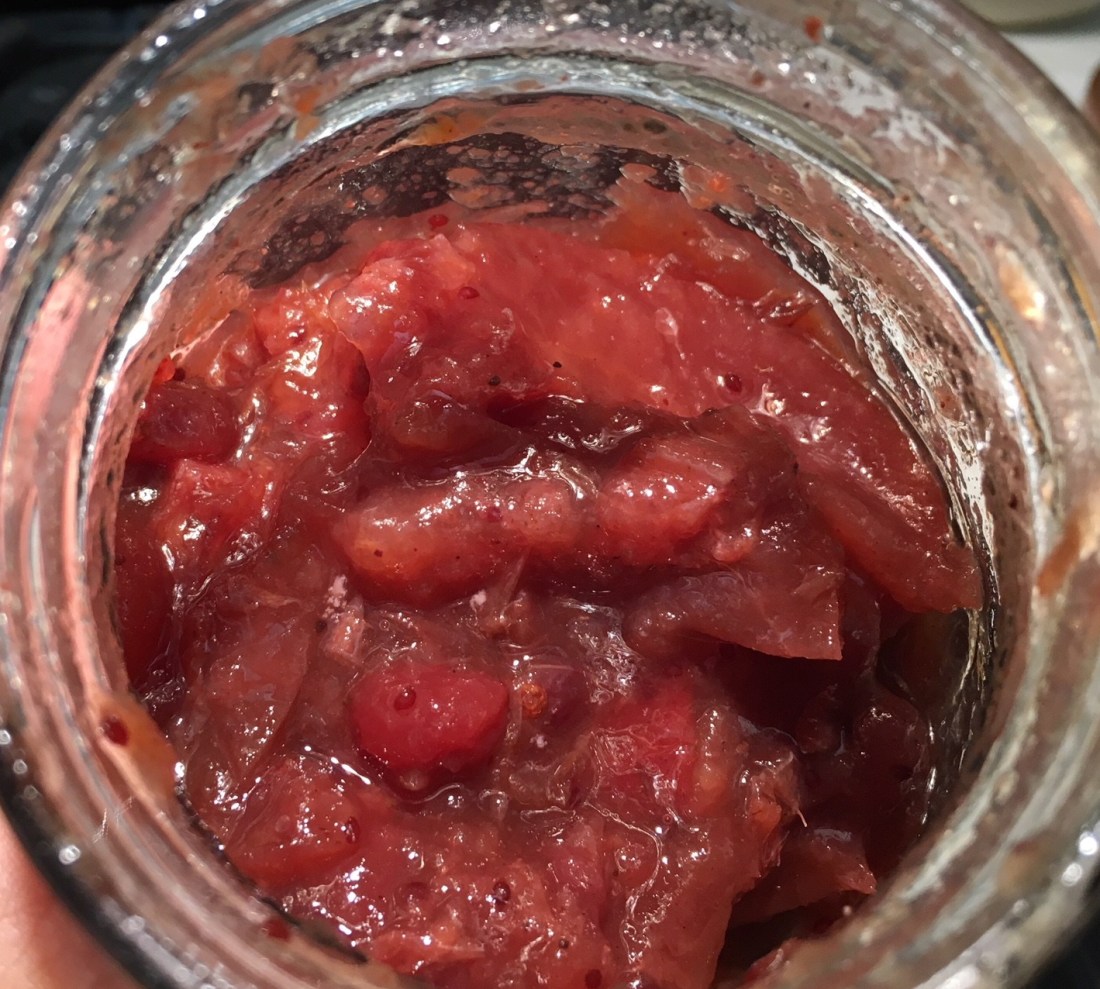
My featured photo today is my jammy fruit compote that I call CAOS (sounds like chaos!)  I created this one Thanksgiving as my answer to cranberry sauce that we serve with turkey.  Making more than one jar at a time also assured that I will have fruit to serve during times of our Native ceremonies where we have some fruit of the bounty.

So, what is CAOS? Cranberry, apple, orange, spice.  I love the taste of Chinese 5-Spice, so I used it as my spice.  Here’s my recipe:

24 ounces (680.39 g) fresh cranberries

6 red (any kind) apples – cored and chopped (do not peel)

3 oranges – chopped (do not peel and remove seeds if applicable)

2 cups (453.59 g) apple cider

1/2 cup (113.40 g) honey

1 Tablespoon (140.18 g) Chinese 5 Spice (my version is a mixture of cinnamon, ginger, cardamom, cloves, and nutmeg). Sometimes I use fennel or anise seeds in place of cardamom.

Combine all ingredients, and bring slowly to a boil stirring to a simmer.  Simmer until nice and thick until to a gelling point.  You can test for gelling by checking your stirring spoon.  I like to put a small pat of butter in my jams to reduce foaming.  When the jam is thickened, ladle into hot canning jars leaving 1/4 inch head space, seal with new lids and rings.  Process in a boiling water bath “canner” for 15 minutes.  Remove from boiling water and place on a towel on the counter out of a breeze.  The jammy fruit is ready to store when you hear the little “pop” that tells you it’s sealed.  Let the jars cool completely before you store on the shelf in your pantry.

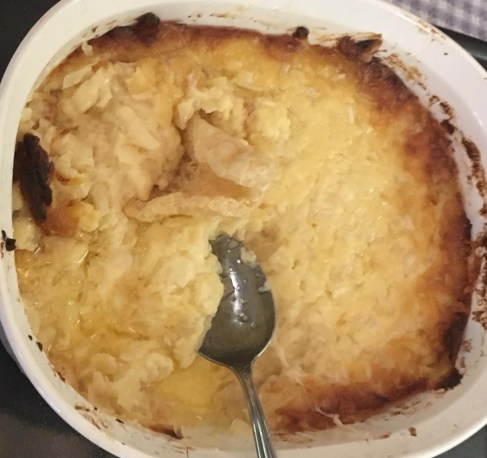
Now, dinner with friends, Mark and Kathy, which was sort of a potluck since Kathy brought one of her famous appetizers (“appies”), Vidalia Onion Dip.  Rather than serve with the, usual crackers, we ate the dip with pork rinds to make it a low “carb” snack. I can’t remember Kathy’s recipe for the dip other than 1 or 2 whole onions, Swiss cheese, and mayonnaise.  Then you bake it.  Kathy says it freezes well, too.  I think I prefer it with crackers over the pork rinds.
vidalia-onion-dip.jpg

For the main course, I served ground lamb kabobs, which are really ground lamb with a handful of chopped cilantro, garlic, and salt/pepper.  Form a log or a patty.  Grill the lamb and serve with tzaziki (yogurt, cucumber, and garlic powder).   Lately, we’ve been sauteing red cabbage in butter with a little pepper.  It’s delicious when you allow the butter to caramelize the cabbage a bit.  We served the ground lamb with a dollop of my cilantro pesto (made with walnuts, Parmesan, garlic,and olive oil) and grilled Halloumi cheese.

  ground lamb kabob tzaziki cabbage and grilled halloumi cheese

Delightful flavors await you when you experiment.  Luckily, I have friends who like my experiments.

Thank you for reading.
A Ute Prayer: Earth Teach Me to Remember

I can’t remember where I found this, but it comes from my father’s people, the Uncompahgre a.k.a. Northern Ute.

Earth teach me stillness
as the grasses are stilled with light.
Earth teach me suffering
as old stones suffer with memory.
Earth teach me humility
as blossoms are humble with beginning.
Earth Teach me caring
as the mother who secures her young.
Earth teach me courage
as the tree which stands alone.
Earth teach me limitation
as the ant which crawls on the ground.
Earth teach me freedom
as the eagle which soars in the sky.
Earth teach me resignation
as the leaves which die in the fall.
Earth teach me regeneration
as the seed which rises in the spring.
Earth teach me to forget myself
as melted snow forgets its life.
Earth teach me to remember kindness
as dry fields weep in the rain.

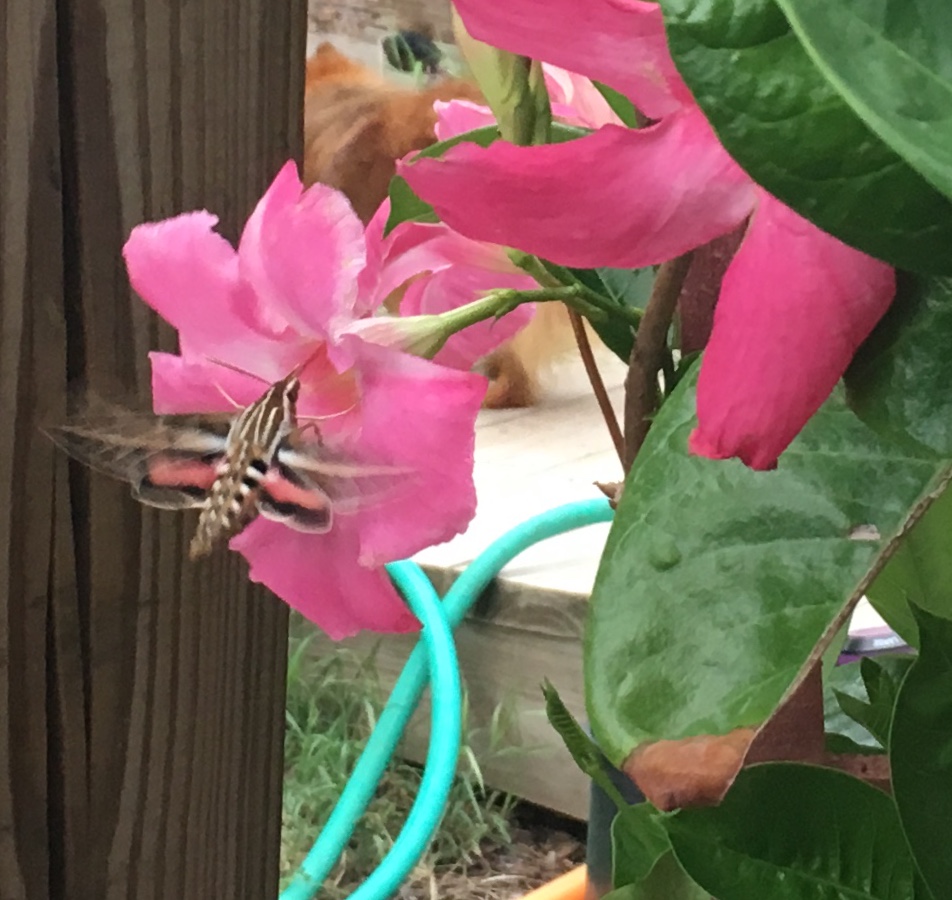
p.s. I posted a picture of a hummingbird moth (sphinx moth) feeding on an umbrella plant.  It reminds me of the beautiful wonder of nature.

Thank you for reading.

My Teaching Philosophy

Okay, so I’m not in a formal classroom anymore.  However, I do have a teaching philosophy through which I see an educational setting.

I think that every day humans seek to achieve personal, tribal, familial, institutional, and community well-being. Actions may differ from place to place because of varying cultural patterns, environmental conditions, geographical locations, political capital, natural capital, cultural capital, social capital, and other resources that affect human lives.  The teacher, be it formal or informal, affects the lives of his or her students’ thinking by leading them toward seeing the world through unbiased lenses, and to see each human being for what he or she contributes to the fabric of humanity.

A passionate teacher does everything in her or her power to build learners.  How can we make our classrooms a level playing field so that each learner engages within his or her own abilities.  Does that means that we have to employ a variety of methods that speak to varying types of learners: visual, auditory, and kinesthetic.  Do teachers have this luxury, or is their day proscribed for them?  I would like to see feedback for this notion.

Though the classroom, naturally, employs a variety of textbooks, I believe that students learn from encouraged self-discovery so that they see themselves in the contexts of educational settings, the family, the social arena, in cultural arenas, the workplace, the community, national arena, and the world.  These contexts help the students to visualize how cultures, ideals, and preferences are built.

Other concepts and questions:

I love geography, because it employs geographic inquiry, which helps students understand local to global issues in physical and human systems.  This inquiry also helps students to ask questions about the past, understand present issues affecting community, and to envision a future that includes individuals and families who are emotionally, socially, healthfully, financially, and civically-minded.

Other elemental themes in teaching could include meta-cognition tools that encourage students to understand their own thought processes that shape personal, cultural, and world thought.

Spatial orientation and thinking encourages students to think about environments, where they live, work, and play (habitats), and the world in spatial terms.  Spatial thinking gives students a sense of place in history, presently, and the future.  How do we go beyond thinking to describing our “spaces”, relationships of objects to one another, and going from the large (macro) to the small (micro)?  A possible question: Beyond thinking, can you describe your “spaces” using direction, employing mental maps, describing scale (size), and other relational vocabulary?

Places and Regions:  Does where you live affect how you interact with your environment? Does where you live affect your way-of-knowing?  Does where you live influence your health? Does where you live influence your economic well-being?  Can people have different points-of-view living in the same community, region, or family?  Do your places/regions change?  How does that affect you?

Not sure if I’m repeating myself, but I love education, and I hope that each students walks away better for it.


Everyday Mindfulness

Not too long ago, I collaborated with two of my extension colleagues to write a lesson on everyday mindfulness.  The lesson and leader’s guide can be found in the K-State Research and Extension online bookstore.

Our journey to present this information comes from the idea that we, as a society, are so very focused on earning a living, acquiring wealth, planning for the future, and the other worries of everyday life.

Leading this charge to write this was my colleague Donna.  She and her husband are devout followers of meditation and “Do-In”, also know as “self-Shiatsu”.

Personally, I had been following what the practice of mindfulness meditation was doing for building self-respect and “de-colonizing” thought for people on our Native reservations.  I had been following the work of sociologist and professor, Dr. Michael Yellowbird , presently, at North Dakota State University.

To describe the concept behind mindfulness, I will go to our publication.  (Here’s the URL for the pdf): https://www.bookstore.ksre.k-state.edu/pubs/MF3424.pdf 

Mindfulness:

  • Living in the present moment/awareness of
    the present moment — paying close attention
    to thoughts, physical sensations, and our
    surroundings.
  • Observing personal experiences of mindfulness,
    being completely focused on a project —
    reading a book, doing a hobby, or playing a
    sport. This heightened awareness is mindfulness.
  • Taking a few deep breaths — becoming fully
    aware of the present moment.
  • Having nonjudgmental awareness in which each
    thought, feeling, and sensation is acknowledged
    and accepted in their present state. This steady
    and non-reactive attention usually differs from
    the way people normally operate in the world.
  • Paying attention, precisely, to the present
    moment without judgment

This is a good start.  I think the idea behind mindfulness and meditation gives us the tools to take better care of ourselves.

Thanks to Donna Krug and Charlotte Olsen for the collaboration on writing this lesson.  Enjoy!

End of the Day Reflection

I’m always looking for ways to encourage and support myself.  It is my hope to encourage and support those around me as well.  Reading is a good way to do that  Do you have a favorite passage, book, or article that you like to read?

My dear friend, Mary Lake, gave me an “End of the Year Reflection”.  It has wonderful prompts for pondering a year in review.  Well, I’ve rewritten to help me reflect the end of my day, and it gives me something to think about for tomorrow.  I hope it’s useful to you.  Here is is:

End of the Day Reflection

What were the highlights of this day for you?

What were your greatest successes?

What gift(s)/talent(s) did you see in yourself today?

Which value did you honor the most?

Have you found a way to focus on your successes rather than any failures?

What new characteristic did you discover about yourself today?

What are you grateful for today?

Name what this day was about for you by giving it a title much like a chapter in a book: Your book!

Looking toward tomorrow

What did you learn today that you want to put into use tomorrow?

What kind of person do you want to be?

Which value or action would bring you closer to a vibrant way of living?

What will tomorrow be about for you, again, naming the chapter title or some other metaphor perhaps?

There are many traditions and rituals that humans practice.

If you were to design your own personal ritual for tomorrow and your future what would it be?