Community Engagement and Social Connectedness

I’m wondering if the phrase, “social capital” has run its course.  Robert Putnam, in his Bowling Alone certainly moved the discussion along about the effects of isolation and not building relationships within and across groups.  Even then, Putnam isolates social capital without looking at community environments, which contribute to whether or not we build human connections.  If you look at the work of Flora, Flora, Fey, and Emery’s framework called, “Community Capitals”, you would be treated to a more holistic framework, which helps us understand human development.  (This “team” did much of this work while at Iowa State University).

I like the concept of community capitals, because we are led to talk about humans in their environments in terms of: social, financial, built, natural, human, cultural, and political capitals.

Remember, capital, of any kind, is a resource in which we invest to create new resources down the road. For example, our cultural capital begins at birth.  In childhood, we learn how to act, how to speak, what to value, and we acquire certain symbols that partly define us.  That is our cultural capital.  It belongs to us individually and as part of a group.  When we are employed, we are part of the human capital for our employers.  We offer our human capital (talents, education, skills, etc.) to our employers out of which some kind of product is produced.

Ogallala Commons is a non-profit organization that trains community interns for service (2 months in the summer, usually).  The community, being served, invites an intern based on a community need.  “OC” (the acronym for Ogallala Commons), uses a “12 Key Assets of a Commonwealth” as a framework for addressing human capital needs in a community: education, health, leisure & recreation, history, sense of place, water cycle, arts & culture, wildlife & natural world, soil & mineral cycle, foodshed, renewable energy, and spirituality.  Every community has these assets, which can be understood as a foundation for building new careers for the interns while the community reaps the benefits of the interns’ human capital.

This brings me to “social capital”, our relationships with those within our immediate circle of friends, family, and colleagues and those relationships we build outside our closest associates.  I think it’s all about relationships.  Relationships matter!

Think about your relationships.  Are they beneficial to you? Perhaps, it’s not a deliberate notion; how we build our relationships. But, as I look back on my past years, I realize that I’ve built some rather wonderful relationships and great friends these past 30-some years.  Each of my friends delight me in different ways, and I’m a richer person for it.  My friends are my support system, and they all accept me for my weird self!  All of us don’t think alike.  We don’t have the same political views.  We don’t all have the same level of financial security (some have planned better for their futures and some have not). I think we learn from each other at many different levels.  I think mutual respect, among my wide circle of friends, is the hallmark of our relationships.  The opposite of my level of social engagement is isolation.

What does isolation do to people?  Think of that elderly person who sits at home without friends and family around him or her.  An isolated person is more likely to display a tendency toward sadness, more physical illnesses, and cognitive degeneration.  I once visited a federal penitentiary.  The “tour guide” said that people who go into the penal system at a young age, like early 20s, are more likely to display symptoms of dementia by mid-40s since a prison environment is not one known for its stimulation of cognitive function.  Relationships matter!

If you think about your community, do you see well developed personal relationship among those who live in your neighborhood or your town?  Here are qualities of a well developed community:

  • You know your neighbors
  • You feel attached to your neighborhood
  • You are politically active and feel like your voice is heard
  • You have trusting and reciprocal relationships
  • You are involved in your community (volunteer…)

What happens when you live in a community with well-developed, intercultural relationships:

  • Crime rates are lower
  • Have better health outcomes across the generations
  • Experience more collective actions
  • Increase in shared resources
  • Mutual respect across groups of difference

Yes.  It may seem like a utopia, but wouldn’t it be great to live in such a community?

Thank you for reading.  I do have references for much of what I say, by the way.
Creativity and the Joy of Music

Humans create to adorn themselves, to express themselves, to release emotion, and to elevate their senses.  Of course, there are other reasons humans create.  I think of the arts, especially music, for these thoughts today.

I live in a town where the municipal band has performed, continuously,  since 1874.  Since the 1930s, this municipal band performs under a WPA (Works Progress Administration) band shell in a town square surrounded by WPA brick streets.  Though evenings in Kansas tend not to cool off, it’s a lovely time to hear people from the community performing new and old compositions.  All which culminate with a “grand march” where people in the audience, mostly children, march waving small flags.

Last night, which was the last for the season, which begins the first Friday in June, there was the addition of a community choir.  I was excited to be in that choir.  My love of performing in a choir goes back to four years of high school choir under the direction of my mentor and best teacher, ever, Mr. D. W. Bauguess. I’m unsure about using people’s whole names in this venue.  Anyway, our choir, last night, sang three songs: Boogie Woogie Bugle Boy (a WWII favorite performed by the Andrews Sisters), Don’t Get Around Much Anymore (A Duke Ellington gem), and a Porgy & Bess medley (the “folk opera” by the beloved George Gershwin).  They are wonderful old songs, and it was with great delight that we presented them, complete with a first soprano solo by a local, professional, coloratura soprano.

This makes me think of the joys of music.  We know that music helps us develop our brains, when classical music is played for infants.  We know that singing releases endorphins, which make us happy.  We know that music helps us to use that part of the brain that supports mathematics.  And, of course, we know that music uses that part of the brain that supports creativity.  Every culture has its music.  Most humans respond to music.

I’m in a little folk music band.  Our band consists of four people: three females and one male.  Our instruments include guitar, bass, ukuleles, banjo, mandolin, harmonica, and the occasional percussion instruments.  My favorite saying:”We only play the best nursing homes in town.”   We’re not a great band, but we make up for it in enthusiasm!  When we sing at the retirement homes or at the senior center, our music brings joy to the people, and we stay to visit when the musical hour has come to its end.  I’ve been trying to get my band, who doesn’t like to practice much, to set up on the street downtown and play music.  You know: like buskers!

Do you have music in your head?  Do you walk around with a song repeating itself?  I come by my constant flow of music in my head honestly.  I remember my maternal grandmother whistled while she was in the kitchen cooking and doing laundry.  She whistled all the time.  My brother, Lee, hums, and so do I.  We, including our nephew Dylan, like to hum while we eat!  It likely annoys those around us, but what do you do?  It’s such a joy to hear our granddaughter and one of our grandsons singing quietly to themselves while they do tasks.

Music is joy, and I find a way to incorporate it into my day in one form or another; whether I’m listening to it or performing it.  What’s your musical “power”?

Thank you for reading.

Human Ecology and Geography

I work on a campus that has a College of Human Ecology and a department of geography in the College of Arts and Sciences.  I often wonder if the two have ever noticed that their work is quite similar, especially when one looks at their descriptions of studying people interacting with their environments?  Well, I love the disciplines of human ecology and geography!

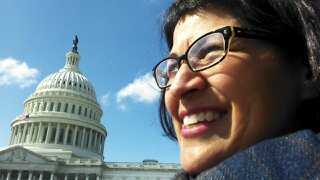
People fascinate me, and, given their environments, they act and re-act differently.  I like to study such things. I posted this picture of me visiting our Nation’s Capital (standing here in front of the Capitol!).  Next time you’re in Washington DC, go to the Smithsonian’s National Museum of the American Indian.  It’s one of my favorite places on earth.  When you enter the museum, there is an amphitheater on your left, and a grill/cafe on the right.  In the seating area for the cafe, there are marvelous photographs of varying groups including Alaskan Natives.  My favorite picture is of three Alaskan Native boys, about eight years of age, gathered around a white granite ware, sort of, tub from which they are happily eating.  They are shoe-less and have the happiest grins on their faces.  I took a photograph of that photograph, and I use it in my power point slides when I’m teaching about intercultural relationship building.  I did not show it here, because there could be some copyright restrictions.  When I ask workshop attendees to look at the photo then give me their impressions, I’ve noticed that middle class people will give me descriptions of “dirty”, “poor”, and “unkempt”.  Out of 23 times of presenting this workshop, perhaps, three people have noticed the absolutely delightful expressions on the boys’ faces.  I know that the Alaskan Native population does not have a word for “stress”.  When you study “simple” versus “complex” societies (the U.S. is a complex society, and many populations (Native to their lands) are often called “simple” societies).  Simple societies are less likely to live stressful lives, because they work to support a collective and are not caught up in acquiring things (read Jared Diamond’s, Guns, Germs, and Steel).

From a human ecology point of view, our environments determine how we live, how we meet our daily living needs, and those things influence how we develop as humans.  From the time we are born, our environments (family, church, schools, politics) influence our development of our preferences, our knowledge, our traditions, our points-of-view, and our paths in life (Bronfenbrenner).  Our geography has that influence, too.  I grew up in Colorado, in the mountains.  Being in the outdoors and  living in high altitude determined how we dressed and in what sorts of activities we engaged.   If one lives in a hunter-gatherer society, then one works in a subsistence culture, which tend to be collective communities (where everyone works for the common good).  If one lives in a capitalistic society, it tends to be more individualistic.  The gaps in wealth tend to be wider in a complex society than a simple society.   In terms of simple and complex societies, one is not better than the other.  They are different.  If simple societies were left alone (not colonized), they functioned quite well on their own.  It does terrible things to the psyche when people in a simple society are told they are wrong (“uncivilized, savage, heathens, etc.), and that “wrongness” carries through to the subsequent generations.  From my point of view, the effects of colonization has not been good for simple societies.  It’s caused many disparities among the colonized people, and it’s developed environments of inequalities.

I think I will come back to this, because I have not developed my thoughts completely.  Besides, my granddaughter wants a bedtime story!  Thank you for reading.

Everyday Mindfulness

Not too long ago, I collaborated with two of my extension colleagues to write a lesson on everyday mindfulness.  The lesson and leader’s guide can be found in the K-State Research and Extension online bookstore.

Our journey to present this information comes from the idea that we, as a society, are so very focused on earning a living, acquiring wealth, planning for the future, and the other worries of everyday life.

Leading this charge to write this was my colleague Donna.  She and her husband are devout followers of meditation and “Do-In”, also know as “self-Shiatsu”.

Personally, I had been following what the practice of mindfulness meditation was doing for building self-respect and “de-colonizing” thought for people on our Native reservations.  I had been following the work of sociologist and professor, Dr. Michael Yellowbird , presently, at North Dakota State University.

To describe the concept behind mindfulness, I will go to our publication.  (Here’s the URL for the pdf): https://www.bookstore.ksre.k-state.edu/pubs/MF3424.pdf 

Mindfulness:

  • Living in the present moment/awareness of
    the present moment — paying close attention
    to thoughts, physical sensations, and our
    surroundings.
  • Observing personal experiences of mindfulness,
    being completely focused on a project —
    reading a book, doing a hobby, or playing a
    sport. This heightened awareness is mindfulness.
  • Taking a few deep breaths — becoming fully
    aware of the present moment.
  • Having nonjudgmental awareness in which each
    thought, feeling, and sensation is acknowledged
    and accepted in their present state. This steady
    and non-reactive attention usually differs from
    the way people normally operate in the world.
  • Paying attention, precisely, to the present
    moment without judgment

This is a good start.  I think the idea behind mindfulness and meditation gives us the tools to take better care of ourselves.

Thanks to Donna Krug and Charlotte Olsen for the collaboration on writing this lesson.  Enjoy!

Community Cohesion

The concept of community cohesion continues to be a topic of importance to me.  What is community cohesion?  Communities that demonstrate shared visions for its people, common goals for the future, equal voice for all, common respect for difference, and promote a sense of belonging for its citizens, tend to be cohesive.  People in a cohesive community “stick together”!

As I was reading about different notions around community cohesion, I found a “Guidance to Promote Community Cohesion” written as part of a mandate on race relations for the schools in Great Britain.  Its focus was on “community cohesion”.  I will offer these quotes from the guide:

By community cohesion, we mean working towards a society in which there is a
common vision and sense of belonging by all communities; a society in which the diversity of people’s backgrounds and circumstances is appreciated and valued; a society in which similar life opportunities are available to all; and a society in which strong and positive relationships exist and continue to be developed in the workplace, in schools and in the wider community

Most impressive to me is the explanation of why the British Department on Children, Schools, and Families wrote such a guide. These were actually words recited on the floors of Parliament in 2006!

Schools have a duty to eliminate unlawful racial discrimination and to promote equality of opportunity and good relations between people of different groups.
Every school – whatever its intake and wherever it is located – is responsible for educating children and young people who will live and work in a country which is diverse in terms of cultures, religions or beliefs, ethnicities and social backgrounds.

Yes. This was 12 years ago.  I have not found further information to say if this “duty” continues to be recognized or enforced in British schools.  It’s just that I like the idea of  human diversity being valued for what it brings to communities.  Yes. The mainstream may be challenged to adjust, accommodate, and step outside its ethnocentrism, but an appreciation for plurality is key to community cohesion as the U. S. moves toward a pluralistic society by 2040, as suggested by the World Bank.

A sociologist friend of mine put it into perspective for me.  He said, “Boomers reached young adulthood in the 60s when White, middle class people were the majority, and immigration was at its lowest in the U. S.   Homogeneity was common for most communities.   Boomers, being born in the 40s, or so,  were too far away from the time when the U. S. was young and most were foreign born.  Remember, this country was “settled” by immigrants who displaced Native populations onto reservations in order to give the land to more settlers coming from Europe to grow a nation.

My point, and I do have one, is that when we find common ground with one another, we are more likely to live in a cohesive community.   How can we move toward cohesion?

The “guide” that I’ve discussed does have some suggestion on understanding the concept of community cohesion:

“Cohesion is therefore about how to:
  • avoid the corrosive effects of intolerance and harassment:
  • build a mutual civility among different groups, and
  • ensure respect for diversity alongside a commitment to common and shared bonds”

Again, I should tell you I live in a region of Kansas marked by Minority-majority schools and communities.  I love living, working, and playing in a region were I can experience coffees from Africa, foods from Asia, art from Latin America, and I can learn about other cultures.  I have found that some communities, in my region, have focused on integration of the different ethnicities and cultures.  Some have not.  Maybe, one day…