Why does a toasted cheese sandwich and tomato soup “hit the spot” in the winter months? I’m not sure that was a childhood staple for you, but I grew up in the mountains, and when we came home from sledding, skating, or skiing, that particular menu item filled our bellies and warmed our hearts! Perhaps Mom and/or Dad fed us that because bread, cheese, butter, and tomato soup we cheap and filling to seven hungry children. To this day, I think my siblings would say that it’s a “go to” meal. Well, except my sister, Eileen. She watches her weight. I just watch my weight…grow.
If this is your first time reading me, I took a different job within the institution of higher education where I once serve as a faculty member for 13 years. In this iteration, I am now in a different department where I serve as director of intercultural learning (that’s another story). So, I am living in temporary quarters until we sell a house and buy one.
One of my roommates, Regan, bakes a fantastic loaf of sourdough bread! My other roommate has a friend who makes hard cheese (white cheddar), and I like to make tomato soup from scratch. Together, served a delicious and simple meal.
My tomato soup:
12 Roma Tomatoes (blanched, peeled, and blended, or chopped finely)
6 ounces (170g) of homemade pesto (I’ve offered my recipe for this a number of entries ago, but you likely have a good recipe yourself).
4 mushrooms of your choice
1/4 of a small onion or 2 shallots
One cup of red wine
1 block of cream cheese (8 ounces/227g)
1 tablespoon (14.2g) olive oil
Begin by heating oil on medium heat. Add onions/shallots and cook until transparent. Add mushrooms, and cook until water has evaporated. Add tomatoes, and cook until liquid has dissipated. Add wine, and cook until the alcohol has evaporated, but the flavor remains. Now add the pesto. You get your salt, more oil, and texture from the pine nuts in the pesto, so you don’t have to add too much more salt, but make sure it’s to your taste. If you want a smoother soup, you can use an immersion blender, here. When your soup reaches a thick point, and you are getting close to serving it, add the cream cheese with the heat lowered just a little bit. Here it is.
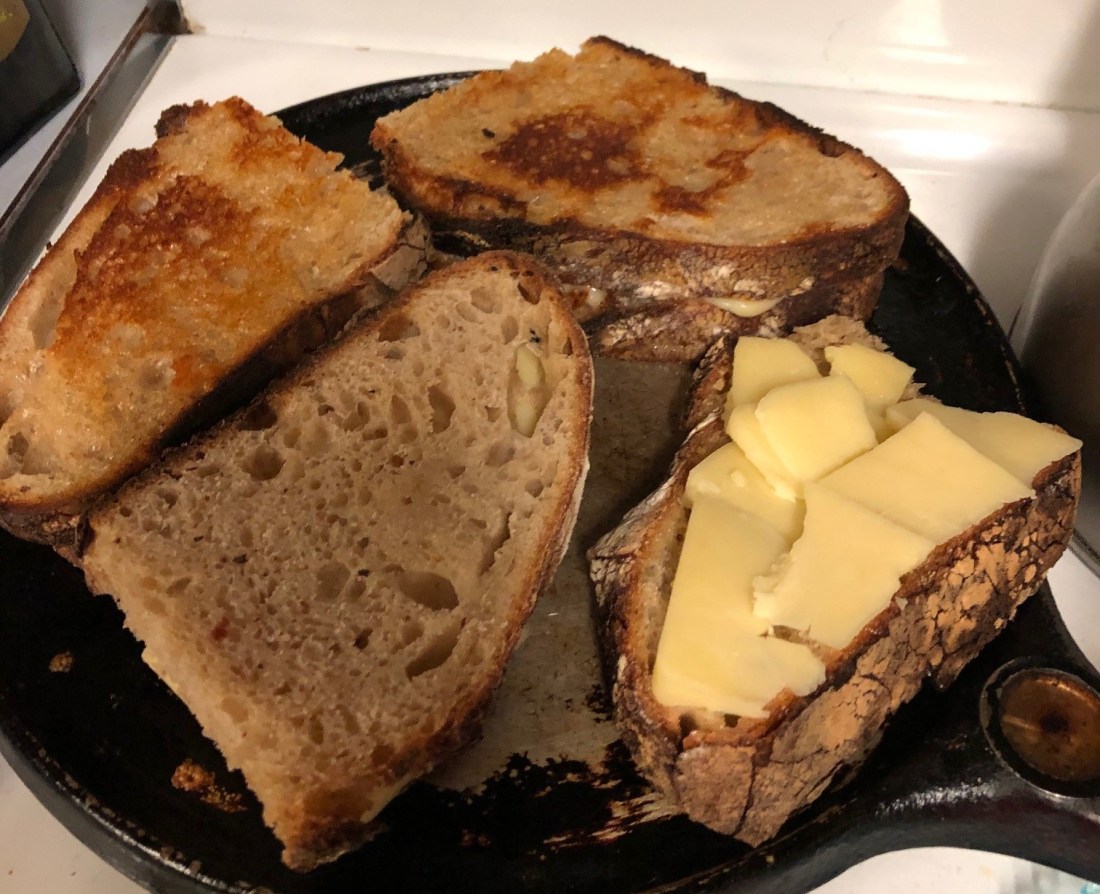
While you’re watching your soup come together, you can build your toasted (sometimes called, “grilled cheese”) sandwiches. We sliced the lovely sourdough bread, buttered it on the outside, and laid the sliced cheese. For the two-sided, enclosed sandwich, we buttered two slices of bread to put on the outside so that it made contact with the griddle. We used a toaster oven for the open-faced, toasted cheese sandwich. Both are wonderful! Now, you may think that my tomato soup looks a little like Welsh Rarebit. I don’t put Worcestershire sauce, or dry mustard, or flour, or stout, but you could modify this recipe to be Welsh Rarebit, which is also quite delicious. Leave out the pesto, wine, and mushrooms, however.
When we assembled our tomato soup and toasted cheese sandwiches so that we could dip the sandwiches into the soup. The next morning, for breakfast, I poured the thick soup over my toasted cheese sandwich.
As with all meals, eat them with people you love and who allow you to be who you are.
I am a geographer specializing in human systems. My passion is studying underrepresented populations so that I can assist in their integration into the communities in which they live. I studied Human Ecology because it is a wonderful blend of the disciplines of geography, anthropology and sociology. No matter the context in which I find myself, I am an observer of humans in their environments and how the influences in those settings build and nurture sense-of-self, sense-of-place, and sense-of-direction in educational, familial, and community settings. My work focuses on the cross-cultural and intercultural traditions of multi-lingual populations acculturating into their receiving communities and being successful in educational arenas of higher education. This work includes gathering, analyzing, and writing about health, well-being, and environmental/social connectedness in their communities. My research focuses on Minority-majority, rural, Midwest communities. My role as director of intercultural learning and academic success at Kansas State University allows me to discover more about myself as I work with others in their paths to self-discovery in their own interactions with students and families who come from different parts of the country and the world all converging in educational spaces. Recently, I lived, worked and played in Southwest Kansas, a region marked by Minority-majority populations centers (56% – 68%). Some of my research results are used to address poverty, low educational attainment, poor health outcomes, and cultural norms in multi-cultural settings. I work to assure a representative sample for my research, so I engage in multi-lingual research (English, Spanish, Burmese, French, Tigrinya, and Somali). Building trust and relationships is the key to my success as a multilingual researcher. Presently, my research takes me in the micro-communities of populations represented by nine African countries (Eritrea, Ethiopia, Sudan, Kenya, Senegal, Uganda, Ivory Coast, Somalia, and Cameroon), seven Latin American countries, and six Asian countries. Yes, it is rural Southwest Kansas, and many of the densely-settled and frontier rural communities act as receiving centers for refugees and other displaced populations, because of the availability of jobs.
I am the recent recipient of National Geographic Society’s Research and Exploration grant to introduce Geographic Information Systems (GIS) to females of color. This inter-generational, intercultural class hosted middle school, high school, and adult females who learned the basics of GIS with a variety of applications from remote sensing to city planning to Google Earth, and to Pokémon GO! By the time the young ladies finished the class, they were able to build cities, map their communities, log trips from their countries of origin to the Midwest. I am in the mid-year of the grant funding, and my target for completion was July 2018. I have new funding to extend this work to new cohorts.
Currently, I work at Haskell Indian Nations University on an NSF project: Rising Voices Changing Coasts addressing climate change in Indigenous Coastal Communities in Alaska, Puerto Rico, Hawai'i, and the Louisiana Gulf Coast.
I am a mother, grandmother, sibling, friend, banjo player, and a geographer dedicated to studying humans in their environments.
View all posts by djhbolton

![IMG_0423[1]](https://peopleandcultures.blog/wp-content/uploads/2019/02/img_04231-e1549583690892.jpg?w=1100)
 Human Ecology: People, Foods, Travel, Culture, and Social Justice