Remember Gary Chapman’s book about the love languages? I see truths in it. Chapman’s premise centers on ways a couple demonstrate love to one another: words of affirmation, quality time, gift-giving, acts of service, and physical touch. Actually, this communication and service go beyond couples in a committed relationship. I think one can demonstrate loving language to any one. Of course, there may be parts that are off limits. For example, I have a co-worker that gives me vegetables from his garden, but I can’t imagine that we’ll ever exchange hugs!
So why is my featured photo a cauliflower steak? I think I share the love language of cooking with my spouse. We certainly share the desire to eat tasty and creative foods. Cooking together, I suppose, falls into the love languages of “quality time” and “acts of service”. Our meals together seem to be an affectionate time of the day, so I share our delicious meal tonight: grilled salmon, cauliflower steak, and rice with my ginger-soy-shallots-quince sauce.
First, I made a marinade for the salmon. In the bottom of a rectangle glass cake pan, I added:
2 tablespoons (28g) sesame oil, 1 tablespoon (14g) grated ginger, 1 teaspoon (4g) garlic powder, grated pepper, 3 Tablespoons (42g) soy sauce, and a splash of teriyaki sauce to assure browning. Mix it in the glass cake pan. Then add salmon skin side up. Smear the salmon in the marinade, and then repeat on the skin side. Grill on the skin side down, with the grill lid closed, until it reaches an internal temperature of 145 degrees F. (63 C) taken on the thickest part of the flesh.
I cook my rice in a rice cooker, and we usually put start it in the morning, and it stays warm until we’re ready to use it. For the rice, I made a sauce. We have a quince tree in the front yard. It produces about six pieces of fruit on a good year. Quince, related to apples, adorns a yard quite beautifully. It blooms a lovely pink blossom in the spring, and turns a pale yellow in the fall. The quince tree protects itself from predators with long thorns, which make harvesting the fruit a bit perilous. My harvest take today was one piece of fruit. Here’s the tree in the spring.
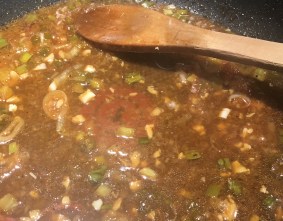
The fruit packs a wallop in pectin, so it’s prized for thickening jams. The one tiny, little fruit added pectin to thicken my sauce, and a sort of glutamate flavor enhancer. Here’s my recipe for the rice sauce. I’m not going to call it a gravy, because it’s not heavy. It’s a light sauce.
2 cloves garlic, 2 TBS (28g) sesame oil, 2 chopped green onions (set one chopped green onion aside for the final garnish), 2 TBS (28g) chopped ginger, 1 peeled and grated quince. (If you don’t have a quince, grate a half small apple), and 3 TBS (42g) soy sauce . Cook all ingredients until it begins to thicken. Add 1 cup (.23 kg) water. Continue to simmer until thickened.
As featured in the header, the cauliflower was cooked in butter with some added salt and pepper. Now it’s time to eat!
We usually eat our Asian-inspired rice dishes with chop sticks. Here’s the rice. To finish it, I sprinkled it with the chopped green onion and toasted sesame seeds. We added a nice white wine, and watched Robin Hood with Russell Crowe (old movie). Voilà!
I am a geographer specializing in human systems. My passion is studying underrepresented populations so that I can assist in their integration into the communities in which they live. I studied Human Ecology because it is a wonderful blend of the disciplines of geography, anthropology and sociology. No matter the context in which I find myself, I am an observer of humans in their environments and how the influences in those settings build and nurture sense-of-self, sense-of-place, and sense-of-direction in educational, familial, and community settings. My work focuses on the cross-cultural and intercultural traditions of multi-lingual populations acculturating into their receiving communities and being successful in educational arenas of higher education. This work includes gathering, analyzing, and writing about health, well-being, and environmental/social connectedness in their communities. My research focuses on Minority-majority, rural, Midwest communities. My role as director of intercultural learning and academic success at Kansas State University allows me to discover more about myself as I work with others in their paths to self-discovery in their own interactions with students and families who come from different parts of the country and the world all converging in educational spaces. Recently, I lived, worked and played in Southwest Kansas, a region marked by Minority-majority populations centers (56% – 68%). Some of my research results are used to address poverty, low educational attainment, poor health outcomes, and cultural norms in multi-cultural settings. I work to assure a representative sample for my research, so I engage in multi-lingual research (English, Spanish, Burmese, French, Tigrinya, and Somali). Building trust and relationships is the key to my success as a multilingual researcher. Presently, my research takes me in the micro-communities of populations represented by nine African countries (Eritrea, Ethiopia, Sudan, Kenya, Senegal, Uganda, Ivory Coast, Somalia, and Cameroon), seven Latin American countries, and six Asian countries. Yes, it is rural Southwest Kansas, and many of the densely-settled and frontier rural communities act as receiving centers for refugees and other displaced populations, because of the availability of jobs.
I am the recent recipient of National Geographic Society’s Research and Exploration grant to introduce Geographic Information Systems (GIS) to females of color. This inter-generational, intercultural class hosted middle school, high school, and adult females who learned the basics of GIS with a variety of applications from remote sensing to city planning to Google Earth, and to Pokémon GO! By the time the young ladies finished the class, they were able to build cities, map their communities, log trips from their countries of origin to the Midwest. I am in the mid-year of the grant funding, and my target for completion was July 2018. I have new funding to extend this work to new cohorts.
Currently, I work at Haskell Indian Nations University on an NSF project: Rising Voices Changing Coasts addressing climate change in Indigenous Coastal Communities in Alaska, Puerto Rico, Hawai'i, and the Louisiana Gulf Coast.
I am a mother, grandmother, sibling, friend, banjo player, and a geographer dedicated to studying humans in their environments.
View all posts by djhbolton




 Human Ecology: People, Foods, Travel, Culture, and Social Justice
Awesome recipe
LikeLike