Financial Opportunities and Micro Loans

Some friends and I were discussing building financial opportunities for women.  It made me think of the micro-loans that were championed by the Grameen Bank many years ago.  One of my colleagues, a Bangladeshi engineer, was personal friends with Grameen founder, Muhammad Yunus, Nobel Laureate.  The concept of micro-credit and micro-finance has worked in many places to help people build financial security.

Our discussion centered on ways to help women, specifically, to build financial security.  It made me think of a study trip to Mexico, a few years ago, when I was able to learn from people who were using micro-credit to run very small farms called, ejidos (Eh-hee-tho).  Looking back at my journal notes, I will describe their process for growing tomatoes (tomates).

We visited several farms in the county (municipio) of Ayala.  An ejido farm can be compared to a parking lot. When you go to a parking lot, you just know there will be a place for you to park. And as long as you do not abuse your parking privileges, you can continue to park in a spot in that lot. An ejido farmer does not own his/her “lot”, but as long as he or she wants to farm there, and as long as it is used properly, the farmer can be on the land indefinitely. Like paid parking lots, there are only small fees to be paid, or food can be supplied to municipios.

My colleagues and I visited a wonderful tomato farming operation, which had been in production for about five months. It took about one month to begin to produce significant quantities for sale. Before entering the facility, we had to step inside a sunken, concrete box holding chlorine bleach.
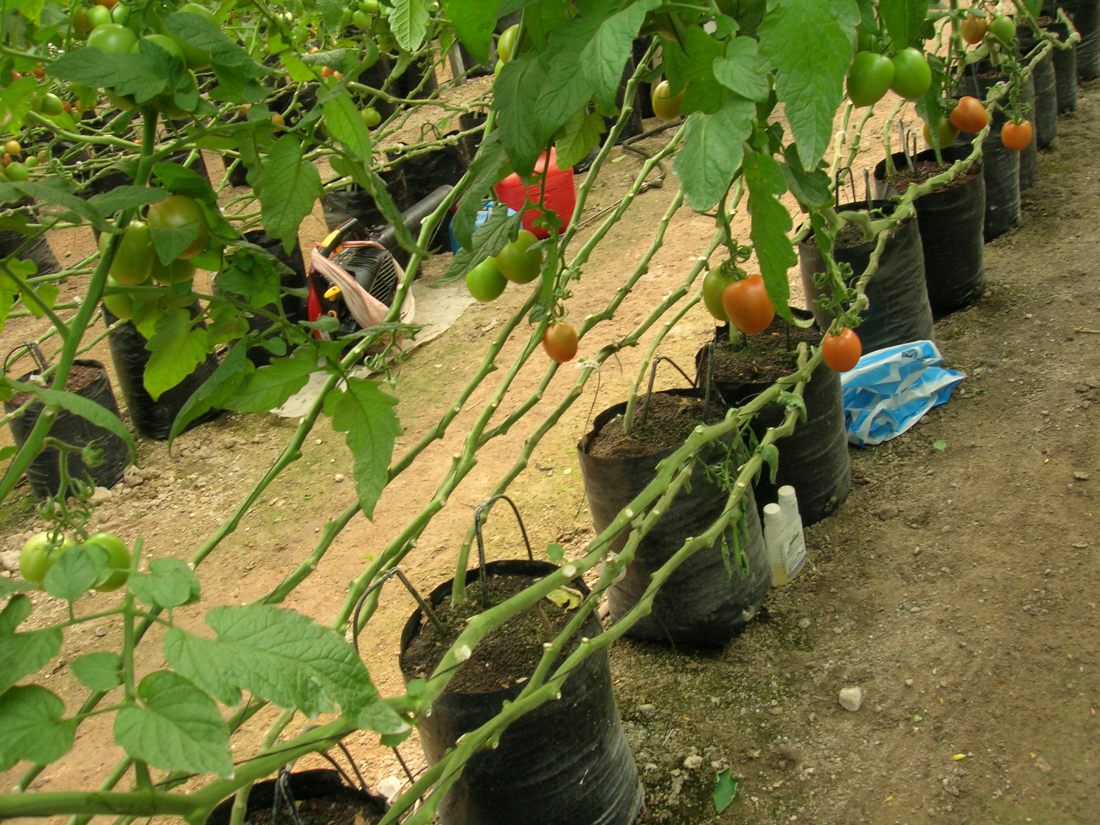
Situated on approximately one-fourth hectare, which is about 2,500 meters, which is about .62 acres, is a screen-enclosed structure holding about nine-thousand tomato plants. The plants’ soil and root systems sit inside heavy, pliable, black plastic bags, which are approximately 13 inches in diameter and 14 inches high. The stems of the plants are three to six inches in diameter. The plants vine up strings rising 12 feet above to horizontal wires running parallel to each row of plants. The tomatoes nearest the bucket-like bags, holding the dirt and root systems, ripen first. As tomatoes are harvested, the green tomatoes nearest the horizontal wires are lowered to run more parallel with the ground. Then the top of any given plant will be hanging over buckets 10 spaces away. Every 15 days, the strings are lowered, and the tomatoes nearest the ground ripen first. This Loreto-variety of tomatoes takes a lot of nitrogen, we were told. If you want to see pictures, please let me know. You would love seeing this operation.
The plants take 20-thousand liters of water a day, which is about 5,265 gallons. The farmer harvests 200 boxes of tomatoes per week. The boxes held about two bushels, which is about 106 pounds. There is not much exporting, but this operation supplies several grocery stores (tiendas) weekly. The picked fruits are sold to the stores, and the fallen fruits are sold in the barrios (neighborhoods).
The producer told us the next thing to be learned is composting so that something useful can be done with the organic waste, which is one other by-product of this operation.

All this was built from a micro-loan, and the farmers told us they thought they’d begin to see a profit just after the second round of purchases.

Here’s another:

“EJIDOTARIAS” (EH-HEE-THO-TAR-EE-AHS)
Don’t forget to roll the “Rs”.  Okay, so I already introduced the ejido farm producer. The community or municipio owns the land. You stake a claim, of sorts, to some land, and you farm it. As long as you do not abuse the land or other farms around you, you can work that land as long as you like. There is a small usage fee to help the community. The county (municipio) government usually helps with initial seeding, reclamation, and improvements.

We visited the farm of two women near the minicipio of Ayala, state of Morelos. The señoras farmed their ground together. They produced corn, green beans, squash, and sugar cane. Their corn seed came from the U.S., and they grew both grain (maiz) and sweet corn (elote) – pronounced “my-eese” and “eh-lo-tay.”

Farming 3,000 feet above sea level, the ladies planted, irrigated, and harvested by hand and with the use of oxen and horses. Small irrigation ditches ran through the land. It is up to the farmer to flood her fields from the ditches with dams and canals. They farmed four hectares (about 10 acres) per year. It costs about 5,000 pesos per hectare (2.48 acres) including 200 pesos for fertilizer and 350 pesos for insecticide. They pay their water usage annually. The ladies gave us an estimate that it took about 29,000 pesos to get their produce to the market. That is about $2,900.

In the ejido system, producers help one another plant and harvest. For example, the sugar cane was harvested with a machete. It takes strong arms to swing a machete. The crops go to market in Mexico City. Visiting this particular farm held a few contradictions. Everything was done by hand, which took us back in time. The power lines above had electricity surging through them, audibly. That brought us back to reality.

Thank you for reading.
A day in the lives of refugee and other immigrant families settling into new cultures

In this text, I have borrowed from myself.  I was attempting to write a white paper to help educators better understand the students in their classrooms.  I think it’s always best to back up and start at the beginning to understand a journey.

Why do people emigrate?  That is, what makes a family leave its own country and venture into an unknown land, in many cases, across oceans?  In most cases, this movement is considered a “Forced Migration”, which is displacement because of persecution, armed conflict, generalized violence, human rights violations, natural or environmental disaster, famine, ineffectual government, or lack of financial opportunities (Baker, 2014; Goetz, & Rupasingha, 2007).  Often times, the process of migrating is dangerous and may take up to 10 years with many stops along the way (Salgado de Snyder, 2007).  Humans have always migrated, and it, likely, never will stop because of constant changes in governments and other political policies, food supplies, societal mainstream notions, and religious views.

For the past 25 years, immigrants of all statuses, have been part of my daily life living in Southwest, Kansas, both professionally and personally.  I’ve worked with Southeast Asian and African refugees.  I’ve worked with immigrants from all of the Americas (Meso, Central, South and North (I call them economic refugees), and with immigrants who come with professional careers from India, Mexico, Peru, Philippines, China, Africa, Brazil, the Caribbean, Canada, and different parts of Europe.  It is an enriching experience to learn from those who come from other backgrounds.

All the immigrants who have come to Kansas in the past 30 years have one thing in common. They’ve come to the United States to seek better ways of lives.  Lives without conflict and strife.  Lives filled with hopes for their futures.  While their stories of how they arrived on the shores or across the borders into the U.S. vary, there are common denominators in the challenges of which they face.  The greatest challenge, possibly, is that of acculturation.  That is, fitting into a new land, learning the folkways and mores of the people, and understanding how their own cultures either blend or clash with the “mainstream”.  They do all this while trying to learn a livelihood for their families’ survival and hoping to move to a place of thriving in their lives.   There are many struggles and challenges of acculturating to new lives in new cultures. Granted, the Canadians with whom I’ve worked don’t have as many challenges because of a common language and European ancestry as the U.S. mainstream. However, the most obviously “different” immigrants do have challenges. For example, these are some of the question and comments that I hear along the way:

  • How and where do our children go to school?
  • Is there a place for me to learn English?
  • Where do we get an identification and address immigration status?
  • What are rules for driving a car?
  • Where do we get the foods of our traditions?
  • What are the rules for schools regarding age of entry, immunizations, school readiness?
  • Where do we find child care provider for our children?
  • Where do we find a doctor?
  • Is there public transportation?
  • Are we safe to walk to where we need to go?
  • “We are starting all over, and I need to purchase items for my home, again, and I don’t know anybody, so I have to make new friends, too.”


The United States is heading toward a demographic where there will be no one majority of population by the year 2040 (World Bank).  My observation is that this notion strikes fear in people.

After nearly 30 years of living, working, and playing alongside the immigrants who have come these past three decades, my observation is that they have not come to colonize these lands and the mainstream.  They (immigrants) have come for better lives for their children.  Historically, most are the victims of colonization on their lands of origins.  If you get the opportunity, hear their stories, share their foods, understand their laughter, and most importantly, empathize with the fears that pushed them out of their home soils.

Thank you for reading.

Socio-Ecological and Logic Models

If you’ve read any of Urie Bronfenbrenner’s work, you, no doubt, know about the socio-ecological framework.  In that Bronfenbrenner asserts that we have “spheres of influence” in which we develop who we are and what we like and do.  That’s an easy way to understand why we become that person we see when we look in the mirror.

Another framework that helps us to organize our thoughts, objectives, and ultimate results is called the “logic model”.  I love the logic model.  As an abstract-random thinker (as opposed to “concrete-sequential), the logic model helps me to think linearly.  As a historian, I have the ability to think linearly when I’m looking at time lines of events. But when I approach my day, linear can go out the door.  So the logic model helps us to see a situation that needs to be addressed, decide who and what the players will be (inputs), what the activities around addressing the situation will be (outputs), and the different levels of results (short-term, medium-term, and long-term).  Of course long-term results (outcomes) are the future we hope to see.  Long-term outcomes are the ultimate.  “I put $500 a month in the bank”.  It’s happening, and there is not future tense in the long-term outcome.  I have my logic model workshop participants either tie their shoes or get dressed for the day using a logic model.  Believe it or not, you use a logic model more often than you think!

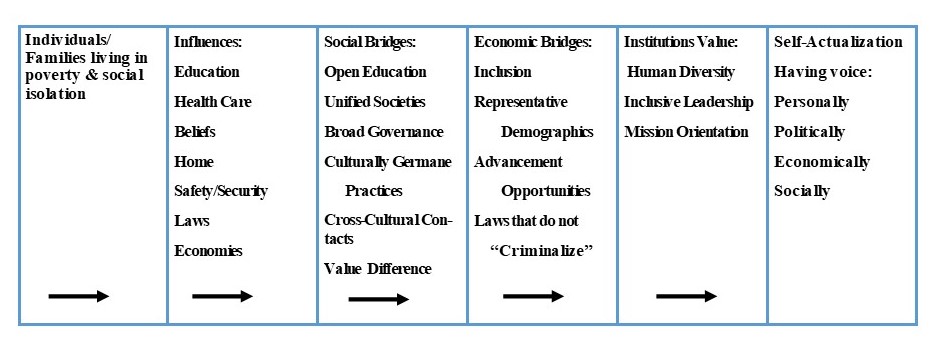
Now, I have a colleague who worked on a national nutrition program.  Her team, in their infinite wisdom, combined the socio-ecological and logic model in one document to address a working model to bring nutrition to the masses.  I love their model and have adapted it into a model that I call, “adaptive and culturally relevant practices”.  My first go at the title was, “culturally relevant and adaptive practices”, but you can see it made for a terrible acronym!

As some background, my work is to find ways to address inequities that exist among families living in poverty and families of color.  I say if we see a situation, we can find ways to address those inequities with the help of a logic model that’s been embedded with the socio-ecological model. My example is the featured photo today.

Thanks to Major F.M. Hernandez (U.S. Army) and Dr. Charlotte Olsen for collaborating with me on this.

Human Ecology and Geography

I work on a campus that has a College of Human Ecology and a department of geography in the College of Arts and Sciences.  I often wonder if the two have ever noticed that their work is quite similar, especially when one looks at their descriptions of studying people interacting with their environments?  Well, I love the disciplines of human ecology and geography!

People fascinate me, and, given their environments, they act and re-act differently.  I like to study such things. I posted this picture of me visiting our Nation’s Capital (standing here in front of the Capitol!).  Next time you’re in Washington DC, go to the Smithsonian’s National Museum of the American Indian.  It’s one of my favorite places on earth.  When you enter the museum, there is an amphitheater on your left, and a grill/cafe on the right.  In the seating area for the cafe, there are marvelous photographs of varying groups including Alaskan Natives.  My favorite picture is of three Alaskan Native boys, about eight years of age, gathered around a white granite ware, sort of, tub from which they are happily eating.  They are shoe-less and have the happiest grins on their faces.  I took a photograph of that photograph, and I use it in my power point slides when I’m teaching about intercultural relationship building.  I did not show it here, because there could be some copyright restrictions.  When I ask workshop attendees to look at the photo then give me their impressions, I’ve noticed that middle class people will give me descriptions of “dirty”, “poor”, and “unkempt”.  Out of 23 times of presenting this workshop, perhaps, three people have noticed the absolutely delightful expressions on the boys’ faces.  I know that the Alaskan Native population does not have a word for “stress”.  When you study “simple” versus “complex” societies (the U.S. is a complex society, and many populations (Native to their lands) are often called “simple” societies).  Simple societies are less likely to live stressful lives, because they work to support a collective and are not caught up in acquiring things (read Jared Diamond’s, Guns, Germs, and Steel).

From a human ecology point of view, our environments determine how we live, how we meet our daily living needs, and those things influence how we develop as humans.  From the time we are born, our environments (family, church, schools, politics) influence our development of our preferences, our knowledge, our traditions, our points-of-view, and our paths in life (Bronfenbrenner).  Our geography has that influence, too.  I grew up in Colorado, in the mountains.  Being in the outdoors and  living in high altitude determined how we dressed and in what sorts of activities we engaged.   If one lives in a hunter-gatherer society, then one works in a subsistence culture, which tend to be collective communities (where everyone works for the common good).  If one lives in a capitalistic society, it tends to be more individualistic.  The gaps in wealth tend to be wider in a complex society than a simple society.   In terms of simple and complex societies, one is not better than the other.  They are different.  If simple societies were left alone (not colonized), they functioned quite well on their own.  It does terrible things to the psyche when people in a simple society are told they are wrong (“uncivilized, savage, heathens, etc.), and that “wrongness” carries through to the subsequent generations.  From my point of view, the effects of colonization has not been good for simple societies.  It’s caused many disparities among the colonized people, and it’s developed environments of inequalities.

I think I will come back to this, because I have not developed my thoughts completely.  Besides, my granddaughter wants a bedtime story!  Thank you for reading.

Community Cohesion

The concept of community cohesion continues to be a topic of importance to me.  What is community cohesion?  Communities that demonstrate shared visions for its people, common goals for the future, equal voice for all, common respect for difference, and promote a sense of belonging for its citizens, tend to be cohesive.  People in a cohesive community “stick together”!

As I was reading about different notions around community cohesion, I found a “Guidance to Promote Community Cohesion” written as part of a mandate on race relations for the schools in Great Britain.  Its focus was on “community cohesion”.  I will offer these quotes from the guide:

By community cohesion, we mean working towards a society in which there is a
common vision and sense of belonging by all communities; a society in which the diversity of people’s backgrounds and circumstances is appreciated and valued; a society in which similar life opportunities are available to all; and a society in which strong and positive relationships exist and continue to be developed in the workplace, in schools and in the wider community

Most impressive to me is the explanation of why the British Department on Children, Schools, and Families wrote such a guide. These were actually words recited on the floors of Parliament in 2006!

Schools have a duty to eliminate unlawful racial discrimination and to promote equality of opportunity and good relations between people of different groups.
Every school – whatever its intake and wherever it is located – is responsible for educating children and young people who will live and work in a country which is diverse in terms of cultures, religions or beliefs, ethnicities and social backgrounds.

Yes. This was 12 years ago.  I have not found further information to say if this “duty” continues to be recognized or enforced in British schools.  It’s just that I like the idea of  human diversity being valued for what it brings to communities.  Yes. The mainstream may be challenged to adjust, accommodate, and step outside its ethnocentrism, but an appreciation for plurality is key to community cohesion as the U. S. moves toward a pluralistic society by 2040, as suggested by the World Bank.

A sociologist friend of mine put it into perspective for me.  He said, “Boomers reached young adulthood in the 60s when White, middle class people were the majority, and immigration was at its lowest in the U. S.   Homogeneity was common for most communities.   Boomers, being born in the 40s, or so,  were too far away from the time when the U. S. was young and most were foreign born.  Remember, this country was “settled” by immigrants who displaced Native populations onto reservations in order to give the land to more settlers coming from Europe to grow a nation.

My point, and I do have one, is that when we find common ground with one another, we are more likely to live in a cohesive community.   How can we move toward cohesion?

The “guide” that I’ve discussed does have some suggestion on understanding the concept of community cohesion:

“Cohesion is therefore about how to:
  • avoid the corrosive effects of intolerance and harassment:
  • build a mutual civility among different groups, and
  • ensure respect for diversity alongside a commitment to common and shared bonds”

Again, I should tell you I live in a region of Kansas marked by Minority-majority schools and communities.  I love living, working, and playing in a region were I can experience coffees from Africa, foods from Asia, art from Latin America, and I can learn about other cultures.  I have found that some communities, in my region, have focused on integration of the different ethnicities and cultures.  Some have not.  Maybe, one day…